
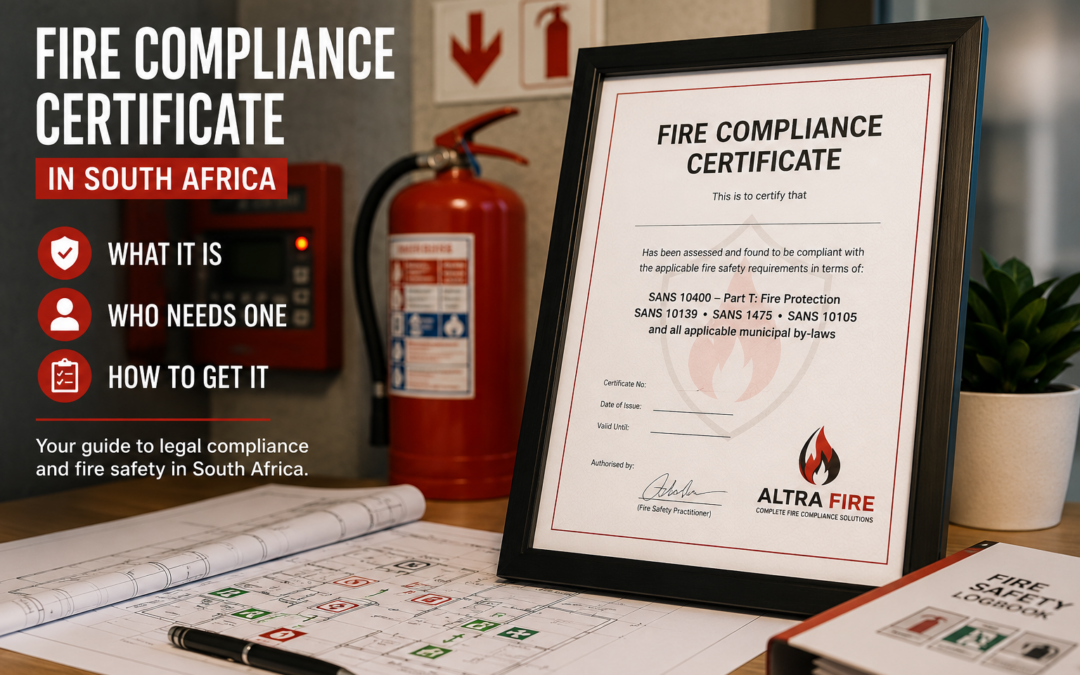
A fire compliance certificate is documented proof that a building’s fire protection — equipment, detection, escape routes and signage — meets SANS 10400-T, the OHS Act and local fire by-laws. It is issued after inspection by the local fire authority or an accredited fire practitioner, and most businesses must renew it annually.
If your insurer, landlord, fire department or Department of Employment and Labour has asked for a “fire compliance certificate”, this guide explains exactly what they mean, which documents you need, and the practical process to get certified — without the run-around.
What is a fire compliance certificate in South Africa?
There is no single national document called a “fire compliance certificate”. In practice, the term covers a set of certificates that together prove your premises comply with fire safety law. The core legal framework is the National Building Regulations and Building Standards Act 103 of 1977 (applied through SANS 10400-T: Fire Protection), the Occupational Health and Safety Act 85 of 1993, the Fire Brigade Services Act 99 of 1987, and your municipality’s fire safety by-laws.
Depending on your building and occupancy, “being compliant” is evidenced by one or more of the documents below.
Which certificates make up fire compliance?
| Certificate | What it covers | Issued by | Validity / renewal |
|---|---|---|---|
| Fire clearance / fire safety certificate | Overall building fire safety against local by-laws and SANS 10400-T (occupancy, escape routes, equipment, signage) | Local fire department / fire safety officer, often supported by an accredited fire practitioner’s report | Typically annual, or per by-law and occupancy type |
| Certificate of Occupancy | Confirms the building may legally be occupied — fire protection must comply before it is issued (Section 14, Act 103 of 1977) | Local authority (building control) | Once-off, but voided by unapproved alterations or change of occupancy class |
| Certificate of Compliance (CoC) — fire equipment | Extinguishers, hose reels and hydrants serviced to SANS 1475 by SAQCC Fire–registered technicians | Registered service provider | Annual service cycle |
| System commissioning / service certificates | Fire detection (SANS 10139), gas suppression (SANS 14520), sprinklers, smoke ventilation — installed, commissioned and maintained by competent persons | Registered designer / installer / service company | Per system standard; servicing is ongoing |
| Flammable substances certificate | Storage or use of flammable liquids/gases above by-law thresholds | Local fire department | Annual |
When an insurer or inspector asks for “your fire compliance certificate”, they usually want the fire clearance certificate plus the supporting CoCs and service records that prove it is still true.
Who needs a fire compliance certificate?
In short: any non-domestic premises, and many residential schemes too.
- Business owners and employers — Section 8 of the OHS Act requires a working environment that is safe and without risk, which includes functional fire protection and proof of it.
- Landlords and property owners — the building itself must comply with SANS 10400-T and by-laws; non-compliance can void the Certificate of Occupancy.
- Body corporates and sectional title schemes — common property fire equipment, escape routes and signage are the scheme’s responsibility.
- Anyone with insurance — most commercial policies require maintained, certified fire equipment; missing CoCs are a common reason fire claims are rejected.
How do you get a fire compliance certificate? (Step by step)
- Fire compliance assessment. A qualified practitioner audits the premises against SANS 10400-T, the OHS Act and local by-laws: equipment coverage, detection, escape routes, fire doors, signage, escape plans (SANS 23601) and documentation.
- Gap report. You receive a prioritised list of non-compliances — what fails, which clause applies, and what it takes to fix.
- Remediation. Defects are corrected: equipment installed or relocated, detection upgraded, fire doors repaired, signage and escape plans brought to standard.
- Servicing and certification of equipment. All portable equipment is serviced to SANS 1475 by SAQCC Fire–registered technicians, and installed systems are certified by competent persons. CoCs are issued.
- Inspection and certificate issue. The fire department (or accredited practitioner, depending on your municipality) inspects and issues the fire clearance / compliance certificate.
- Maintain and renew. Keep a fire file with all certificates, service records and drills, and renew on the required cycle — typically annually.
How long is a fire compliance certificate valid?
Most fire clearance certificates and equipment CoCs run on an annual cycle, but validity is conditional: alter the building, change its use, or miss a service interval and the certificate no longer reflects reality. Inspectors and insurers check the dates on your service records, not just the certificate on the wall.
What happens if you don’t have one?
- Enforcement: compliance notices, fines or prohibition of occupancy under the Fire Brigade Services Act, building regulations and by-laws; OHS Act contraventions carry fines and, for serious cases, imprisonment under Section 38.
- Insurance: after a fire, the first documents the assessor requests are your CoCs and service records. Gaps are grounds for repudiation.
- Liability: directors, the Section 16.2 appointee and property owners can be held personally responsible after an incident.
Frequently asked questions
Is a fire compliance certificate a legal requirement in South Africa?
Yes, in effect. While the exact certificate differs by municipality and occupancy, the law behind it — SANS 10400-T, the OHS Act and local fire by-laws — makes proof of fire compliance unavoidable for any business premises.
Who can issue a fire compliance certificate?
The local fire department issues fire clearance certificates. Equipment CoCs must come from SAQCC Fire–registered technicians servicing to SANS 1475, and system certificates from competent, registered designers and installers.
What is the difference between a CoC and a fire compliance certificate?
A CoC certifies a specific item or system (for example, your extinguishers after a SANS 1475 service). The fire compliance / clearance certificate addresses the building as a whole — and depends on those underlying CoCs being in place.
How often must it be renewed?
Plan on annually. Equipment is serviced on an annual SANS 1475 cycle, and most municipal fire clearance certificates are renewed each year.
Does my insurer really check?
Only after a claim — which is the worst possible time. Maintained certificates are the cheapest insurance condition you will ever meet.
This article is general guidance, not legal advice. Requirements vary by municipality and occupancy class — confirm specifics for your premises with a qualified fire compliance practitioner.
Not sure if your premises would pass?
Altrafire will assess your building against SANS 10400-T, the OHS Act and your local by-laws — and tell you exactly what stands between you and a clean certificate. Call 0861 111 504 or book your free check below.