
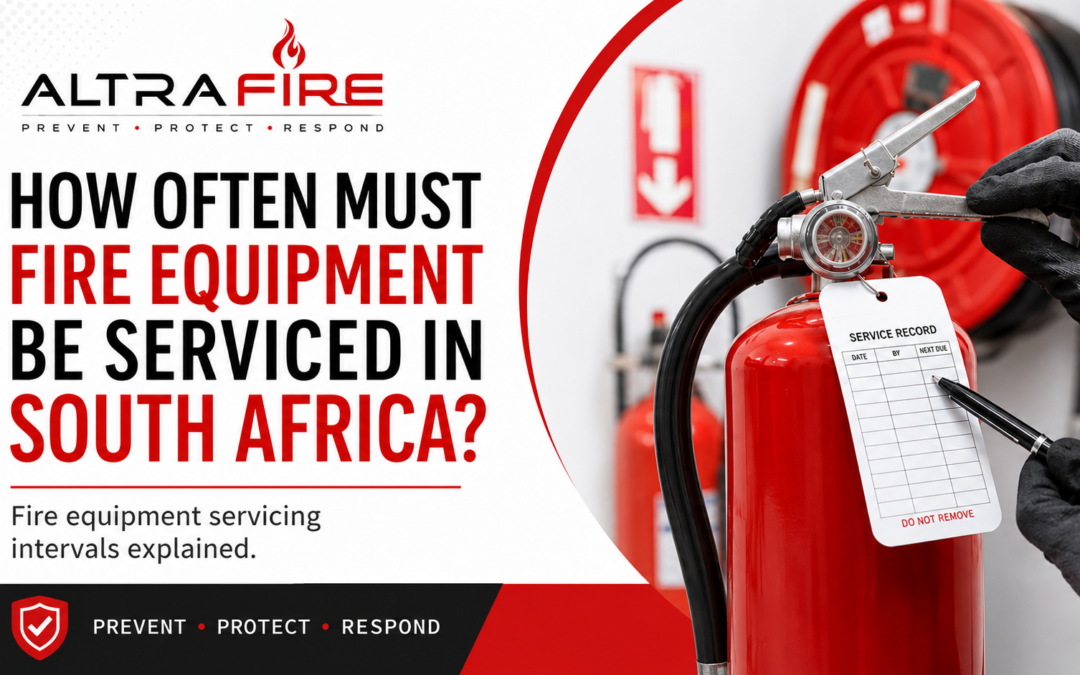
All portable fire extinguishers must be serviced annually and overhauled every five years (CO₂ every ten years) under SANS 1475-1. Fire hose reels and above-ground hydrants must be serviced annually under SANS 1475-2. Fire detection systems require periodic inspection throughout the year plus a full annual test under SANS 10139. Gas suppression systems (SANS 14520) must be fully inspected at least annually, with cylinder contents checked every six months.
If you’ve ever asked “how often do my fire extinguishers need to be serviced?” this is the definitive answer — a single, standards-referenced schedule covering every fire protection system your building is likely to have. Bookmark it; your SAQCC-registered technician, your insurer, and the Department of Employment and Labour inspector will all use the same figures.
The complete fire equipment service schedule for South Africa
The table below is drawn directly from the relevant SANS standards. “Routine service” means a competent, SAQCC-registered technician must inspect, test and certify the equipment. “Overhaul / extended maintenance” means a deeper strip-down, pressure test and full rebuild. “User check” means the responsible person in your building — no specialist required, but it must be recorded.
| Equipment | User / site check | Routine service (competent person) | Overhaul / extended maintenance | Governing standard |
|---|---|---|---|---|
| PORTABLE FIRE EXTINGUISHERS | ||||
| Water, water-based & foam extinguishers | Monthly visual check (owner / responsible person) | Annually | Every 5 years (full strip, internal inspection, pressure test & recharge) | SANS 1475-1 Annex F, Table F.1 |
| Dry powder extinguishers | Monthly visual check | Annually | Every 5 years | SANS 1475-1 Annex F, Table F.1 |
| Dry powder — primary sealed, stored-pressure | Monthly visual check | Annually | At years 5, 10 and 15 | SANS 1475-1 Annex F, Table F.1 |
| CO₂ (carbon dioxide) extinguishers — Class C fires | Monthly visual check | Annually | Every 10 years (cylinder pressure test) | SANS 1475-1 Annex F, Table F.1 |
| Halon extinguishers (legacy — restricted use) | Monthly visual check | Annually | Every 5 years | SANS 1475-1 Annex F, Table F.1 |
| FIRE HOSE REELS & HYDRANTS | ||||
| Fire hose reels (semi-rigid hose, 28–30 m) | Regular site control check by responsible person — ensure seal intact, hose undamaged, no “NO WATER” condition | Annually (full maintenance per SANS 1475-2 Annex B — hose length, pressure, seals, labels) | Replace hose if <28 m or jointed; replace reel if corrosion cannot be corrected | SANS 1475-2 clause 5.2 & Annex B; SANS 10105-2 |
| Above-ground hydrants | Regular site control check | Annually (per SANS 1475-2 Annex B, Table B.2 — valve, pressure at time of service recorded on label) | Replace components as required; no modification permitted | SANS 1475-2 clause 5.2 & Annex B |
| FIRE DETECTION & ALARM SYSTEMS | ||||
| Fire detection & alarm systems — all categories (M, L1–L5, P1–P2) | Weekly: test alarm signal (<1 min), check fault indicators, voice alarm test where applicable. Monthly: emergency generator run-on-load test (1 hr); vented battery visual inspection. |
Periodic inspection & test across the 12-month period (may be split across 2+ visits). All detectors functionally tested; all manual call points tested; all ancillary functions verified. Servicing certificate issued after each visit. | Full annual inspection and test — all detectors, all zones, all ancillary functions, log book updated. Competent person with specialist knowledge required. Non-routine attention as needed (new tenants, alterations, false alarm investigations). | SANS 10139:2021 clauses 12.1–12.2 |
| GAS SUPPRESSION SYSTEMS | ||||
| Gaseous fire suppression systems — halocarbon & inert gas agents (e.g. FM-200, Novec, CO₂ flooding, IG-541) | Weekly: visual check of hazard, enclosure integrity, pipework, gauges. Monthly: confirm all personnel trained on system operation. |
At least annually — full inspection & test by competent personnel; inspection report filed with owner. Hoses examined annually for damage. | Every 6 months: container contents check — halocarbon agents: refill/replace if >5% agent loss or >10% pressure loss (temp-adjusted). Inert gas agents: refill/replace if >5% pressure loss. Enclosure integrity verified at least every 12 months; door fan test repeated if visual check insufficient. | SANS 14520-1:2019 clauses 9.2 & 9.3 |
| ESCAPE PLANS & SIGNAGE | ||||
| SANS 23601 escape plans & emergency signage | Check after any building alteration, change of occupancy or layout change | Review and re-certify whenever building layout, exits or assembly points change | No fixed interval — currency triggered by change; confirm compliance during annual fire audit | SANS 23601; SANS 10400-T |
Why are annual fire extinguisher services legally required?
South African law makes annual extinguisher servicing unavoidable through three overlapping obligations. First, SANS 1475-1 (the reconditioning standard) mandates annual maintenance by a registered competent person and specifies that intervals run from the date of installation, but no later than one year from the date of manufacture marked on the body. Second, the Occupational Health and Safety Act 85 of 1993 (OHSA) places a duty on every employer to maintain a safe working environment — a fire extinguisher that has missed its service date is a documented non-compliance. Third, local fire brigade by-laws, enforced under the Fire Brigade Services Act 99 of 1987, require equipment to be maintained in operational readiness. An out-of-date service label is one of the first things a fire department inspector checks.
The practical consequence: if there is a fire and your insurer finds your extinguisher was last serviced more than 12 months ago, your claim is at serious risk of rejection. The cost of an annual service is trivial against that exposure.
What exactly happens during an annual fire extinguisher service?
A SANS 1475-1 Annex C routine service covers, among other checks: verification of the actual mass against the rated charge; inspection of the cylinder body, handle, hose, nozzle and safety seal for damage or corrosion; renewal of O-rings, washers and hose diaphragms; reassembly and recharge where relevant; and completion of a dated, legally required service label and certificate. The technician must be a registered competent person — registration through SAQCC Fire is the accepted standard in South Africa.
At the five-year mark (ten years for CO₂), the extended maintenance (Annex D) and overhaul (Annex E) require a full strip-down, internal inspection of the cylinder, a hydraulic pressure test, and replacement of all expendable components. This is the point where a cylinder may be condemned if it fails the pressure test.
What is the service interval for fire hose reels, and what does the service cover?
Fire hose reels and above-ground hydrants must be serviced annually under SANS 1475-2 clause 5.2. The annual service covers: checking the mounting bolts and frame; verifying that the drum rotates freely; confirming the hose is between 28 m and 30 m with no joints (shorter or jointed hose must be replaced); testing the inlet stop valve and shut-off nozzle; pressure-testing the hose; inspecting all water seals; and applying new service labels in both the visible and fully-unrolled positions.
A key practical point: if there is no water at the time of service, the technician must mark the reel “NO WATER” in indelible ink and remove the service labels. A hose reel with no water supply is a non-compliance item regardless of how recently it was last serviced. The responsible person — the building owner or their written nominee — is accountable for ensuring the water supply is maintained.
How often must a fire detection system be serviced under SANS 10139?
SANS 10139:2021 sets a layered maintenance regime. At the user level, a brief alarm test should be conducted weekly (duration kept under one minute to distinguish it from a real alarm), with monthly checks of standby power. At the competent-person level, the standard requires periodic inspection and testing spread across the 12-month period — in practice, most systems receive two or more service visits per year, with a full annual test completing the cycle. Each visit must be recorded in the system log book and a servicing certificate issued.
The full annual inspection requires every detector to be functionally tested, every manual call point to be tested, all ancillary functions (door releases, smoke control interfaces, alarm transmission) verified, and all fault circuits checked. The log book must record every false alarm, with the category of each false alarm noted. This documentation is what a fire inspector — or your insurer — will ask to see.
What are the service requirements for a gas suppression system?
Under SANS 14520-1:2019, gas suppression systems have both user-level and specialist-level obligations. Users must conduct weekly visual checks of the hazard, the enclosure (looking for new penetrations that could compromise hold time), pipework and gauges. Monthly, all staff who may need to operate or isolate the system must be confirmed as trained.
At least every six months, the storage containers must be weighed or pressure-checked: halocarbon (liquid) agents must be refilled or replaced if there is more than a 5% loss of agent quantity or more than a 10% pressure loss (temperature-adjusted). Inert gas agents must be refilled or replaced if there is more than 5% pressure loss. At least annually, a competent person must conduct a full system inspection and test, the enclosure integrity must be assessed, and all hoses must be examined for damage. The inspection report must be filed with the owner.
This is one of the most commonly neglected maintenance cycles in South African buildings. A gas system that looks operational but has lost agent pressure will fail to achieve the required design concentration when it discharges — and will not extinguish a fire.
Who is a “competent person” for fire equipment servicing in South Africa?
For portable fire extinguishers, SANS 1475-1 requires a registered competent person — in South Africa this means registration with SAQCC Fire (South African Qualification and Certification Committee for Fire) or demonstrated equivalent competence. For fire detection, SANS 10139 requires a competent person with specialist knowledge of fire detection and alarm systems, including knowledge of the causes of false alarms. For gas suppression, SANS 14520-1 requires competent personnel with specialist knowledge of the system type.
The practical takeaway: using an unregistered or uncertified technician exposes you to invalid service certificates, potential OHSA liability, and — critically — voided insurance coverage. Always ask your service provider for their SAQCC registration number and check it.
How long must fire equipment service records be kept?
Under SANS 1475-2, service records for hose reels and hydrants must be kept by the responsible person for at least three years. SANS 10139 requires the fire detection system log book to be maintained and accessible to all interested parties for the life of the system. In practice, keeping a complete fire file — covering all equipment, all certificates, all inspection reports — indefinitely is prudent: in the event of a fire, a claim dispute, or a DOL investigation, documentation going back several years may be demanded.
What happens if my fire equipment is overdue for service?
The consequences operate on multiple tracks simultaneously. A DOL inspector or municipal fire officer can issue a non-compliance notice requiring immediate remediation, and may prohibit occupation of the premises under the OHSA until compliance is achieved. Your insurer can reject any fire claim on the basis that the equipment was not maintained in accordance with the relevant standards, shifting the entire loss onto you. And in the event that a failure of the equipment contributes to injury or death, the employer and Section 16.2 appointee face personal criminal liability under the OHSA.
The cost of catching up on missed services is always a fraction of any of these outcomes.
Frequently asked questions about fire equipment service intervals
Does a new fire extinguisher need to be serviced immediately?
No — the first annual service falls due 12 months from the date of installation, but no later than one year from the date of manufacture marked on the cylinder body (per SANS 1475-1 Annex F.2). If the unit was manufactured significantly before installation, the first service date may be earlier than 12 months from fitting.
Can the building owner service their own extinguishers?
No. SANS 1475-1 requires maintenance to be carried out by a registered competent person. The building owner’s role is the monthly visual site check — not the annual technical service. Attempting to self-service extinguishers and signing off service labels constitutes a falsification of a safety certificate.
What is the difference between a “service” and an “overhaul” for extinguishers?
An annual service (SANS 1475-1 Annex C) is a functional check, recharge and re-seal. An overhaul at five or ten years (Annexes D and E) includes a complete strip-down, internal inspection of the cylinder under light, hydraulic pressure testing to the specified test pressure, and replacement of all seals and expendable components. Cylinders that fail the pressure test must be condemned and replaced.
Does my fire detection system need a service certificate?
Yes. SANS 10139 requires a servicing certificate to be issued after each inspection and test visit, and for the log book to be updated with dates, faults found, and false alarm records. This certificate is what you produce to a fire inspector or insurer.
How often should a gas suppression system’s cylinders be weighed?
At least every six months under SANS 14520-1 clause 9.2.1.3. For halocarbon (liquid) agents, if any cylinder shows more than 5% agent loss or more than 10% pressure loss (adjusted for temperature), it must be refilled or replaced immediately.
Are escape plans on a service schedule?
Escape plans under SANS 23601 do not have a fixed calendar interval — they must be updated whenever there is a change to the building layout, exits, occupancy, or assembly points. In practice, they should be reviewed as part of every annual fire audit.
This article is general guidance based on the current SANS standards and South African legislation. It does not constitute legal or professional advice. Requirements may differ based on your occupancy type, local by-laws, insurer conditions, or rational fire design. Consult a SAQCC-registered fire protection practitioner for advice specific to your premises.
Not sure if your equipment is overdue for a service?
Altrafire’s SAQCC-registered technicians service and certify the full range of fire protection equipment — extinguishers, hose reels, hydrants, detection systems and gas suppression — across Gauteng and surrounding regions. We’ll check your entire fire file and tell you exactly where you stand. Call 0861 111 504 or use the free compliance check below.