
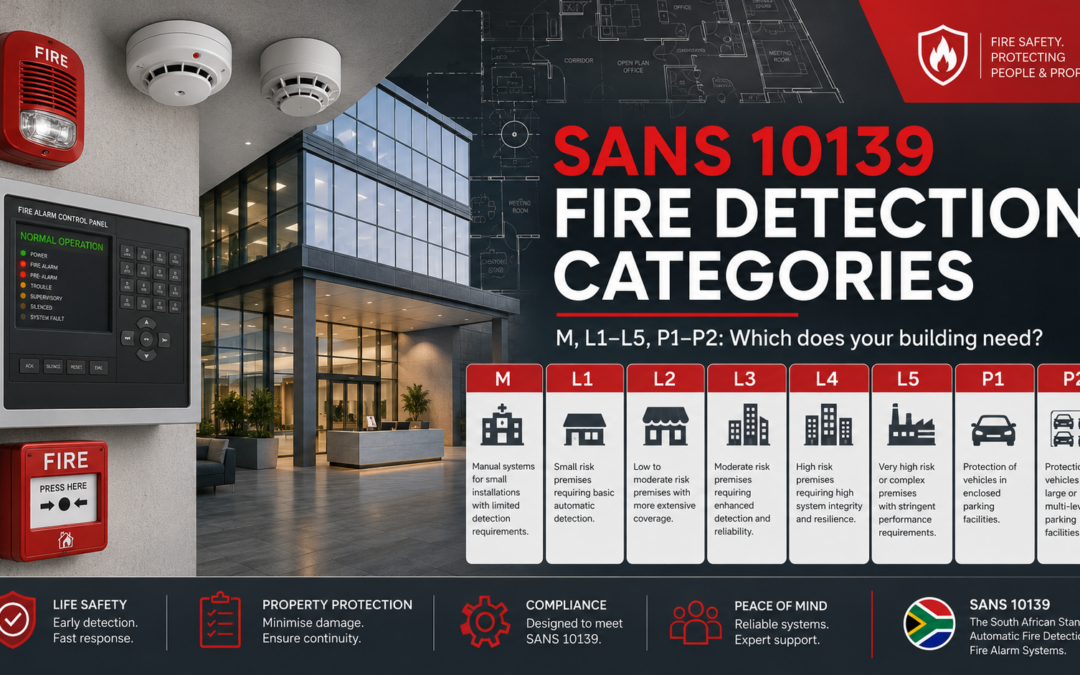
SANS 10139 classifies fire detection and alarm systems into three groups: Category M (manual systems with call points only), Categories L1–L5 (automatic detection designed to protect life) and Categories P1–P2 (automatic detection designed to protect property). The category dictates where detectors must be installed — from escape routes only (L4) up to the entire building (L1).
Specify the wrong category and you either overspend on detection the building doesn’t need, or — far worse — install a system that looks compliant but doesn’t meet the design objective an inspector, insurer or rational designer will hold you to. Here is what each category actually means and how the right one is chosen.
What is SANS 10139?
SANS 10139 is the South African national standard for the design, installation, commissioning and maintenance of fire detection and alarm systems in buildings. It is the standard a designer, installer or inspector will apply when your building requires detection — whether that requirement comes from SANS 10400-T (the fire protection part of the National Building Regulations), a rational fire design, your insurer, or your own risk assessment under the OHS Act 85 of 1993.
The single most important design decision under SANS 10139 is the system category, because the category defines the system’s objective and therefore where detection must be provided.
What are the SANS 10139 system categories?
| Category | Objective | Detection coverage | Typical application |
|---|---|---|---|
| M | Manual alarm — people raise the alarm | Manual call points and sounders only; no automatic detectors | Smaller, continuously occupied buildings where occupants will discover a fire quickly |
| L5 | Life safety — specific objective | Detection in defined localised areas to satisfy a specific fire-engineering objective | Tailored solutions from a rational design, e.g. protecting a particular hazard or compensating for a design departure |
| L4 | Life safety — escape routes | Detection within escape routes: corridors, stairways and circulation areas | Buildings where early warning along the escape path is the key risk |
| L3 | Life safety — escape routes protected | As L4, plus rooms that open onto escape routes | Offices, hotels and similar — warning before a fire makes the escape route impassable |
| L2 | Life safety — defined high-risk areas | As L3, plus specified high-risk or high-hazard rooms | Buildings with identified risk areas: plant rooms, kitchens, sleeping risk areas |
| L1 | Life safety — maximum | Automatic detection throughout virtually the entire building | Sleeping risks and high life-risk occupancies: hospitals, hotels, care facilities |
| P2 | Property protection — defined parts | Detection in defined high-value or high-risk parts of the building | Server rooms, archives, stores — often insurer-driven |
| P1 | Property protection — whole building | Automatic detection throughout the building | High-value facilities where early intervention protects the asset, e.g. warehouses, data centres |
L and P categories are routinely combined — a hotel might be designed as L1/P2, an office as L3 with P2 coverage over its server room. The L categories answer “will people get out?”; the P categories answer “will the building and its contents survive?”
How do the L categories differ in practice?
Think of L4 → L1 as expanding rings of coverage. L4 watches only the escape route itself. L3 adds the rooms opening onto it, so a fire is detected before smoke closes the corridor. L2 extends into rooms you have specifically identified as higher risk. L1 covers essentially everything. L5 sits outside the sequence: it is a custom category where a fire engineer defines exactly what must be protected and why — common in rational designs where detection compensates for some other departure from the deemed-to-satisfy rules.
Which category does your building need?
The category is not chosen from a menu — it is the outcome of:
- Occupancy class and building parameters under SANS 10400-T, which determine whether detection is required at all and at what level;
- The rational design, where a fire engineer has used detection as part of the safety strategy — the category is then fixed by that design;
- Insurer requirements, which frequently push P1/P2 coverage beyond the legal minimum;
- Your OHS Act risk assessment, especially for sleeping risks, high fuel loads or vulnerable occupants.
A common and expensive mistake is specifying “smoke detectors in the passages” (effectively L4) when the building’s risk profile or rational design actually demands L2 or L1. The system will pass a casual glance and fail the audit that matters.
Who may design, install and maintain a SANS 10139 system?
Detection is competence-controlled work. Design, installation, commissioning and servicing must be carried out by competent persons — in the South African market that means SAQCC Fire–registered detection practitioners — and the system must be formally commissioned with certificates issued and retained in your fire file. SANS 10139 also requires ongoing routine testing and scheduled servicing; a commissioned system with no service history is a non-compliance, not an asset.
Common SANS 10139 failures we find on audits
- No documented category or design objective — nobody can say what the system is supposed to achieve;
- Coverage gaps after tenant fit-outs, mezzanines or partitioning that the original design never saw;
- Missing commissioning certificates and no service records;
- Detection present but not interfaced with smoke ventilation, door holders or suppression as the design intended;
- L4-level coverage in buildings whose risk profile requires L2 or better.
Frequently asked questions
Is SANS 10139 legally required?
SANS 10139 becomes binding when fire detection is required — by SANS 10400-T for your occupancy, by a rational design, or by your insurer or risk assessment. Once a system is required, it must be designed, installed and maintained to SANS 10139.
What is the difference between L1 and P1?
Both cover the whole building, but with different objectives. L1 is engineered to protect life (early warning for escape, especially sleeping occupants); P1 is engineered to protect property (early intervention to limit damage). Alarm response, monitoring and interfacing requirements differ accordingly.
Can one building combine categories?
Yes — combinations such as L1/P1 or L3/P2 are normal. The life-safety category sets the minimum for occupant warning, and the property category adds coverage where the asset value justifies it.
How often must a fire detection system be serviced?
SANS 10139 requires routine user testing plus scheduled servicing by a competent person at regular intervals throughout the year. Keep every test and service record in your fire file — inspectors and insurers ask for the history, not just the panel.
Who can install a fire detection system in South Africa?
Competent, registered practitioners — SAQCC Fire registration for detection is the accepted benchmark. Insist on commissioning certificates before signing off any installation.
This article is general guidance, not legal advice or a design specification. The correct category for a specific building must be determined by a competent fire practitioner against SANS 10400-T, the applicable rational design and your risk profile.
Not sure which category your building was designed to — or whether it still complies?
Altrafire audits detection systems against SANS 10139 and SANS 10400-T, identifies coverage gaps, and certifies what’s there. Call 0861 111 504 or start with a free compliance check.