
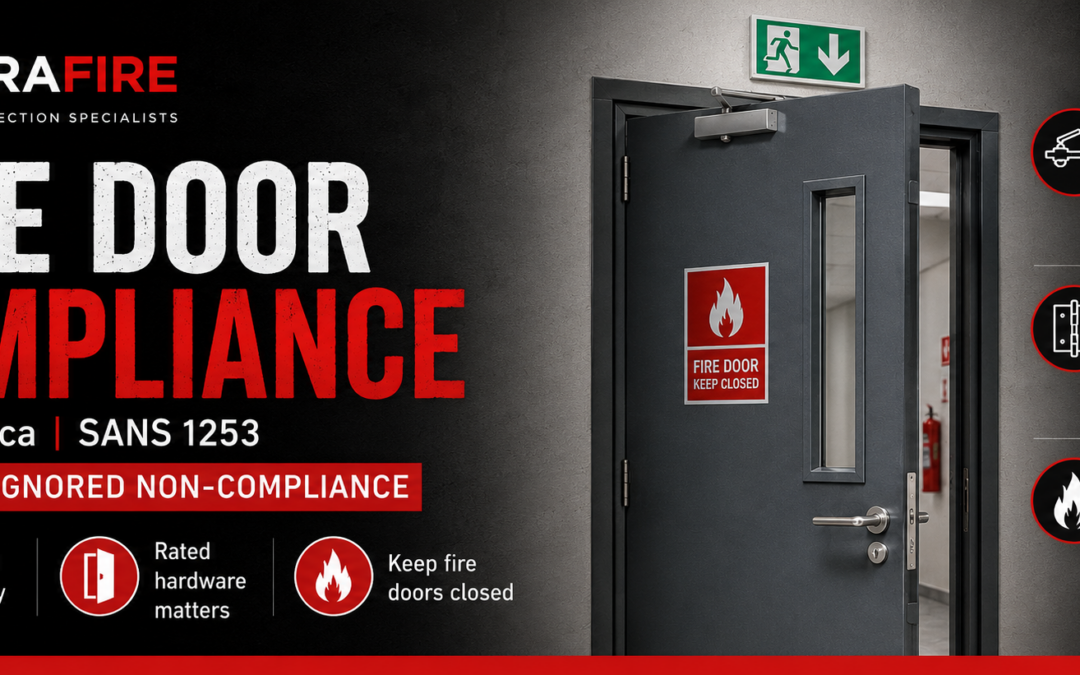
A fire door in South Africa must comply with SANS 1253 as a complete, factory-tested assembly — door, frame, hinges, lock and closer together, not the door leaf alone. SANS 10400-T sets six fire-resistance classes (A–F) linked to the wall the door sits in. The most common non-compliance isn’t a missing door at all — it’s a certified door propped open, missing its closer, or fitted with non-rated hardware.
Walk into almost any commercial building in South Africa and you’ll find fire doors that look perfectly compliant — solid, heavy, the right colour — and are quietly non-compliant anyway. A doorstop wedged under it. A closer that was disconnected last summer because “it kept slamming.” A handle swapped out by a contractor who had no idea it voided the door’s rating the moment it was fitted. None of this shows up on a walkthrough unless someone is specifically looking for it, which is exactly why fire doors are the most ignored non-compliance in the industry.
This guide covers what SANS 1253 actually requires, the six fire door classes and how they map to your walls, the everyday failures that quietly void a door’s certification, and what it costs to put right.
What is a fire door, and why is “SANS 1253 compliant” about more than just the door?
A fire door is designed and tested to slow the spread of fire and smoke between compartments of a building for a defined period, giving occupants time to evacuate and giving emergency services a contained fire to fight. SANS 1253 doesn’t certify door leaves in isolation — it certifies the complete assembly: the door, the frame it’s fitted into, and every piece of essential hardware (hinges, lock, handle, closer) tested together as one unit.
This matters because it means a certified fire door can be decertified without anyone removing the door itself. Change the lock, swap the hinges for a cheaper set, or fit a different handle, and you no longer have a tested assembly — you have an untested combination of parts that happens to look like one. SANS 1253 itself requires that any modification to a certified assembly triggers a formal re-evaluation, and that the modification be carried out by the manufacturer, not a site contractor.
What are the six SANS 1253 fire door classes, and which one does my building need?
SANS 1253 sets six fire-resistance classes for fire door and fire-shutter assemblies, labelled A through F, each tested for integrity (how well the door and frame hold together, with movement limited to 25 mm), stability, and — for the higher classes — insulation (limiting how hot the unexposed face gets). SANS 10400-T then tells you which class applies to which wall, based on the fire resistance that wall is required to provide.
| Wall / location | Required fire resistance | Typical door class |
|---|---|---|
| Occupancy separation wall, high-risk separation | 120 minutes | Class B |
| Occupancy separation wall, standard separation | 60 minutes | Class A |
| Protected corridor or protected stairway enclosure | 30 minutes | Class E |
| General openings in fire-resisting walls (not otherwise specified) | Minimum 30 minutes | Class F |
This is a simplified guide to the most common scenarios. SANS 10400-T’s full table (Table 7) covers every occupancy and wall type, and the exact class your building needs depends on its specific occupancy classification — get this confirmed against your actual building, not against a generic table.
Why are fire doors the most commonly non-compliant system in South African buildings?
Every other fire system on this site — extinguishers, detection, gas suppression — gets serviced on a visible schedule with a sticker or certificate that’s easy to check. Fire doors don’t work that way. Once installed, a fire door looks identical whether it’s fully compliant or has been silently decertified by a year of small, well-intentioned changes. That’s what makes this the system everyone assumes is fine and almost nobody actually checks.
| Common failure | Why it matters |
|---|---|
| Door wedged or propped open | A fire door that isn’t closed provides zero fire resistance — the entire point of the assembly is defeated |
| Self-closing device disconnected, chained back or removed | Required by SANS 10400-T 4.10.4 for almost every fire door; without it the door relies on someone remembering to close it |
| Non-rated hardware fitted after installation | Swapped hinges, locks or handles aren’t part of the tested assembly and can void the certification entirely |
| Gap under the door exceeds tolerance | New flooring, carpet or a worn threshold seal can open a path for smoke even with the door closed |
| Vision panel or glazing added on site | Cutting a window into a certified door without manufacturer re-evaluation removes the basis for its rating |
| Intumescent or smoke seals painted over repeatedly | Thick paint build-up stops the seal expanding properly when heated |
Can I modify, repaint or rehang a certified fire door?
Repainting is generally fine, provided it doesn’t build up over and disable the intumescent seals. Anything structural — rehanging on different hinges, fitting a new lock or handle, cutting a vision panel, trimming the door for a new floor finish — falls under SANS 1253’s modification clause, which requires a re-evaluation of the assembly and the work to be carried out by the manufacturer, not a general contractor or in-house maintenance team.
How are fire doors inspected, and what does an inspector actually check?
A proper fire door inspection checks the door leaf for damage or warping, the frame for security and fit, the gap around the door (door to frame, and door to floor), the self-closing device for correct function and full closure, the hardware for fire-rated specification, the intumescent and smoke seals for condition, and the certification label or plate for the assembly’s class and test reference. Fire doors should be inspected annually as part of your fire compliance audit, and any door that’s failed, been damaged, or had hardware changed should be checked immediately rather than waiting for the annual cycle.
How much does fire door compliance cost in South Africa?
| Item | Typical price range (excl. VAT) | What drives the price |
|---|---|---|
| SANS 1253 fire door — supply & install (per door) | R10 000 – R45 000+ | Fire-resistance class required, door size, frame, hardware |
| Fire door inspection & certification (per door) | R300 – R600 | Door condition, hardware check, closer function |
| Hardware replacement with correctly rated components (per door) | R1 500 – R15 000 | Whether re-evaluation by the manufacturer is required |
These figures reflect 2026 market guidance, not a quote — building-specific factors (door size, class required, access) affect the final price.
Frequently asked questions
Does a fire door need to be locked, or can people open it normally day-to-day?
Fire doors should be free to open and close normally for everyday use — the requirement is that they close and latch automatically when released, not that they’re locked shut. A self-closing device achieves this without restricting normal movement through the door.
Can I replace the handle or lock on a certified fire door?
Only with hardware that’s part of the tested assembly or with a formal re-evaluation carried out by the manufacturer. Fitting a standard, non-fire-rated handle or lock can void the door’s certification even though the door itself hasn’t changed.
How often should fire doors be inspected?
Annually, as part of a full fire compliance audit, with an immediate check after any damage, hardware change, or modification rather than waiting for the next scheduled inspection.
Are glass panels allowed in fire doors?
Only fire-rated glazing, tested as part of the certified assembly, can be used. Cutting a vision panel into an existing certified door on site, using ordinary glass, removes the basis for its fire rating.
What’s the minimum fire rating for a fire door in South Africa?
SANS 1253 covers assemblies rated from 30 minutes upward, across six classes (A–F). The class required for a specific door depends on the wall and occupancy it’s protecting, as set out in SANS 10400-T.
Who can certify or re-certify a modified fire door?
A fire door assembly that has been modified must be re-evaluated, and SANS 1253 requires that re-evaluation and the modification itself to be carried out by the door’s manufacturer — not a general contractor or maintenance team.
This article provides general guidance on SANS 1253 fire door requirements in South Africa and is not legal advice. For a building-specific assessment, including which fire door class applies to your walls, consult a SAQCC Fire-registered fire protection provider or a registered fire engineer.
Not sure if your “compliant” fire doors actually still are?
We’ll check every fire door in your building — hardware, seals, closers and certification — and tell you exactly which ones have quietly fallen out of compliance. Call 0861 111 504 or use the free compliance check below.
Keep reading:
- The Complete Fire Compliance Guide for South African Businesses
- Fire Compliance Certificate in South Africa: What It Is, Who Needs One & How to Get It
- Fire Compliance Costs in South Africa: What Businesses Actually Pay [2026]
- Why Fire Insurance Claims Get Rejected in South Africa (and How to Protect Yours)
- Altrafire Compliance Hub | Free Fire Compliance Check