
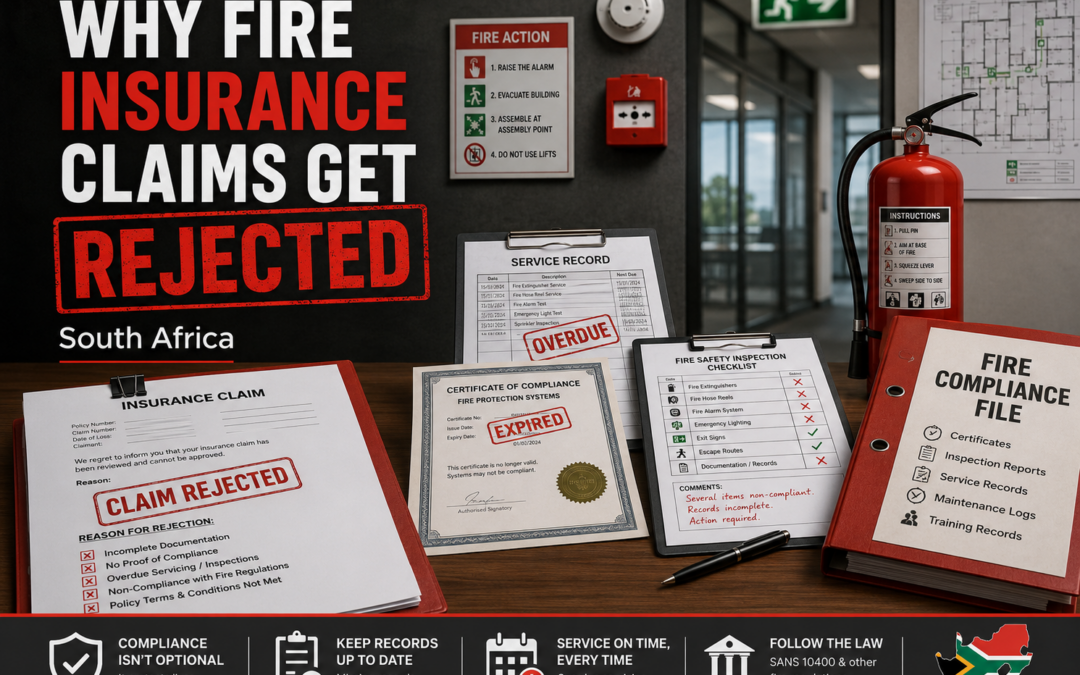
In South Africa, fire insurance claims are most often rejected or reduced because of lapsed equipment servicing, missing Certificates of Compliance, or a building that doesn’t meet SANS 10400-T — not because of the fire itself. Insurers must still show the non-compliance caused or worsened the loss, and you have the right to a written reason and to dispute the decision.
A rejected fire claim almost never comes down to “the fire happened, so we won’t pay.” It comes down to paperwork: a service record that lapsed eighteen months ago, a Certificate of Compliance nobody could produce, or a building modification that was never signed off. The fire is the trigger; the gap in your fire compliance is what the assessor actually writes in the rejection letter.
This guide covers the real reasons claims get rejected in South Africa, what your insurer is legally allowed to do about non-compliance, and the practical steps that protect a claim before a loss ever happens.
Why do fire insurance claims get rejected in South Africa?
When a fire damage claim is lodged, the insurer’s assessor doesn’t just assess the fire — they assess whether the building and its fire protection equipment were compliant at the time of the loss. The most common findings that lead to a rejection or reduced settlement are equipment that was serviced late or not at all, a Certificate of Compliance that was missing or had lapsed, a building that didn’t meet SANS 10400-T requirements for its occupancy, or fire protection work that was carried out by someone not registered to do it.
None of these findings mean the insurer can simply refuse to pay because a box wasn’t ticked. South African insurers are regulated under the Short-term Insurance Act 53 of 1998 and the Policyholder Protection Rules (PPR), which require a clear, specific, written reason for any rejection — and that reason has to stand up to scrutiny.
Does fire non-compliance automatically void my insurance claim?
No, and this is the part most fear-driven advice online gets wrong. To rely on a breach of a policy condition or warranty, South African courts generally require the insurer to show a causal connection — that complying with the condition would reasonably have prevented the loss, or at least reduced its severity. A purely technical non-compliance that had nothing to do with how the fire started or spread is a weaker basis for rejection than one that did.
In practice, this distinction rarely helps as much as it sounds like it should. If your fire detection system had lapsed and the fire burned for twenty extra minutes before anyone noticed, the insurer has an easy causal argument. If your escape plan signage was out of date but had nothing to do with how the fire started, the link is harder for them to prove — but you’ll still be arguing that point from a position of non-compliance, which is a worse place to negotiate from than full compliance.
What documents will my insurer ask for after a fire?
An assessor will typically request the same documents an inspector or auditor would. The table below sets out the most common rejection grounds, what the insurer asks to see, and how to make sure you have it before you ever need it.
| Common rejection ground | What the insurer typically requests | How to prevent it |
|---|---|---|
| Lapsed extinguisher servicing | Current Certificate of Compliance to SANS 1475-1 | Keep annual SAQCC Fire-registered servicing up to date |
| Fire detection system not serviced or tested | SANS 10139 service and annual test records | Maintain the weekly/monthly checks plus the full annual test |
| Gas suppression system not maintained | SANS 14520-1 inspection and cylinder-content records | Keep the 6-monthly and annual inspection cycle current |
| Building doesn’t meet SANS 10400-T for its occupancy | Fire clearance / compliance certificate | Hold an annual fire compliance audit and municipal clearance |
| Servicing done by an unregistered provider | Proof the technician/company is SAQCC Fire-registered | Use only SAQCC-registered providers and verify registration |
| Premises used differently to what was declared | Accurate disclosure of business activity at inception/renewal | Update your insurer whenever occupancy or use changes |
| Blocked escape routes or non-compliant fire doors | SANS 23601 escape plan, fire door inspection record | Keep escape routes clear and fire doors inspected annually |
This table reflects the documents most commonly requested in our experience and the standards behind them — it isn’t a guarantee of how any specific insurer or policy will respond to a specific loss.
What are my rights if my fire insurance claim is rejected?
If your claim is rejected, you’re entitled under the Policyholder Protection Rules to a plain-language explanation detailed enough to let you dispute it, along with information on how to escalate. You can submit written representations to the insurer’s internal escalation unit, and the insurer must give you a final decision within 45 days of receiving them. If you’re still unhappy with the outcome, the next step is a complaint to the Ombudsman for Short-Term Insurance (OSTI).
How do I protect my fire insurance claim before a loss happens?
Everything that protects a claim has to be in place before the fire, not after. Keep a single fire file with every Certificate of Compliance, service record and inspection report for every system in the building — extinguishers, hose reels, detection, gas suppression, escape plans and fire doors. Use only SAQCC Fire-registered providers and keep proof of their registration on file alongside the certificates they issue. Renew your municipal fire clearance certificate on schedule, and tell your insurer immediately if the building’s use, occupancy or layout changes.
The annual cost of staying compliant is consistently a fraction of either a remediation bill after a non-compliance notice, or a fire loss that your insurer is entitled to reduce or reject. Compliance isn’t just a legal requirement under the OHS Act 85 of 1993 — it’s the evidence file your claim depends on.
Frequently asked questions
Does fire non-compliance automatically void my insurance claim?
No. South African insurers generally need to show that the non-compliance was causally connected to the loss — that complying would reasonably have prevented or reduced it — not just that a technical requirement was missed.
Can my insurer reject a claim for something unrelated to how the fire started?
It’s harder for them to do so successfully, but they may still try, and you’ll be arguing the point from a weaker position than if you were fully compliant. Full compliance removes the argument entirely.
What can I do if my fire insurance claim is rejected?
Request the written reasons in detail, gather your evidence (service records, CoCs, photos, inspection reports), and submit formal representations to the insurer’s escalation unit. If that doesn’t resolve it, you can take the matter to the Ombudsman for Short-Term Insurance.
How long do I have to dispute a rejected fire insurance claim in South Africa?
There are specific time limits at each stage, including a court time-bar that runs from a fixed point after the internal escalation process. These deadlines are strict, so act as soon as you receive a rejection letter rather than waiting.
Does using a SAQCC-registered provider actually make a difference to my claim?
Yes. A Certificate of Compliance issued by someone not registered with SAQCC Fire carries no legal weight with an insurer, an auditor, or a fire department inspector — it’s treated the same as having no certificate at all.
This article provides general guidance on fire compliance and South African insurance practice. It is not legal or financial advice and does not consider your specific policy wording — for a claim dispute, get advice from a qualified attorney or the relevant ombud scheme, and for fire compliance, use a SAQCC Fire-registered provider.
Don’t find out your fire equipment is non-compliant after a claim is already rejected
We’ll check your entire fire file — extinguishers, detection, gas suppression, escape plans and fire doors — and tell you exactly where you stand before your insurer ever has to ask. Call 0861 111 504 or use the free compliance check below.
Keep reading:
- The Complete Fire Compliance Guide for South African Businesses
- Fire Compliance Certificate in South Africa: What It Is, Who Needs One & How to Get It
- How Often Must Fire Equipment Be Serviced in South Africa? The Full SANS Schedule
- Fire Compliance Costs in South Africa: What Businesses Actually Pay [2026]
- Altrafire Compliance Hub | Free Fire Compliance Check