
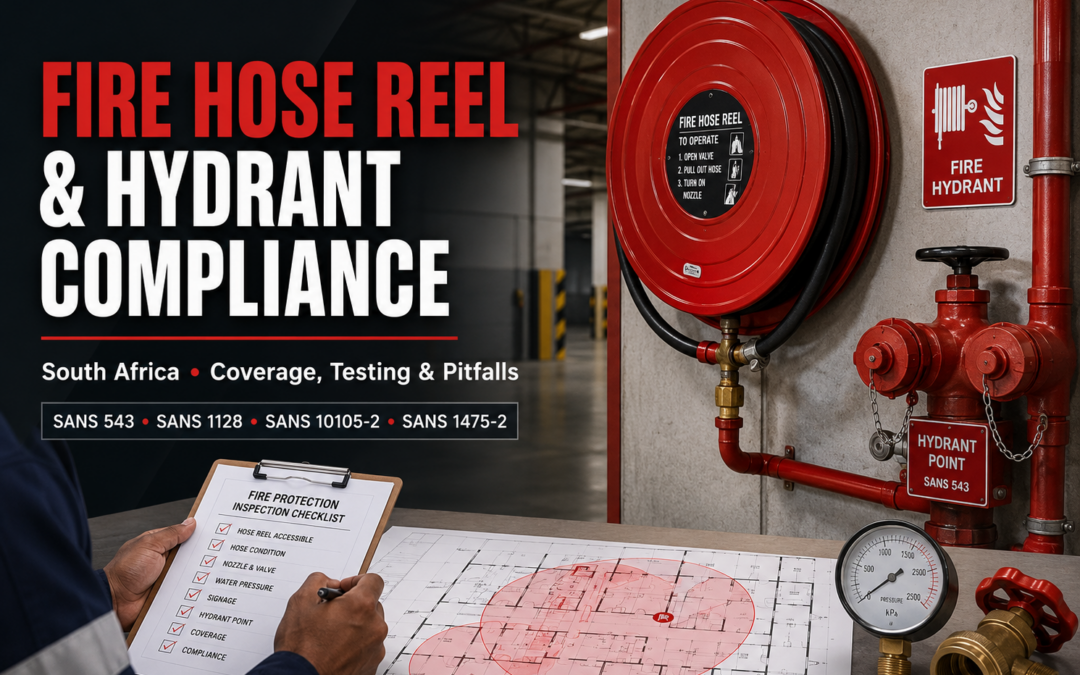
Fire hose reels and hydrants in South Africa are governed by SANS 543 (the reel itself), SANS 1128 (hydrant components and couplings), and SANS 10105-2 / SANS 1475-2 for use, control and servicing. The hose must be at least 28 m, undamaged, and able to reach every point of the area it protects. Most non-compliance comes from a hose that’s been cut short, jointed, or never properly pressure-tested.
Hose reels and hydrants are the fire protection system everyone assumes works, because the equipment is big, obvious, and rarely gets stolen or vandalised the way a portable extinguisher might. That visibility is exactly why so few get checked properly — the reel is clearly still there, so nobody questions whether the hose has shortened over the years, whether the seal is intact, or whether there’s actually water pressure behind it.
This guide covers the standards that govern hose reel and hydrant compliance, the coverage principle that determines where they need to be installed, what the annual service actually checks, and the pitfalls that turn a visibly-present system into a non-compliant one.
Which SANS standards actually govern fire hose reels and hydrants?
Three separate standards work together here, and confusing them is common. SANS 543 covers the fire hose reel itself — the reel, drum and semi-rigid hose as a manufactured product. SANS 1128 covers hydrant system components in two parts: Part 1 for underground and above-ground hydrant system components, and Part 2 for hose couplings, connectors, and branch pipe and nozzle connections. SANS 10105-2 is the “use and control” standard — it sets out how these systems must be installed, located and operated in a building — while SANS 1475-2 governs how they’re serviced and reconditioned once installed.
One requirement cuts across all of them: the equipment itself has to carry SABS approval. A SAQCC Fire-registered technician is not permitted to service, recharge or recondition a hose reel, hydrant component or extinguisher that isn’t SABS-approved — there’s no servicing pathway for non-approved equipment. If a unit on your premises doesn’t carry a valid SABS mark, the correct outcome is condemnation and replacement, not a service visit.
How far must a fire hose reel reach?
SANS 10400-T’s actual requirement is precise and easy to misstate: the nozzle — the physical end of the hose — must be able to touch the furthest point of the room or floor it’s protecting, without passing through a fire door or smoke barrier to get there. This is not the same as saying the hose plus a water jet must reach that point; there’s no allowance counted for the throw of the water stream once it leaves the nozzle. The hose itself, full length, has to physically reach.
This distinction matters when planning hose reel positions on a floor layout — measure from the reel to the furthest point using the hose length alone, not the hose length plus an assumed jet distance.
What does the monthly site check actually need to cover?
Between annual services, a responsible person on site should regularly check that the hose reel’s seal is intact, the hose itself shows no damage, cracking or sun/chemical degradation, and there’s no “NO WATER” condition — meaning the supply valve is open and the system is actually pressurized, not just visually present. The same applies to above-ground hydrants: check the valve operates, the hose and couplings are undamaged, and the unit hasn’t been obstructed by anything stored or built in front of it since the last check.
What happens during the annual SANS 1475-2 service?
A competent person carries out a full maintenance check under SANS 1475-2 Annex B: confirming the hose length, testing the water pressure and recording it on the service label, checking seals and labels, and inspecting the reel mechanism and bracket for corrosion. The hose itself is measured against a hard minimum: if it’s shorter than 28 m, or has been jointed or spliced at any point, it must be replaced rather than repaired. Hydrants follow the same Annex B framework, with valve condition and recorded service pressure as the key checkpoints — no modification to a hydrant assembly is permitted.
| System | Routine check | Annual service | Replacement trigger |
|---|---|---|---|
| Fire hose reel (28–30 m semi-rigid hose) | Seal intact, hose undamaged, no “NO WATER” condition | Hose length, pressure, seals and labels checked (SANS 1475-2 Annex B) | Hose <28 m or jointed; reel replaced if corrosion can’t be corrected |
| Above-ground hydrant | Valve operates, hose/couplings undamaged, unobstructed | Valve and pressure recorded on label (SANS 1475-2 Annex B, Table B.2) | Replace components as required; no modification permitted |
What are the most common fire hose reel and hydrant non-compliances?
The same handful of issues show up repeatedly in audits: a hose shortened over the years by repairs that cut out a damaged section and rejoin it, a reel that’s visually fine but has no actual water pressure behind it because an isolation valve was closed for unrelated plumbing work and never reopened, a hydrant or hose reel obstructed by racking, parked vehicles or stored materials, and corrosion on the reel bracket or hydrant valve that’s been painted over rather than addressed. None of these are visible without an actual hands-on check — which is exactly why the routine site check matters as much as the annual service.
How much does fire hose reel and hydrant compliance cost?
| Item | Typical price range (excl. VAT) | What drives the price |
|---|---|---|
| Annual service — fire hose reel (per unit) | R350 – R650 | Condition, hose replacement needed, water pressure at site |
| Hose reel hose replacement (28–30 m semi-rigid hose) | R900 – R1 800 | Hose brand, diameter, installation labour |
| Annual service — above-ground hydrant (per unit) | R400 – R800 | Valve condition, water pressure recorded, site access |
These figures are 2026 market guidance, not a quote — site access and the number of units serviced in one visit materially affect the final price.
Frequently asked questions
Can a fire hose reel hose be shorter than 30 m?
It can be slightly shorter through normal wear, but SANS 1475-2 sets 28 m as the hard minimum — anything shorter must be replaced, not repaired.
What does “NO WATER” mean on a hose reel?
It means the supply valve is closed or the system otherwise has no actual water pressure behind it, even though the reel and hose look completely normal. This is one of the most common ways a hose reel fails despite looking fine on a visual check.
Can a fire hose be jointed or spliced to make it longer?
No. A jointed or spliced hose fails the SANS 1475-2 requirement regardless of its resulting length and must be replaced with a single continuous length of hose.
What pressure should a hose reel or hydrant have?
The pressure at the time of service is measured and recorded on the service label as part of the annual SANS 1475-2 service — there isn’t a single universal figure, since required pressure depends on the system design, but it must be sufficient to deliver an effective jet at the point of use.
Who is responsible for the monthly check versus the annual service?
The monthly or regular site check is typically done in-house by a responsible person nominated by the building owner or occupier. The annual service must be done by a competent person registered to work to SANS 1475-2.
Are hose reels required in every building?
No, the requirement depends on the building’s occupancy classification and risk under SANS 10400-T. A fire compliance assessment will confirm whether your specific building needs hose reels, hydrants, or both.
What happens if my hose reel or hydrant isn’t SABS approved?
A SAQCC Fire-registered technician cannot service, recharge or recondition equipment that isn’t SABS-approved — there’s no compliant servicing pathway for it. Non-approved equipment must be condemned and replaced with a SABS-approved unit, not serviced or repaired.
This article provides general guidance on fire hose reel and hydrant compliance in South Africa and is not legal advice. For a building-specific assessment, consult a SAQCC Fire-registered fire protection provider.
Are your hose reels and hydrants actually pressurized, or just present?
We’ll check every hose reel and hydrant on your premises — length, pressure, seals and obstruction — and tell you exactly which ones would fail if you needed them tomorrow. Call 0861 111 504 or use the free compliance check below.
Keep reading:
- The Complete Fire Compliance Guide for South African Businesses
- How Often Must Fire Equipment Be Serviced in South Africa? The Full SANS Schedule
- Fire Compliance Costs in South Africa: What Businesses Actually Pay [2026]
- Fire Door Compliance in South Africa (SANS 1253): The Most Ignored Non-Compliance
- Altrafire Compliance Hub | Free Fire Compliance Check