
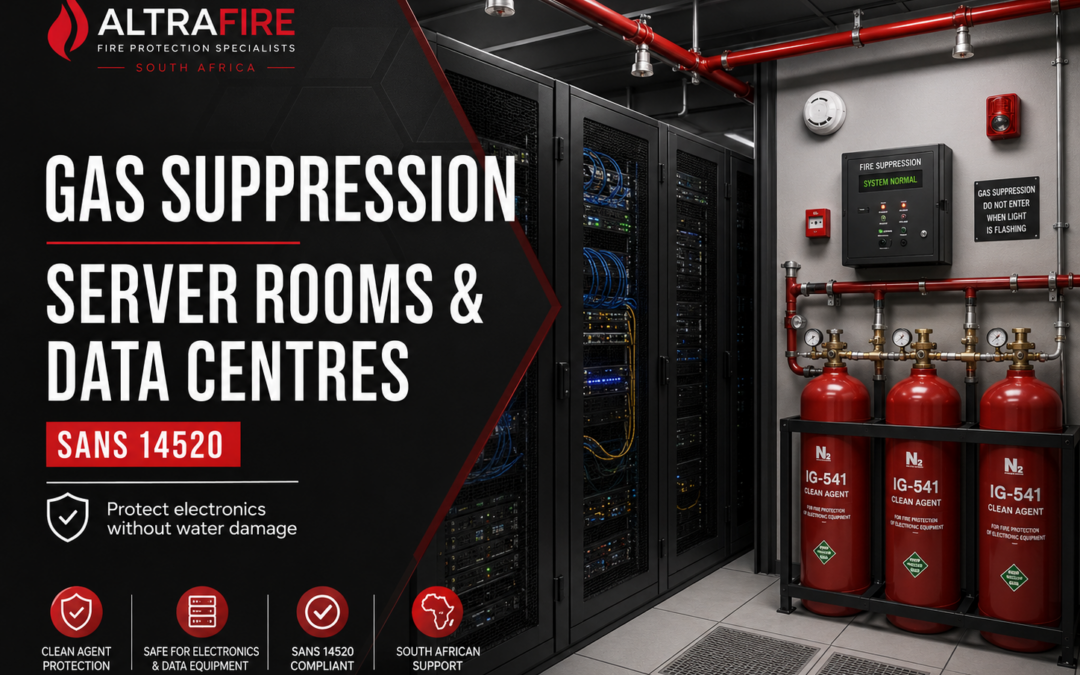
A gas suppression system is a SANS 14520-compliant fire-extinguishing system that floods a server room or data centre with a clean agent or inert gas instead of water or powder, so it protects servers and electronics while extinguishing the fire. It must discharge within seconds, reach a calculated design concentration, and hold that concentration for at least ten minutes.
If your business runs a server room, data hall, MV/LV switch room or UPS room, a sprinkler or extinguisher is the wrong tool — water and powder write off the equipment you’re trying to protect, often more thoroughly than the fire itself would have. Gas suppression is the standard answer, but it’s also one of the most over-sold and under-explained systems in South African fire protection.
This guide covers what SANS 14520 actually requires: which agents are used, how the design quantity is calculated, what a door fan test is, whether the gas is safe for people in the room, and what it really costs to install and maintain.
Why do server rooms and data centres need gas suppression instead of sprinklers?
Water-based suppression and dry powder both extinguish fire effectively, but both also destroy the asset they’re protecting. Water shorts out live equipment and corrodes circuit boards for months afterward. Powder is electrically non-conductive in the air, but the residue is abrasive and conductive once it settles, and it takes specialist clean-up to avoid wrecking hard drives and connectors.
Gas suppression solves this by using an agent that extinguishes the fire — either by absorbing heat faster than the fire can generate it, or by displacing the oxygen the fire needs — and then either evaporates completely (clean agents) or simply ventilates out as ordinary air (inert gases). No residue, no clean-up, no secondary damage to the equipment in the room.
Which gas suppression agents are used in South Africa, and how do they differ?
SANS 14520 (the South African adoption of ISO 14520) covers two families of agent: halocarbon “clean agents” that extinguish mainly by absorbing heat, and inert gases that extinguish by reducing the oxygen concentration. Each agent has its own dedicated part of the standard, since the physical properties and safe-exposure limits differ.
| Agent | SANS 14520 part | Type | How it extinguishes | Typical use case |
|---|---|---|---|---|
| FK-5-1-12 (e.g. Novec 1230) | Part 5 | Clean agent | Heat absorption | Data centres and archives — stored as a liquid, low atmospheric lifetime |
| HFC-227ea (e.g. FM-200) | Part 9 | Clean agent | Heat absorption | Widely installed legacy server room and switch room systems |
| HCFC Blend A (e.g. NAF S-III) | Part 6 | Clean agent (blend) | Heat absorption | Cost-sensitive retrofits of older systems |
| HFC-125 | Part 8 | Clean agent | Heat absorption | Industrial and marine enclosures |
| HFC-23 (e.g. FE-13) | Part 10 | Clean agent | Heat absorption | Sub-zero or low-pressure-tolerant enclosures |
| IG-541 (e.g. Inergen) | Part 15 | Inert gas blend (N₂/Ar/CO₂) | Oxygen dilution | Occupied control rooms — blend is designed to sustain breathing |
| IG-100 (Nitrogen) | Part 13 | Inert gas | Oxygen dilution | Large enclosures, archive and document vaults |
| IG-55 | Part 14 | Inert gas blend (N₂/Ar) | Oxygen dilution | Similar applications to IG-100/IG-541 |
| IG-01 (Argon) | Part 12 | Inert gas | Oxygen dilution | Specific electronics and process protection |
Clean agents are typically designed to concentrations in the single-to-low-double digits (commonly around 4%–10% by volume, agent-dependent). Inert gases work by oxygen dilution and are typically designed well above 30% by volume. The exact figure for your room is not a lookup — it is calculated under SANS 14520 from the enclosure volume, the specific fuel’s flame-extinguishing concentration, and a safety margin.
How does SANS 14520 determine how much agent my server room needs?
The design quantity is based on the net volume of the protected enclosure, the design concentration required for the specific fuel and hazard, and the discharge and hold-time requirements. Liquefied agents must reach 95% of design concentration within 10 seconds of discharge starting; inert gas systems are allowed a longer discharge window. Whichever agent is used, the concentration at the height of the protected hazard must stay at or above 85% of the design value for the full hold time — a minimum of 10 minutes unless the authority specifies otherwise.
There’s a South Africa-specific factor most generic (often US- or UK-written) gas suppression articles miss entirely: altitude. SANS 14520 requires the design quantity to be corrected for ambient pressure once the site is more than roughly 1 000 m from sea level. A data centre on the Highveld — Johannesburg and Pretoria both sit at 1 300–1 800 m — needs measurably less agent mass for the same room volume than an identical room in Durban or Cape Town, because the correction factor at that elevation is around 0.78–0.83 of the sea-level figure. A system designed using sea-level defaults, or copied from a coastal installation, will be wrongly specified on the Highveld.
What is a door fan integrity test, and why does my server room need one?
Reaching the design concentration is only half the requirement — the room also has to hold it for the full hold time. A door fan (or “enclosure integrity”) test, set out in SANS 14520-1 Annex E, uses a calibrated fan mounted in a doorway to measure how much air the enclosure leaks, then predicts how long the discharged agent will actually stay above 85% of design concentration before it leaks away through cable penetrations, raised-floor gaps, ceiling voids and door undercuts.
Server rooms and data centres fail this test more often than almost any other enclosure type, simply because they get modified constantly — new cabling runs, raised floor tiles lifted for cooling work, ceiling access for new racking. Any of these can open a leak path large enough to drop the hold time below 10 minutes, silently turning a fully-charged, freshly-serviced system into one that won’t actually work when discharged. The test should be redone after any structural change to the room, not only on the routine 12-month cycle.
Is gas suppression safe for people working in an occupied server room?
Yes, when the system is correctly designed and the safety provisions of SANS 14520 are followed — but it is not automatically safe at every concentration. The standard sets two thresholds for every agent: the No-Observed-Adverse-Effect Level (NOAEL) and the Lowest-Observed-Adverse-Effect Level (LOAEL). Systems designed up to the NOAEL require a pre-discharge alarm and time delay. Systems designed above the NOAEL up to the LOAEL additionally require an automatic-to-manual switch. Systems designed at or above the LOAEL require a lock-off device as well, and exposure must be limited to the times specified in the standard — never more than 5 minutes.
The practical implication for an occupied server room: anyone inside must be able to evacuate within the pre-discharge time delay, evacuation routes and signage must be unobstructed (an OHS Act 85 of 1993 obligation that applies regardless of which suppression agent is used), and nobody should re-enter until the room has been ventilated and cleared — for halocarbon agents, decomposition products from contact with a hot surface can leave a sharp, irritating residue even after the fire is out.
How much does a gas suppression system cost for a data centre in South Africa?
Cost depends heavily on agent choice, room volume, cylinder count and whether you’re installing new or maintaining an existing system. The ranges below are 2026 market guidance, not a quote — request a site assessment for figures specific to your room.
| Item | Typical price range (excl. VAT) | What drives the price |
|---|---|---|
| Annual inspection — small server/comms room | R3 500 – R7 000 | Cylinder count, agent type, whether a door fan test is due |
| Annual inspection — larger multi-cylinder data hall | R7 000 – R20 000+ | Cylinder count, room complexity, number of protected zones |
| Cylinder recharge / agent top-up | R10 500 – R18 000 per cylinder (larger cylinders R15 000 – R25 000+) | Agent type (FM-200, Novec 1230, inert gas), cylinder size, exchange-rate-linked agent cost |
| Door fan integrity test | R3 000 – R6 000 per enclosure | Room size, number of penetrations to be assessed |
| New system design & installation | From roughly R120 000 for a small comms room to R500 000+ for a large multi-cylinder data hall | Agent type, room volume, cylinder count, detection integration, civil/ducting work |
Inert gas systems generally cost less per refill (the agent itself is cheap) but need more cylinders and pipework for the same room. Clean agent systems need fewer, larger cylinders but the agent itself costs significantly more to recharge. Neither is universally “cheaper” — it depends on room size and layout.
How often must a gas suppression system be inspected and serviced?
SANS 14520-1 sets out a layered schedule — short, frequent in-house checks plus longer specialist inspections:
| Check | Who performs it | Frequency |
|---|---|---|
| Visual check (gauges, seals, signage, access) | Owner / responsible person | Weekly to monthly |
| Cylinder/container contents check | Competent person | Every 6 months |
| Full system inspection | Competent person | Annually |
| Enclosure integrity (door fan) test | Competent person | Every 12 months, or immediately after any structural change to the room |
This sits inside the same master service schedule that covers every other fire protection system in your building — see our full SANS service schedule for extinguishers, hose reels, hydrants and detection.
Frequently asked questions
What’s the difference between FM-200 and Novec 1230?
Both are halocarbon clean agents covered by SANS 14520, but FM-200 (HFC-227ea, Part 9) has a longer atmospheric lifetime and a higher global warming potential than Novec 1230 (FK-5-1-12, Part 5). Novec 1230 is stored as a liquid at lower pressure and has become the more common choice for new installations, while FM-200 remains widely installed in older systems.
Can people remain in a server room when the gas suppression system discharges?
They should evacuate during the pre-discharge time delay, not remain in the room. The time delay exists specifically to allow safe evacuation before discharge. Once discharged, re-entry should wait until the room has been ventilated and confirmed safe.
Does gas suppression damage servers, hard drives or data?
No — properly designed clean agent and inert gas systems are non-conductive and leave no residue, so they don’t damage electronic equipment or stored data. This is the core reason gas suppression is specified for server rooms instead of water or powder.
How quickly does a gas suppression system put out a fire?
Liquefied clean agents must discharge to 95% of design concentration within 10 seconds, and typically suppress a fire within seconds of reaching that concentration. Inert gas systems are permitted a longer discharge window but still act within the first one to two minutes.
Do I still need a fire detection system if I have gas suppression?
Yes. Gas suppression is triggered by a dedicated detection and control system designed to SANS 10139 principles — automatic discharge relies on fast, reliable detection (commonly cross-zoned smoke detection) to confirm a real fire before releasing the agent.
Who is legally responsible for maintaining a gas suppression system in South Africa?
The building owner or occupier is responsible for ensuring the system is maintained under SANS 14520-1 and that records are kept. Maintenance itself must be carried out by a competent, SAQCC Fire-registered service provider — it is not a task for general building maintenance staff.
This article provides general guidance on SANS 14520 gas suppression requirements in South Africa and is not legal advice. It is not a substitute for a site-specific design, calculation and sign-off by a registered fire engineer or fire engineering technologist — always have your system designed, installed and maintained by a SAQCC Fire-registered provider.
Not sure if your server room’s gas suppression is actually compliant?
Cylinder weight, enclosure integrity, control panel programming and detection coverage all need to line up — and most non-compliances aren’t visible until the system is tested. We’ll check your gas suppression system against SANS 14520 and tell you exactly where you stand. Call 0861 111 504 or use the free compliance check below.
Keep reading:
- The Complete Fire Compliance Guide for South African Businesses
- How Often Must Fire Equipment Be Serviced in South Africa? The Full SANS Schedule
- SANS 10139 Fire Detection Categories Explained (M, L1–L5, P1–P2)
- Fire Compliance Costs in South Africa: What Businesses Actually Pay [2026]
- Altrafire Compliance Hub | Free Fire Compliance Check