
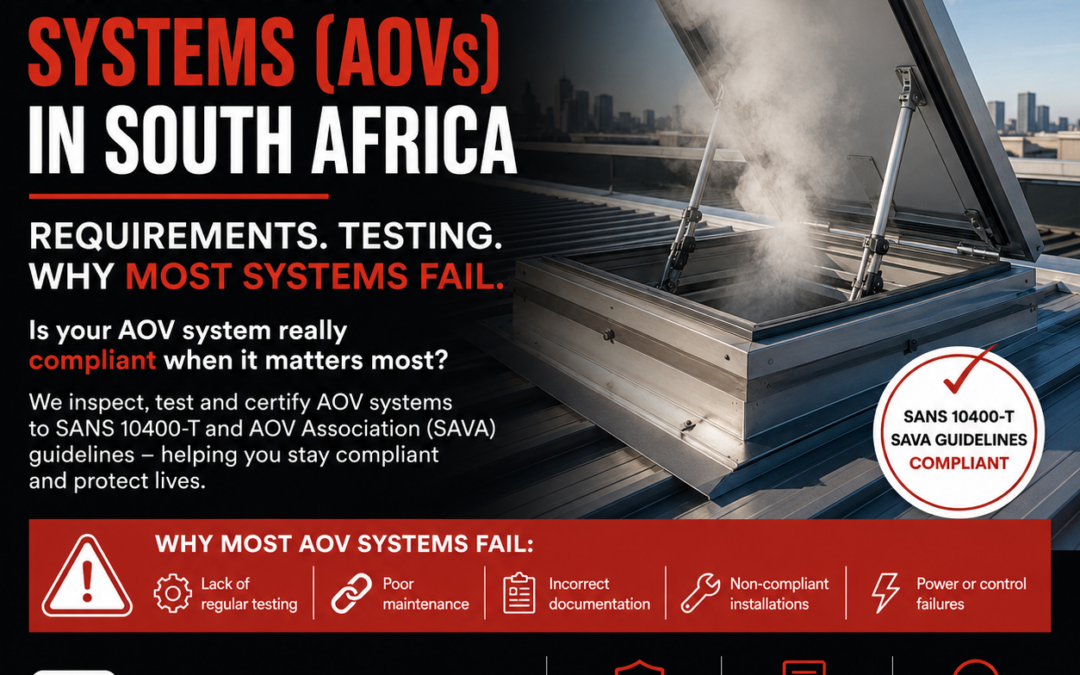
An AOV (automatic opening vent) clears smoke and heat from stairwells and other high-risk areas so people can evacuate safely, required under SANS 10400-T. South Africa has no AOV-specific SANS testing standard — Part T leans on the EN 12101 series for equipment performance. Most AOV failures trace back to a blocked vent, a dead backup battery, or an actuator nobody has tested since installation.
Smoke, not flame, is what kills most people in building fires — it fills escape routes faster than heat spreads and reduces visibility to almost nothing within minutes. Smoke ventilation systems exist specifically to buy occupants time by clearing that smoke out of stairwells and escape routes. They’re also one of the least-tested systems in the country, because unlike an extinguisher or a detection panel, an AOV can sit dormant for years with nobody ever triggering it — until the one time it’s actually needed.
This guide covers what SANS 10400-T requires, which standard actually governs AOV equipment and testing, the everyday failures that quietly disable these systems, and what compliance costs.
What is an AOV, and where does SANS 10400-T require one?
An AOV is a vent — typically a roof light, louvre or façade panel — that opens automatically on detection of smoke or fire to let smoke and hot gases escape, rather than build up inside an escape route. SANS 10400-T requires smoke ventilation for high-risk buildings and specifically for stairways: an unpressurized stairway needs a vent or window of at least 1 m² per storey for natural ventilation, or the stairway must be mechanically pressurized instead to keep smoke out entirely.
The same logic extends to basements, deep-plan office floors without direct external access, and other areas where smoke would otherwise have nowhere to go. Fire dampers in the HVAC ductwork serve a related but distinct purpose — stopping fire and smoke spreading through the air-conditioning system itself rather than venting it out of the building.
Which standard actually governs AOV testing in South Africa?
This is where a lot of confusion sits, and it’s worth being precise about: South Africa doesn’t have its own dedicated SANS standard for AOV component performance or testing. SANS 10400-T sets the requirement that smoke ventilation must be provided, but for the actual equipment — the vents, actuators, control panels and power supplies — the industry works to the EN 12101 series (the European standard for smoke and heat control), since no local equivalent exists. EN 12101-2 covers natural smoke and heat exhaust ventilators specifically, EN 12101-9 covers control panels, and EN 12101-10 covers power supplies.
In practice, this means a vent and its actuator are tested and certified together as one product, not as interchangeable parts — fitting a generic actuator to any window doesn’t make it a compliant AOV, even if it physically opens. If a supplier can’t produce a Declaration of Performance or test certificate referencing EN 12101 for the specific vent-and-actuator combination installed, you don’t have a tested system.
Why do most AOV systems fail when they’re actually needed?
An AOV that’s never tested looks identical to one that works perfectly — right up until the day it has to open. The most common reasons smoke ventilation systems fail are mundane, not dramatic:
| Common failure | Why it happens |
|---|---|
| Vent painted, sealed or bolted shut | Usually during a roof or maintenance job, by someone who didn’t know it was a smoke vent |
| Vent opening physically obstructed | Signage, racking, HVAC ducting or a false ceiling added after installation, blocking the vent’s free area |
| Backup battery dead or never tested | The system runs fine on mains power for years, so nobody discovers the battery has failed until a power cut |
| Actuator stroke insufficient for the declared free area | A replacement actuator fitted without checking it can fully open the vent to its certified fire-open position |
| Vent wired into general building management system logic, not dedicated smoke detection | The vent only opens on a manual override or HVAC schedule, not automatically on smoke detection |
| Stairwell pressurization fan switched off | Often disabled to reduce noise or energy use, and never switched back on |
None of these failures are visible on a casual walkthrough — an AOV system has to actually be triggered and observed opening to confirm it works.
How often should smoke ventilation systems be inspected and tested?
Since South Africa has no bespoke testing schedule of its own, providers generally apply the layered testing regime built into EN 12101 commissioning and maintenance practice:
| Check | What it covers | Frequency |
|---|---|---|
| Visual and functional check | Confirm vents open and close correctly when triggered; check for obstructions or visible damage | Weekly to monthly |
| Power-failure simulation | Confirm the backup battery or fail-safe mechanism opens the vent if mains power is lost | Monthly |
| Comprehensive service | Full system test by a specialist — actuators, control panel, battery condition, free area verification | Every 6 months |
What does smoke ventilation compliance cost in South Africa?
| Item | Typical price range (excl. VAT) | What drives the price |
|---|---|---|
| Six-monthly comprehensive service (per system) | R2 500 – R6 000+ | Number of vents, accessibility, control panel complexity |
| Backup battery replacement (per unit) | R500 – R1 500 | Battery type and capacity required |
| Actuator repair or replacement (per vent) | R3 000 – R9 000 | Actuator type, stroke length, accessibility |
| New AOV installation (per vent, supplied & fitted) | R15 000 – R45 000+ | Vent size, actuator type, control panel and detection integration |
These figures are 2026 market guidance, not a quote — building height, access and the number of vents in the system materially affect the final price.
Frequently asked questions
Is smoke ventilation a legal requirement in every building?
Not every building, but it’s required wherever SANS 10400-T identifies a high-risk condition — unpressurized stairways, basements, and deep-plan areas without direct ventilation are the most common triggers. A fire compliance assessment will confirm whether your specific building needs it.
What’s the difference between natural and mechanical smoke ventilation?
Natural smoke ventilation uses vents that open to the outside, relying on the buoyancy of hot smoke to rise and escape. Mechanical smoke ventilation uses fans to actively extract smoke or pressurize a stairway to keep it smoke-free. Many buildings use a combination of both.
Do AOVs need a backup battery?
Yes — an AOV has to be able to open even if mains power fails during a fire, which is exactly the scenario it’s most likely to face. This is almost always achieved with a monitored backup battery or a spring-return fail-safe mechanism.
Who can test and maintain an AOV system in South Africa?
A competent fire protection specialist familiar with EN 12101-based smoke ventilation systems, not general building maintenance staff. The system needs to be physically triggered and observed during testing, which requires specific knowledge of the control panel and override procedures.
How much free area must an AOV provide?
This depends on the specific building design and risk assessment, not a single fixed figure — SANS 10400-T’s stairway requirement (1 m² per storey if unpressurized) is one example, but the free area for other applications is calculated as part of the building’s fire engineering design.
Can I paint or seal an AOV vent?
No. Painting over the vent frame, sealing gaps for weatherproofing, or bolting a vent shut during unrelated maintenance work are among the most common ways a compliant AOV is quietly disabled.
This article provides general guidance on smoke ventilation and AOV requirements in South Africa and is not legal advice. For a building-specific assessment, including whether smoke ventilation is required for your premises, consult a registered fire engineer or a SAQCC Fire-registered fire protection provider.
Has your AOV system ever actually been triggered and watched open?
If you can’t answer that with certainty, neither can your fire compliance audit. We’ll test your smoke ventilation system properly — not just visually inspect it — and tell you exactly where it stands. Call 0861 111 504 or use the free compliance check below.
Keep reading:
- The Complete Fire Compliance Guide for South African Businesses
- Fire Door Compliance in South Africa (SANS 1253): The Most Ignored Non-Compliance
- SANS 10139 Fire Detection Categories Explained (M, L1–L5, P1–P2)
- Fire Compliance Costs in South Africa: What Businesses Actually Pay [2026]
- Altrafire Compliance Hub | Free Fire Compliance Check