
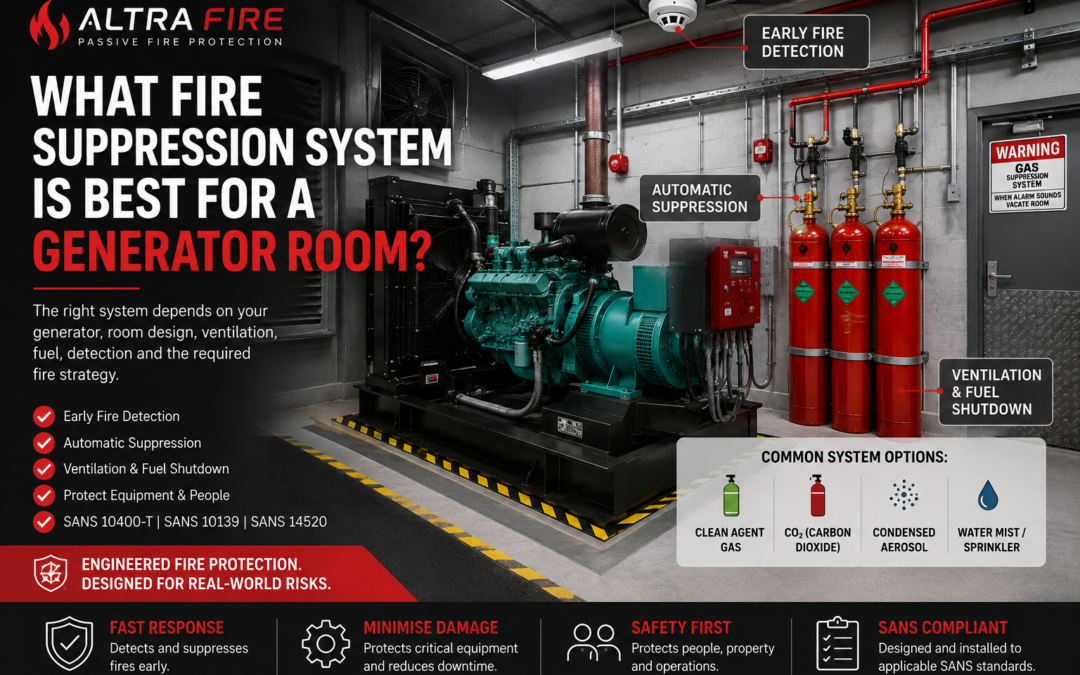
What is the best fire suppression system for a generator room? There is no single answer that is correct for every generator installation. A diesel generator room can contain several different fire hazards at the same time, including fuel, lubricating oil, hot exhaust components, batteries, electrical equipment and cabling.
The correct suppression system therefore depends on the generator, the fuel arrangement, room construction, ventilation, occupancy, room volume, openings, fire detection system and the consequences of an accidental or delayed discharge.
Depending on the application, suitable options can include clean-agent gaseous suppression, CO₂, condensed aerosol, water-based systems or a specially engineered combination of detection and suppression.
Quick answer: For an enclosed generator room, a properly engineered gaseous or other automatic suppression system can provide very effective protection, but the enclosure, ventilation, fuel supply and fire detection must all be considered together. Installing a suppression cylinder without controlling the room openings and generator systems is not a complete fire-protection design.
Does Every Generator Room Need an Automatic Fire Suppression System?
No. There is no blanket rule in SANS 10400-T stating that every room containing a generator must automatically have a fixed suppression system.
The requirement can arise from:
- the overall building fire strategy;
- an approved rational fire design;
- the location and size of the room;
- the type and quantity of fuel present;
- the risk that a fire presents to the rest of the building;
- insurance requirements;
- local authority requirements;
- business-continuity requirements; or
- the value and importance of the equipment being protected.
SANS 10400-T does, however, require fixed automatic fire-fighting systems in certain building circumstances and recognises systems designed in accordance with standards including SANS 306-4, SANS 10287 and SANS 14520-1, as appropriate.
This means generator-room suppression needs to be considered as part of the complete fire strategy for the building, rather than as a stand-alone product decision.
Why Are Generator Rooms a Significant Fire Risk?
A generator room can contain several ignition sources and combustible materials within a relatively small space.
Common risks include:
- diesel fuel;
- engine lubricating oil;
- hot engine surfaces;
- exhaust manifolds and turbochargers;
- batteries;
- battery chargers;
- electrical switchgear;
- alternators;
- starter motors;
- control panels;
- fuel pumps and pipework; and
- electrical cabling.
A small fuel or oil leak onto a hot surface can create a rapidly developing fire.
The fire can then involve cabling, plastic components, acoustic insulation or other combustible materials in the room.
The First Question: What Type of Fire Are We Trying to Detect and Suppress?
The detector and suppression system should be selected according to the expected fire.
A generator room can potentially experience:
- a slow electrical or cable fire producing smoke;
- an overheating component;
- a rapidly developing diesel or oil fire;
- a battery-related fire;
- a fire involving plastic or acoustic materials; or
- a combination of these hazards.
This is why the fire detection system should not automatically consist of one smoke detector and one suppression cylinder.
The expected fire characteristics need to be considered during the design.
Fire Detection Is Critical to Automatic Suppression
Most automatically released suppression systems depend on a dedicated fire detection and control system.
SANS 10139 allows a fire alarm system to initiate other fire-protection systems and safety functions, including:
- automatic fire extinguishing systems;
- shutdown of air-handling systems;
- closing of valves; and
- other associated control functions.
The fire detection system is therefore not an optional accessory to the suppression system. It is part of the complete sequence of operation.
What Type of Detector Should Be Used in a Generator Room?
There is no single detector type that is automatically correct for every generator room.
SANS 10139 requires detector selection to consider factors including:
- the nature and quantity of combustible material;
- the likely type of combustion;
- the expected rate of fire growth;
- temperature and environmental conditions;
- dust and contamination;
- ventilation;
- room height and geometry;
- the required speed of detection; and
- false-alarm risk.
Smoke Detection
Smoke detection may be useful where early detection of electrical cabling, control-panel components or other smouldering fires is required.
However, generator rooms can contain dust, exhaust contamination and significant air movement, all of which need to be considered when selecting and positioning smoke detectors.
Heat Detection
Heat detection can be more tolerant of dirty environments than ordinary smoke detection.
However, it normally responds later because sufficient heat must reach the detector before an alarm occurs.
Whether that later response is acceptable depends on the fire-safety objective.
Flame Detection
Flame detection can be particularly relevant where the main concern is a rapidly developing fuel or oil fire.
SANS 10139 recognises that with a flammable-liquid fire, a flame detector can operate before smoke or combustion-gas detection.
Flame detectors do, however, require a clear line of sight to the hazard and must be selected and positioned correctly.
Multi-Sensor or Coincidence Detection
In some applications, more than one detector or detection principle may be used to provide a reliable confirmed fire signal before automatic discharge.
SANS 10139 defines coincidence as an arrangement where an output is produced only when at least two independent triggering signals are present.
This can help reduce the risk of an unwanted suppression discharge while still providing rapid detection.
What Is the Best Suppression System for a Generator Room?
The main options normally considered are:
- clean-agent gaseous suppression;
- inert-gas suppression;
- CO₂ suppression;
- condensed aerosol suppression;
- water-based suppression such as sprinkler or water mist; and
- local-application systems designed for a specific generator or hazard.
Each has advantages and limitations.
Option 1: Clean-Agent Gas Suppression
Clean-agent suppression is often considered where the generator room is enclosed and contains electrical and control equipment that could be damaged by water or dry chemical powder.
A total-flooding gaseous system works by discharging a calculated quantity of extinguishing agent into the room.
The objective is to establish and maintain the required extinguishing concentration throughout the protected enclosure.
Advantages of Clean-Agent Suppression
- No powder residue.
- No water damage.
- Suitable for rooms containing electrical equipment.
- Rapid automatic operation.
- Can protect the entire enclosure rather than only one component.
Limitations
A gaseous system depends heavily on the condition of the room.
Potential problems include:
- large ventilation openings;
- permanently open louvres;
- extract fans that continue running after discharge;
- open cable penetrations;
- unsealed doors;
- open floor or ceiling voids; and
- other leakage paths.
Important: A gas suppression system cannot be evaluated by looking only at the cylinders. The protected room itself is part of the suppression system. If the enclosure cannot retain the agent for the required period, the system might not control the fire as intended.
For more information about gaseous suppression principles, see:
Gas Suppression for Server Rooms & Data Centres – SANS 14520
Option 2: Inert Gas Suppression
Inert-gas systems use gases that reduce the oxygen concentration in the protected enclosure to a level at which combustion can no longer be sustained effectively.
They leave no residue and can be suitable for electrical and mechanical plant areas.
However, they generally require:
- sufficient cylinder-storage space;
- properly designed pipework;
- pressure-relief consideration;
- a suitable enclosure; and
- careful consideration of personnel safety.
The room and system must be properly engineered rather than selected only on cylinder cost.
Option 3: CO₂ Fire Suppression
Carbon dioxide has been used for many years to protect machinery, electrical equipment and industrial plant.
It is an effective extinguishing agent and leaves no residue.
However, CO₂ presents a serious life-safety hazard to people inside the protected space.
This means its use requires especially careful consideration of:
- whether the room is normally occupied;
- access control;
- warning arrangements;
- discharge delays where applicable;
- means of escape;
- signage;
- system isolation procedures;
- maintenance procedures; and
- the applicable CO₂ suppression standard.
Do not select CO₂ simply because it is effective and relatively economical. Personnel exposure is a fundamental design consideration and must be dealt with correctly.
SANS 10400-T specifically recognises SANS 306-4 for appropriate CO₂ fixed extinguishing installations.
Option 4: Condensed Aerosol Suppression
Condensed aerosol systems are also used in certain electrical, mechanical and generator applications.
They can be attractive where:
- space for large cylinders is limited;
- complex pipe networks are undesirable;
- the protected enclosure is relatively compact; or
- a modular suppression approach is suitable.
However, aerosol is not automatically the best choice merely because it is compact.
The designer must consider:
- the room volume;
- hazard type;
- agent suitability;
- required concentration;
- discharge distribution;
- equipment manufacturer requirements;
- personnel exposure; and
- post-discharge clean-up or visibility implications.
Option 5: Water-Based Suppression
Water-based systems should not automatically be ruled out for generator rooms.
Depending on the building and hazard, a sprinkler, water-mist or other engineered water-based system may be appropriate.
Water has significant advantages for controlling heat and preventing fire spread.
However, the designer must consider the electrical equipment, fuel hazard, drainage, equipment sensitivity and the intended suppression objective.
SANS 10400-T recognises SANS 10287 for automatic sprinkler systems.
Clean Agent vs CO₂ vs Aerosol
| Consideration | Clean Agent / Inert Gas | CO₂ | Aerosol |
|---|---|---|---|
| Residue | Generally none | None | Depends on system and application |
| Electrical equipment | Often well suited | Often well suited | Can be suitable |
| Occupied room | Requires agent-specific safety assessment | Major life-safety concern | Requires system-specific assessment |
| Enclosure integrity | Critical for total flooding | Important | Depends on design |
| Cylinder / equipment space | Can be significant | Can be significant | Often compact |
| Design complexity | Engineered system | Engineered system | Engineered according to product/system requirements |
Ventilation Is One of the Biggest Generator-Room Issues
Generators require significant airflow for cooling and combustion.
This often means the room contains:
- large fresh-air louvres;
- radiator discharge openings;
- mechanical extract fans;
- ducts;
- motorised dampers; or
- large openings directly to the outside.
These openings can create a major problem for total-flooding gas suppression.
If the extinguishing agent is discharged while large fans remain operational or dampers remain open, the agent can be removed from the room before it has performed its function.
Should the Generator-Room Ventilation Shut Down on Fire?
Where required by the suppression design, ventilation and air-handling equipment should be interfaced with the fire system so the protected enclosure can achieve the conditions required for extinguishment.
SANS 10139 specifically recognises fire-alarm control functions such as shutting down air-handling systems.
SANS 10400-T also requires air-conditioning and artificial ventilation systems to be designed so that products of combustion are not distributed through the building during a fire.
The required sequence of operation must be documented during the system design.
What About Large Generator Cooling Louvres?
This is often the deciding factor between a successful and unsuccessful gaseous suppression design.
A generator may require a very large air inlet and radiator discharge opening while operating.
If these openings remain open after a confirmed fire:
- suppression agent can escape;
- outside air can continue entering;
- the required extinguishing concentration might not be achieved; or
- the concentration might not be retained for long enough.
An engineered system may therefore require appropriate automatic closure arrangements, subject to the generator and ventilation design.
This must be coordinated with the mechanical engineer, generator supplier and suppression designer.
Should the Generator Shut Down Before Suppression Discharges?
This must form part of the cause-and-effect design.
Continuing to run the generator during a confirmed fire can potentially:
- continue supplying fuel;
- continue producing heat;
- continue moving large quantities of air;
- continue operating ventilation fans; and
- affect the suppression concentration.
Where shutdown forms part of the fire strategy, the fire-detection and suppression system should provide the required control signal and the generator controls should be designed to respond correctly.
The sequence must also consider whether the generator provides emergency power to other life-safety systems in the building.
Important: Generator shutdown should never be treated as a simple relay connection without understanding what the generator supplies. If it provides emergency power to fire pumps, smoke-control equipment, emergency lighting or other critical systems, the overall fire strategy must be considered.
Should the Fuel Supply Be Shut Off?
Where a generator-room fire involves fuel, stopping further fuel supply can be an important part of the protection strategy.
Depending on the installation, this may involve:
- fuel solenoid valves;
- day-tank pumps;
- transfer pumps;
- remote emergency stops; or
- other fuel-isolation arrangements.
SANS 10139 recognises that fire-alarm systems can initiate functions such as closing oil or gas valves.
The required arrangement should be established by the complete fire and mechanical design.
The Fuel Tank Must Be Included in the Assessment
The generator itself is only part of the risk.
The designer should identify:
- whether there is an integral base tank;
- whether a separate day tank is installed;
- the tank capacity;
- whether there is bulk fuel storage;
- how fuel is transferred;
- where the fuel pipes enter the room;
- where the filler and vent lines terminate; and
- whether leaks can spread beyond the generator area.
SANS 10400-T contains specific provisions for liquid-fuel tanks and references standards such as SANS 10089-3 and SANS 10131 for relevant fuel installations.
Room Integrity Is Critical for Gas Suppression
Total-flooding gaseous systems depend on the enclosure retaining the extinguishing agent.
Common generator-room leakage paths include:
- radiator openings;
- air-intake louvres;
- extract ducts;
- doors;
- cable penetrations;
- fuel-pipe penetrations;
- exhaust penetrations;
- floor drains;
- roof openings; and
- unsealed wall penetrations.
The enclosure should therefore be assessed as part of the suppression design, not after the cylinders have already been installed.
Fire-Stopping Penetrations Is Also Important
Generator rooms can contain many services passing through fire-resisting walls.
SANS 10400-T requires services penetrating a wall or floor with a required fire resistance to be sealed so that the fire resistance is not compromised.
This can include penetrations for:
- power cables;
- control cables;
- fuel pipes;
- ducts;
- conduits;
- drainage pipes; and
- other services.
Ordinary building foam should not automatically be assumed to provide an acceptable fire stop.
What Is a Cause-and-Effect Matrix?
A cause-and-effect matrix defines exactly what must happen when each detector or control device operates.
A generator-room suppression sequence might include functions such as:
- first detector operates;
- local fire condition indicated;
- second independent fire signal confirms the fire;
- pre-discharge warning activates;
- generator receives shutdown signal;
- fuel-transfer equipment stops;
- ventilation shuts down;
- motorised dampers close;
- time delay starts where applicable;
- suppression system discharges;
- discharge is confirmed at the control panel; and
- the main building fire alarm receives the appropriate signal.
The actual sequence depends on the suppression technology and the approved design.
What Is Coincidence Detection?
Coincidence detection means that two independent initiating signals are required before a particular output occurs.
For example:
Detector A + Detector B = confirmed fire / suppression release sequence.
This is often used where an unwanted discharge could be expensive, disruptive or dangerous.
It should not be confused with simply receiving two successive signals from the same detector.
Do You Need a Separate Suppression Control Panel?
Many suppression installations use dedicated releasing control equipment designed for the extinguishing system.
The system can then interface with the building’s main fire alarm system.
The designer needs to determine:
- which panel performs the releasing function;
- which detectors initiate release;
- which signals are sent to the main fire panel;
- which plant shutdowns are controlled;
- how faults are monitored; and
- how manual controls are provided.
Manual Release and System Isolation
Depending on the suppression technology and design, manual controls can include:
- manual release controls;
- automatic/manual selectors;
- system isolation controls;
- emergency shutdown controls; and
- other safety functions.
These controls need to be clearly labelled and their operation must be understood by the responsible personnel.
What About an Abort Button?
Abort or hold functions are associated with certain suppression designs, but they should not simply be added because they are commonly seen on other systems.
The correct operation must be determined from the extinguishing-system standard and the approved cause-and-effect philosophy.
The user must also understand exactly what pressing the device does — and what it does not do.
Can You Use a Portable Fire Extinguisher Instead?
Portable extinguishers remain an important first-response measure, but they are not necessarily a substitute for automatic suppression where automatic suppression is required by the fire strategy.
SANS 10400-T requires portable extinguishers to be installed in accessible and unobstructed positions and allows the local authority to require additional units where particular hazards warrant it.
The extinguisher type should suit the actual hazards present in the generator room.
Is Dry Powder a Good Generator-Room Solution?
Dry chemical powder can extinguish many types of fire effectively, but discharge into a generator room can contaminate:
- alternators;
- electrical switchgear;
- control electronics;
- relays;
- battery chargers; and
- other equipment.
Therefore, when protecting valuable electrical equipment, the damage caused by the extinguishing medium itself should form part of the decision.
What About the Generator Exhaust?
The exhaust system can reach very high temperatures and should be considered during the fire-risk assessment.
The suppression designer should understand:
- where the exhaust passes through the room;
- where it penetrates walls or roofs;
- the insulation around the exhaust;
- clearances from combustible materials;
- possible fuel or oil spray exposure; and
- whether the exhaust remains hot after shutdown.
Suppressing the flame does not instantly remove the ignition source presented by hot metal surfaces.
What About Batteries?
Generator starter batteries and battery chargers introduce another fire and electrical risk.
The type of battery installed should be identified during the assessment.
Traditional lead-acid batteries and lithium-ion battery systems present different hazards and may require different controls.
A general generator-room suppression design should therefore not assume that every battery risk is identical.
Can Gas Suppression Work in a Room With Permanent Louvres?
Possibly, but this must be established by design.
A large permanently open louvre can make it difficult or impossible for a total-flooding system to maintain its required extinguishing concentration.
Possible design responses include:
- automatic fire-rated or suitable shutdown dampers;
- a different suppression technology;
- a local-application system;
- changes to the ventilation arrangement; or
- another engineered fire-protection approach.
The correct answer must be determined before equipment is purchased.
Can I Simply Install FM-200 in My Generator Room?
Not without a complete design.
Even where a clean agent is suitable for the hazard, the system still needs to consider:
- room volume;
- design concentration;
- temperature;
- agent quantity;
- nozzle positioning;
- pipework;
- ventilation shutdown;
- room leakage;
- pressure effects;
- fire detection;
- release logic;
- personnel safety; and
- post-discharge procedures.
The correct question is therefore not:
“How many cylinders do I need?”
It is:
“What fire suppression design is appropriate for this generator room?”
What Should Be Checked Before Quoting a Generator-Room Suppression System?
A proper site assessment should record at least:
- room dimensions;
- generator make and rating;
- fuel type;
- fuel-tank size and position;
- day tanks and bulk tanks;
- fuel transfer arrangements;
- ventilation inlet size;
- radiator discharge opening;
- mechanical extract systems;
- doors and louvres;
- cable and pipe penetrations;
- room construction;
- existing detection;
- existing suppression;
- other electrical equipment;
- battery systems;
- room occupancy;
- access and escape arrangements; and
- the equipment supplied by the generator during a mains failure.
Common Generator-Room Fire Protection Mistakes
- Installing suppression without assessing the ventilation openings.
- Leaving radiator fans or extract systems running during gas discharge.
- Using one detector type without considering the likely fire.
- Installing smoke detectors in a contaminated environment without considering unwanted alarms.
- Ignoring rapid fuel-fire detection.
- No defined generator shutdown sequence.
- No fuel-isolation strategy.
- No coordination between the fire contractor and generator contractor.
- Unsealed cable and pipe penetrations.
- Assuming that a gas cylinder alone means the room is protected.
- No room-integrity consideration.
- Installing CO₂ without adequately considering personnel safety.
- No documented cause-and-effect matrix.
- Suppression system not properly interfaced with the main fire alarm.
- Changes made to ventilation after the suppression system was commissioned.
Generator Room Fire Suppression Checklist
- What type of generator is installed?
- What fuel does it use?
- Where is the fuel stored?
- How much fuel is present?
- What other electrical equipment is in the room?
- What type of battery system is installed?
- What fire scenarios are credible?
- What detector technology is suitable?
- Is coincidence detection required?
- What happens when the first detector operates?
- What happens when fire is confirmed?
- Does the generator shut down?
- Does the fuel supply shut off?
- Do ventilation fans stop?
- Do dampers or louvres close?
- Can the room retain a gaseous agent?
- Are all wall penetrations properly fire-stopped?
- Is personnel safety addressed?
- Is the suppression system connected to the building fire alarm?
- Is a cause-and-effect matrix available?
- Are design, installation and commissioning records available?
- Has the room changed since the suppression system was originally designed?
Frequently Asked Questions
Does every generator room need gas suppression?
No. The requirement depends on the building fire strategy, generator-room risk, location, fuel arrangement, regulatory requirements and other factors. Gas suppression is one possible solution, not an automatic requirement for every generator room.
What is the best fire suppression system for a diesel generator?
There is no single best system. Clean-agent gas, inert gas, CO₂, aerosol or water-based suppression may be suitable depending on the generator, enclosure, fuel risk, ventilation and occupancy.
Can FM-200 be used in a generator room?
A suitable clean-agent system can potentially be used where the hazard and enclosure support the design. Room volume, leakage, ventilation shutdown, design concentration, detector logic and other factors must be calculated and assessed.
Can CO₂ be used in a generator room?
CO₂ can be an effective industrial extinguishing agent, but it presents a serious hazard to people. Occupancy, warning, escape and system safety controls therefore require careful consideration.
Should the generator switch off when the fire suppression operates?
Often generator and ventilation shutdown form part of the suppression cause-and-effect design, but the exact sequence must consider what critical systems the generator supplies and the approved building fire strategy.
Should the fuel supply stop during a generator-room fire?
Fuel isolation can be an important control where continued fuel flow could feed the fire. The arrangement should form part of the coordinated generator, fuel and fire-protection design.
Can a gas suppression system work with open ventilation louvres?
Large open louvres can allow extinguishing agent to escape rapidly. Whether gas suppression can work depends on the enclosure and whether openings can be appropriately controlled during discharge.
Is a smoke detector enough for a generator room?
Not necessarily. Detector selection should reflect the expected fire and environment. A generator room may contain both smouldering electrical-fire risks and rapidly developing fuel-fire risks.
Can flame detectors be used in generator rooms?
They can be appropriate where rapid flaming fuel fires are a significant hazard, provided the detector has the required field of view and is suitable for the environment.
Does a suppression system still need a fire alarm panel?
Automatic suppression normally requires detection, control and releasing functions, and it will often interface with the main building fire alarm. The exact equipment arrangement depends on the system design.
Need a Generator Room Fire Suppression Assessment?
Altra Fire designs, installs, commissions and maintains automatic fire suppression and fire detection systems for generator rooms, electrical rooms and other critical plant areas.
We can assess:
- the generator and fuel hazard;
- existing fire detection;
- suppression-system suitability;
- room volume and enclosure condition;
- ventilation and louvre arrangements;
- generator shutdown interfaces;
- fuel isolation;
- fire alarm interfaces;
- cause-and-effect programming;
- fire-stopping deficiencies; and
- existing system documentation.
Not Sure Which Suppression System Your Generator Room Needs?
A suppression system should be designed around the actual generator room — not selected from a catalogue before the room, ventilation and fuel system have been assessed.
Complete the form below and Altra Fire can assess the risk and recommend an appropriate solution.
Related Altra Fire Guides
-
Automatic Fire Suppression Systems
-
Gas Suppression for Server Rooms & Data Centres – SANS 14520
-
Commercial Fire Detection Systems in South Africa: A Practical 2026 Buying Guide
-
Fire Detection Systems – Design, Installation, Commissioning and Maintenance
-
Firefighting Equipment
Technical note: This article provides general guidance only. Generator-room fire suppression must be based on the actual building, generator, fuel system, ventilation arrangement, occupancy and approved fire strategy. Applicable requirements may include SANS 10400-T, SANS 10139, SANS 14520, SANS 306-4, SANS 10287 and other standards or regulations relevant to the particular installation. A site-specific design should be prepared by competent persons before suppression equipment is selected or installed.