
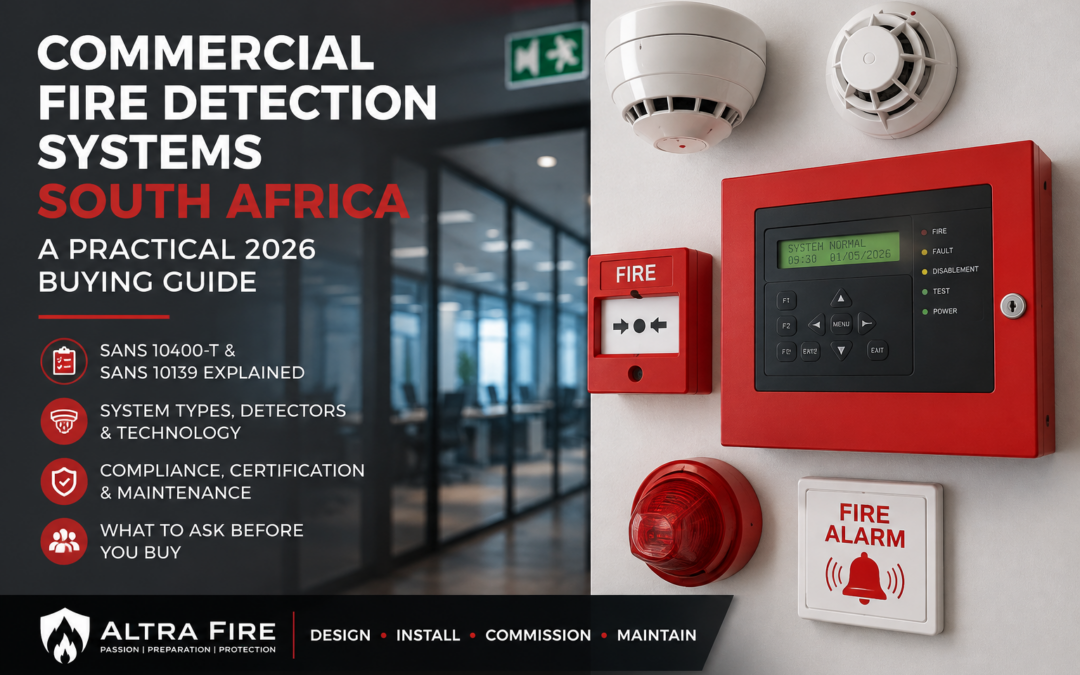
Choosing a commercial fire detection system in South Africa is not simply a matter of deciding how many smoke detectors, call points and sirens to install.
The correct system depends on the building, its occupancy, fire risk, required level of protection and the applicable South African fire safety requirements.
A system can contain modern, expensive equipment and still be unsuitable or non-compliant if it has been incorrectly designed, detectors have been placed in the wrong locations, the required system category has not been established, interfaces do not work correctly, or the necessary certification and documentation are missing.
Quick answer: Start with the building and the required fire detection category — not the brand of fire alarm panel. Once the required level of protection has been established, the designer can select the appropriate system architecture, detectors, alarm devices, interfaces and equipment.
Which Standards Apply to Commercial Fire Detection in South Africa?
Two South African standards are particularly important when considering a new commercial fire detection system or upgrading an existing installation:
- SANS 10400-T:2024 – Fire Protection
- SANS 10139:2021 – Fire detection and alarm systems for non-domestic premises
These two standards serve different purposes, and understanding the difference is an important starting point.
SANS 10400-T vs SANS 10139: What Is the Difference?
SANS 10400-T
SANS 10400-T provides the deemed-to-satisfy fire protection requirements associated with Part T of the National Building Regulations.
The fire protection measures required for a building can depend on factors such as:
- occupancy classification;
- building size;
- building height;
- layout;
- use;
- fire load;
- escape strategy; and
- the overall fire risk.
This means it is incorrect to assume that every commercial building requires exactly the same type or extent of automatic fire detection.
For unusual, large or complex buildings, the requirements may also be determined by a rational fire design prepared by an appropriately competent person.
SANS 10139
Once a fire detection and alarm system is required, SANS 10139 provides the code of practice for how that system should be designed, installed, commissioned, documented, maintained and managed.
It deals with matters including:
- fire detection system categories;
- detector selection;
- detector positioning;
- manual call points;
- alarm devices;
- fire alarm zoning;
- power supplies;
- false alarm management;
- interfaces with other systems;
- commissioning;
- certification; and
- ongoing maintenance.
In simple terms: SANS 10400-T helps establish what fire protection the building requires. SANS 10139 tells us how a required fire detection and alarm system should be designed and implemented.
For a broader overview of building fire compliance, see our Complete Guide to Fire Compliance for South African Building Owners.
Start With the Required Fire Detection Category
One of the most common problems found when assessing existing fire alarm installations is that nobody can identify the category the system was originally designed to achieve.
Under SANS 10139, systems are broadly divided into:
- Category M – manual fire alarm systems;
- Category L – systems primarily intended for protection of life; and
- Category P – systems primarily intended for protection of property.
The L and P categories are subdivided according to the extent and purpose of the automatic detection.
The system category should not simply be guessed by looking at the number of detectors installed.
It should be established as part of the fire detection design.
Before asking, “Which fire alarm panel should we buy?”, first ask: “What level of fire detection does this building actually require?”
For a detailed explanation, read our guide to SANS 10139 fire detection categories.
Conventional vs Addressable Fire Detection Systems
One of the next decisions is whether a conventional or addressable fire detection system is appropriate.
Both can be suitable when correctly selected and designed for the application.
Conventional Fire Detection
A conventional system divides the building into detection zones.
When a detector or manual call point operates, the fire panel normally identifies the affected zone, rather than the individual device.
For example:
FIRE – FIRST FLOOR EAST WING
Staff or emergency responders must then investigate the zone to locate the activated device or area.
Conventional fire detection can be practical for relatively small and uncomplicated premises.
Addressable Fire Detection
An addressable fire alarm system communicates with individual devices connected to the system loop.
Each detector, call point or interface can have its own address and descriptive text.
Instead of simply showing a zone, the panel could display:
SMOKE DETECTOR – SERVER ROOM – SECOND FLOOR
This can make investigation considerably faster in larger and more complex buildings.
Addressable systems can also provide more detailed information regarding:
- individual device status;
- fault locations;
- system events;
- device contamination;
- interfaces; and
- system diagnostics.
Which Is Better?
Addressable does not automatically mean compliant, and conventional does not automatically mean outdated.
The correct choice depends on factors including:
- building size;
- building complexity;
- number of devices;
- required system category;
- future expansion;
- maintenance requirements;
- fire strategy;
- availability of technical support; and
- budget.
For large commercial, industrial and multi-storey facilities, addressable systems often provide significant operational and maintenance advantages.
Detector Selection Is as Important as Detector Spacing
A competent fire detection design does not simply install smoke detectors everywhere.
The detector must be suitable for both:
- the type of fire that may reasonably be expected; and
- the environment in which the detector is installed.
The designer should consider early fire detection together with the risk of unwanted alarms.
Optical Smoke Detectors
Optical smoke detectors are commonly used where visible smoke is expected to provide an early indication of fire.
Typical applications include:
- offices;
- passages;
- retail areas;
- meeting rooms;
- general commercial spaces; and
- many escape routes.
They may, however, be unsuitable in areas containing high levels of dust, steam or airborne contamination.
Heat Detectors
Heat detection can be more appropriate in environments where normal conditions could cause unwanted smoke alarms.
Examples can include some:
- kitchens;
- boiler rooms;
- workshops;
- dusty environments; and
- industrial areas.
Heat detection normally responds later in the development of a fire than smoke detection.
It should therefore not simply be selected because a smoke detector is causing false alarms. The underlying environment and fire risk must first be considered.
Multi-Sensor Detection
Multi-sensor detectors evaluate more than one fire characteristic.
Depending on the technology, this may include combinations of:
- smoke;
- heat;
- carbon monoxide; or
- infrared characteristics.
Multi-sensor technology can improve discrimination between genuine fire conditions and environmental effects in certain applications.
Aspirating Smoke Detection
Aspirating Smoke Detection, commonly abbreviated to ASD, continuously draws air through a network of sampling pipes into a sensitive detection unit.
ASD can be particularly useful in:
- data centres;
- server rooms;
- telecommunications facilities;
- high-airflow environments;
- high-value equipment areas;
- difficult-to-access spaces; and
- applications requiring very early warning.
ASD is not automatically required simply because a room contains valuable equipment. Its use should be based on the fire risk and detection strategy.
Beam Smoke Detection
Optical beam smoke detection can be useful for large open spaces and high ceilings.
Typical applications can include:
- warehouses;
- large factories;
- shopping malls;
- atriums;
- aircraft hangars; and
- large halls.
Flame Detection
Flame detectors may be suitable in applications where rapidly developing flaming fires are a significant risk.
These systems are often associated with specific industrial hazards rather than ordinary office or retail environments.
Detector Positioning Matters
Even the correct detector cannot provide adequate protection if it is installed in the wrong position.
Fire detector positioning can be affected by:
- distance from walls;
- ceiling height;
- ceiling shape;
- beams;
- bulkheads;
- partitions;
- air-conditioning outlets;
- ventilation;
- ceiling voids;
- raised floors;
- storage racks; and
- the detector technology being used.
Our detailed guide to smoke detector spacing in South Africa explains the basic point-smoke-detector layout principles in more detail.
Building Alterations Can Make an Existing System Inadequate
A fire detection system may have been correctly designed when originally installed and become unsuitable years later because the building changed around it.
Common examples include:
- new office partitions;
- additional ceilings;
- new rooms;
- mezzanine floors;
- warehouse racking;
- changes in occupancy;
- new air-conditioning systems; and
- changes in the fire risk.
A fire alarm panel displaying “system normal” does not prove that the detector layout remains suitable for the building.
Fire Alarm Sounders and Visual Alarm Devices
Detecting the fire is only the first part of the system.
Once a fire condition has been identified, the people who need to respond must be effectively warned.
Fire alarm sounders must therefore be designed with consideration for:
- background noise;
- building layout;
- doors and partitions;
- sleeping accommodation where applicable;
- industrial noise;
- hearing protection;
- occupant characteristics; and
- the evacuation strategy.
Some applications may also require visual alarm devices such as flashing beacons.
Fire Detection System Interfaces
Modern fire alarm systems frequently interact with other building systems.
Depending on the fire strategy, the fire panel may need to interface with:
- air-conditioning and ventilation;
- smoke control systems;
- access-controlled doors;
- magnetic door holders;
- lifts;
- fire dampers;
- building management systems;
- gaseous fire suppression systems;
- remote alarm monitoring; and
- other plant or safety systems.
These functions should be defined during the design stage and documented in the system cause-and-effect requirements.
During commissioning, the interfaces should be tested to confirm that the required action actually occurs.
Does the Fire Alarm System Activate the Sprinklers?
Not usually in a conventional wet-pipe sprinkler installation.
Standard sprinkler heads are normally heat-activated individually. The fire detection system may monitor:
- sprinkler water flow;
- valve positions;
- pump conditions; or
- other sprinkler-system signals.
The fire alarm panel does not normally release each sprinkler head.
Systems such as pre-action, deluge and some special suppression systems operate differently and can have more complex interfaces with the fire detection system.
Fire Detection and Gaseous Suppression
Fire detection plays an especially important role where a room is protected by gaseous fire suppression.
A typical release arrangement can include:
- confirmed fire detection;
- pre-discharge audible warnings;
- visual warnings;
- HVAC shutdown;
- damper closure;
- discharge delay;
- gas release;
- manual release controls;
- abort controls where applicable; and
- system-status signals.
The suppression system has its own design and commissioning requirements.
A compliant fire alarm system does not automatically mean that the gas suppression installation is compliant.
False Alarms Are a Design and Management Problem
Repeated unwanted fire alarms should not simply be accepted as normal.
False alarms create disruption and can eventually cause occupants to lose confidence in the warning system.
Possible causes include:
- incorrect detector selection;
- poor detector positioning;
- dust;
- steam;
- environmental conditions;
- contaminated detectors;
- poor maintenance;
- building alterations;
- defective equipment; and
- incorrect system programming.
A good fire detection design should aim to provide reliable early warning while keeping unwanted alarms to an acceptable minimum.
Backup Power Is Essential
A commercial fire detection system must continue to function if the normal mains power supply fails.
This is particularly important in South Africa, where power interruptions can occur for numerous reasons.
The standby power supply therefore needs to be designed for the actual system load.
It is not enough to simply install batteries in the fire panel and assume that the system has sufficient standby capacity.
The designer and maintenance provider should consider:
- battery capacity;
- battery age;
- battery condition;
- charger condition;
- system current consumption;
- alarm load; and
- required standby duration.
Who Should Work on a Commercial Fire Detection System?
Fire detection is a life-safety discipline, and the competence of the people carrying out the work matters.
The persons responsible for design, installation, commissioning and maintenance should hold the appropriate SAQCC Fire registration for the function being performed.
When selecting a contractor, ask:
- Who is responsible for the fire detection design?
- Is the designer appropriately registered?
- Who will supervise the installation?
- Who will commission the system?
- Who will sign the applicable certificates?
- Who will maintain the system after handover?
Different functions require different competencies. Registration in one function should not automatically be assumed to cover every other stage of the project.
What Documentation Should You Receive?
A compliant fire alarm installation is more than equipment attached to ceilings and walls.
Depending on the project, the handover documentation should include the appropriate documentation associated with:
- design;
- installation;
- commissioning;
- acceptance;
- as-fitted drawings;
- zone information;
- system operating instructions;
- cause-and-effect requirements;
- logbook;
- system certificates;
- approved variations;
- equipment information; and
- user training.
Instead of asking only:
“Will I get a COC?”
Ask:
“Which SANS 10139 certificates and system documents will be supplied at handover?”
For more detail on existing-system compliance and documentation, see Is Your Fire Alarm System SANS 10139 Compliant? 6 Questions to Ask.
Fire Detection System Maintenance
A commercial fire alarm system cannot simply be installed and forgotten.
Routine user testing and professional maintenance are important for ongoing reliability.
Under SANS 10139:2021, professional servicing is normally carried out at intervals not exceeding six months.
The maintenance process also progressively verifies the operation of installed devices and system functions.
The building user should maintain a fire alarm logbook containing information such as:
- routine tests;
- false alarms;
- fire activations;
- system faults;
- isolations;
- maintenance visits;
- repairs; and
- alterations.
A system that displays “normal” on the panel is not proof that every detector, siren and interface will perform correctly during a fire.
15 Questions to Ask Before Buying a Fire Detection System
Before accepting a quotation, ask the prospective contractor these questions:
- What fire detection category does this building require?
- What is that decision based on?
- Who will perform the fire detection design?
- Is the designer appropriately SAQCC Fire registered?
- Why has this detector technology been selected?
- Is the proposed system conventional or addressable, and why?
- How will future expansion be accommodated?
- What interfaces with other building services are required?
- How will the system be commissioned?
- Which SANS 10139 certificates will be supplied?
- Will as-fitted drawings and a zone plan be supplied?
- Will a fire alarm logbook be provided?
- Who will train the building’s responsible persons?
- What maintenance and technical support are available after handover?
- Are replacement parts and technical support available locally?
A contractor who cannot clearly answer these questions may be selling fire alarm equipment rather than providing a properly designed fire detection solution.
Why Two Fire Alarm Quotations Can Be Very Different
It is common for building owners to receive quotations with similar detector quantities but very different prices.
The reason may be that the scopes are not actually comparable.
Check whether each quotation includes:
- site assessment;
- system design;
- drawings;
- equipment;
- installation;
- cabling;
- programming;
- interfaces;
- cause-and-effect programming;
- commissioning;
- certification;
- zone plans;
- logbook;
- user training;
- as-fitted drawings; and
- maintenance support.
Two quotations containing the same number of detectors can therefore represent completely different levels of work.
Should You Choose the Cheapest Fire Detection System?
Price is important, but a commercial fire detection system is a life-safety system that may remain in service for many years.
The cheapest installation price can become expensive if:
- replacement parts are difficult to obtain;
- technical support is unavailable;
- the panel cannot be expanded;
- false alarms become frequent;
- documentation is missing;
- the system was poorly designed;
- interfaces were omitted; or
- the installation must later be redesigned.
Consider the expected lifetime of the installation rather than only the initial price.
Does a Fire Detection System Guarantee Insurance Cover?
No.
No fire contractor should claim that installing a particular fire alarm system automatically guarantees that an insurance claim will be accepted.
Insurance policies and risk requirements differ.
However, insurers may specify particular fire protection requirements, and the condition, maintenance and compliance of the installed systems can become important after a loss.
Building owners should therefore understand both:
- the applicable fire safety requirements; and
- the specific conditions contained in their insurance policy.
Existing Fire Alarm System? Don’t Assume It Is Compliant
Many buildings already have fire alarm panels and detectors installed.
The presence of equipment does not necessarily prove compliance.
When assessing an existing installation, important questions include:
- Is there a documented fire detection design?
- Is the required system category known?
- Are the required certificates available?
- Are detectors correctly positioned?
- Are all required areas protected?
- Have building alterations affected coverage?
- Is the zone plan accurate?
- Are alarm devices effective?
- Do interfaces operate correctly?
- Are standby batteries healthy?
- Is the system maintained correctly?
- Is there a current logbook?
- Are as-fitted drawings available?
- Are false alarms being recorded and investigated?
Where information is missing, it is often sensible to establish the current condition and compliance status before deciding whether the system should be repaired, upgraded or replaced.
Can an Existing Fire Alarm System Be Upgraded?
Often, yes.
Whether an upgrade is practical depends on factors such as:
- age of the equipment;
- availability of spare parts;
- condition of the cabling;
- panel capacity;
- system architecture;
- existing detector coverage;
- required system category;
- building alterations;
- documentation; and
- the extent of any non-compliance.
A proper assessment should normally take place before deciding between repair, partial upgrade and complete replacement.
Choosing a Fire Detection Contractor in South Africa
A suitable contractor should be able to explain not just what equipment is being proposed, but why the system has been designed that way.
Look for a contractor who can provide clear information regarding:
- system design;
- SAQCC Fire competence;
- system category;
- detector selection;
- system architecture;
- commissioning;
- certification;
- documentation;
- maintenance;
- technical support; and
- future expansion.
Frequently Asked Questions
Does every commercial building in South Africa require automatic fire detection?
No. The required fire protection depends on the building’s occupancy, size, layout, use and fire strategy. The applicable building requirements and any rational fire design need to be considered before deciding what type of fire detection is required.
What is SANS 10139?
SANS 10139 is the South African code of practice covering the design, installation, commissioning and maintenance of fire detection and alarm systems in non-domestic premises.
What is the difference between conventional and addressable fire detection?
A conventional system normally identifies the alarm zone. An addressable system can identify individual detectors, call points and other devices by their programmed address.
Is an addressable fire alarm system always better?
No. Addressable systems offer significant operational advantages in many larger or complex buildings, but a correctly designed conventional system can still be appropriate for a smaller and simpler building.
Does an addressable system automatically comply with SANS 10139?
No. Compliance depends on the complete design, installation, commissioning, documentation and maintenance of the system. Sophisticated equipment can still be installed incorrectly.
How often should a commercial fire detection system be serviced?
Professional servicing under SANS 10139 is normally carried out at intervals not exceeding six months, together with the required routine user tests and functional testing regime.
Do I receive a fire alarm COC?
Rather than asking only for a generic COC, the building owner should establish which specific SANS 10139 design, installation, commissioning and other applicable project documents will be issued at handover.
Can fire detection operate a gaseous suppression system?
Yes. Fire detection can form part of the release and control logic for a gaseous fire suppression system. The detection, control sequence and suppression installation must all be correctly designed and commissioned.
Can an old fire alarm system be upgraded instead of replaced?
Often yes. The decision depends on the system condition, equipment availability, cabling, panel capacity, existing design, required fire detection category and the extent of any deficiencies.
How Altra Fire Can Help
Altra Fire designs, installs, commissions, maintains and assesses commercial fire detection systems throughout South Africa.
Our approach starts with the building and the required level of protection rather than simply selecting equipment from a catalogue.
We can assist with:
- fire detection system assessments;
- SANS 10139 fire detection design;
- conventional fire alarm systems;
- addressable fire alarm systems;
- system upgrades and extensions;
- detector selection and positioning;
- fault finding;
- fire alarm monitoring;
- interfaces with HVAC and other building services;
- gaseous suppression integration;
- system commissioning;
- maintenance;
- compliance documentation;
- zone plans; and
- as-fitted drawings.
Planning a New Fire Detection System or Upgrade?
Tell us about your building, existing fire alarm system or proposed project. Altra Fire can assist with system assessment, design, installation, commissioning or a quotation.
Complete the form below and our team will contact you.
Related Altra Fire Guides
- Is Your Fire Alarm System SANS 10139 Compliant? 6 Questions to Ask
- SANS 10139 Fire Detection Categories Explained: M, L1–L5 and P1–P2
- How Far Apart Must Smoke Detectors Be in South Africa?
- The Complete Guide to Fire Compliance for South African Building Owners
- Fire Detection Systems — Design, Installation, Commissioning and Maintenance
Technical note: This article provides general guidance for building owners and facility managers considering commercial fire detection systems. Fire detection requirements must be established for the individual building with reference to the applicable legislation, standards, fire strategy, occupancy, risk and site conditions. System design should be carried out by an appropriately competent person.