
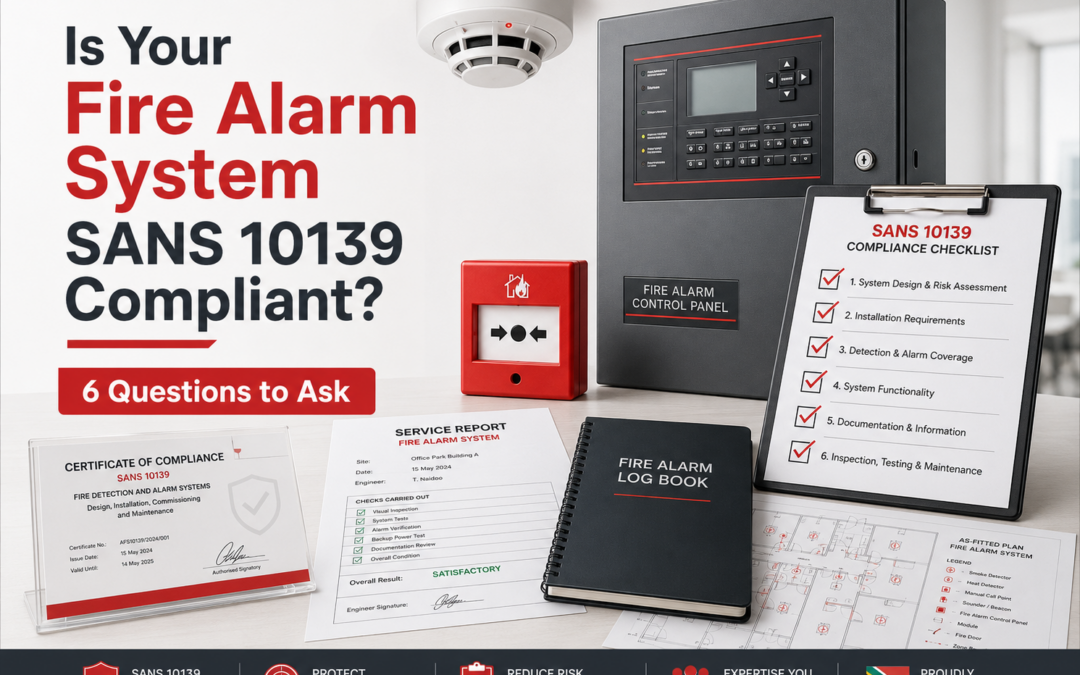
Is your commercial fire alarm system actually compliant with SANS 10139:2021 — or is it simply switched on and showing “System Normal”?
A compliant fire detection and alarm system involves much more than having smoke detectors, manual call points and a fire alarm panel installed.
The system should have a clearly defined SANS 10139 category, appropriate design and installation documentation, commissioning records, periodic inspection and servicing, functional testing, acceptable false alarm performance, an up-to-date logbook and accurate as-fitted information.
Many problems only become obvious when a building is inspected, a fire alarm fault occurs, a new service provider takes over the system, or the owner is asked to produce the system documentation.
If you already have a fire detection system installed, these six questions provide a useful starting point for assessing whether the system is being managed in accordance with SANS 10139.
Not sure which fire detection category your building requires?
Read our guide to SANS 10139 fire detection categories M, L1–L5 and P1–P2.
1. Do You Know Your Fire Alarm System’s SANS 10139 Category?
One of the first questions a building owner or facilities manager should be able to answer is:
What category was this fire detection system designed to provide?
SANS 10139 groups fire detection and alarm systems according to their intended objective and extent of protection.
- Category M — manual fire alarm systems;
- Categories L1–L5 — systems intended primarily for protection of life; and
- Categories P1–P2 — systems intended primarily for protection of property.
Different categories require different levels of automatic fire detection coverage.
For example, a Category L4 system concentrates detection on escape routes, while an L1 system provides automatic fire detection throughout virtually the entire building.
Life-safety and property-protection categories can also be combined where the design requires it.
The category should therefore not be guessed by looking at how many detectors have been installed.
It should form part of the design basis and documentation for the fire detection system.
Why Does the Category Matter?
The category tells everyone what the fire detection system was designed to achieve.
Without that information, it becomes difficult to determine whether:
- the correct areas have automatic detection;
- extensions to the system maintain the required coverage;
- building alterations have created detection gaps;
- the existing system still satisfies the original design objective; or
- the installation should be upgraded.
If nobody responsible for the building can identify the fire alarm category, the design documentation should be investigated.
2. Do You Have the Required Design, Installation and Commissioning Documentation?
A fire alarm panel showing no faults does not prove that the system was correctly designed or installed.
SANS 10139 provides for formal certification of the different stages of the fire detection installation.
| Document | Purpose |
|---|---|
| Design Certificate | Records responsibility for the system design, including the intended category and design basis. |
| Installation Certificate | Records responsibility for installing the fire detection system in accordance with the design and applicable requirements. |
| Commissioning Certificate | Records that the completed system was tested, commissioned and checked before handover. |
These documents are particularly important when another fire detection company takes over maintenance of an existing system.
Without proper documentation, the new service provider may have no reliable record of:
- the original design category;
- the intended detector coverage;
- cause-and-effect programming;
- interfaces with other fire systems;
- system modifications; or
- the basis on which the installation was originally approved.
What If the Certificates Cannot Be Found?
This is common with older installations.
It does not mean that the entire fire alarm system should automatically be replaced.
It does mean that the existing installation may need to be properly surveyed and assessed so that its current configuration, condition and compliance can be established.
3. Has Your Fire Detection System Been Serviced Within the Last Six Months?
SANS 10139 requires periodic inspection and servicing of the fire detection and alarm system, with the period between periodic inspection visits not exceeding six months.
This is different from the annual servicing interval normally associated with portable fire extinguishers.
Fire detection systems: maximum six-month interval between periodic inspection visits.
The service should not consist only of looking at the panel, resetting faults and checking whether a few detectors respond.
Periodic inspection and maintenance should establish the condition and operation of the fire alarm system and identify faults or deterioration that could affect its reliability.
For fire detection compliance work in South Africa, use a competent practitioner with the appropriate fire detection competency and registration.
Ask for the Service Records
The responsible person should be able to produce records showing when the system was last inspected or serviced and what was found.
If the previous visit identified faults, the records should also indicate whether those faults were subsequently corrected.
A yellow fault light that has been present for months should never become part of the normal appearance of the fire alarm panel.
4. Has Every Detector and Manual Call Point Been Functionally Tested?
One of the most important differences between visual inspection and proper fire alarm testing is that a detector must actually be proven capable of responding to the fire phenomenon it is intended to detect.
A smoke detector can appear perfectly normal on the ceiling and still fail to respond correctly.
The same applies to manual call points.
Functional testing helps establish that:
- the detector actually responds;
- the correct device or zone is identified at the panel;
- the alarm information is understandable to the user;
- the required alarm outputs operate; and
- the system returns correctly to its normal condition following testing.
Over the appropriate testing cycle, the automatic detectors and manual call points should be functionally tested and the results recorded.
Why Visual Inspection Is Not Enough
A panel can communicate normally with an addressable detector while the detector’s sensing chamber has become contaminated or ineffective.
Similarly, a conventional zone may show completely normal resistance even though an individual detector is unable to respond correctly.
Electrical supervision and functional fire detection testing are not the same thing.
5. Is Your Fire Alarm Producing Too Many False Alarms?
Repeated false alarms are not merely an inconvenience.
SANS 10139 specifically addresses the management and investigation of false alarms because excessive unwanted alarms reduce confidence in the fire alarm system.
If occupants repeatedly hear the fire alarm when there is no fire, they can become slower to react when a genuine alarm occurs.
False alarm patterns should therefore be recorded and investigated rather than dealt with by repeatedly resetting the panel.
What Can Cause Repeated False Alarms?
Possible causes include:
- incorrect detector selection;
- smoke detectors installed near kitchens or steam;
- dust contamination;
- construction work;
- poor detector positioning;
- air-conditioning affecting smoke movement;
- electrical interference;
- damaged equipment;
- ageing detectors;
- environmental conditions unsuitable for the detector type; or
- incorrect system configuration.
If your building is experiencing repeated unwanted activations, read our detailed guide:
Why Does My Fire Alarm Keep Giving False Alarms?
The fire alarm logbook is particularly valuable here because it allows the responsible person and service provider to identify patterns.
For example, the records may show that:
- the same detector repeatedly activates;
- alarms occur at a particular time;
- alarms follow cleaning activities;
- one tenant or process is involved; or
- the same zone repeatedly creates problems.
6. Do You Have an Up-to-Date Fire Alarm Logbook and As-Fitted Drawings?
The logbook is one of the most useful documents associated with a fire detection system — yet it is also one of the documents most commonly missing from site.
The fire alarm logbook should provide a running history of the system.
The user should record important events such as:
- weekly system tests;
- fire alarms;
- false alarms;
- faults and defects;
- system isolations;
- maintenance visits;
- repairs;
- modifications; and
- other significant events affecting the fire detection system.
This information allows a technician to see what has been happening between service visits.
The Logbook Belongs With the Fire Alarm System
The user of the system has an important responsibility for routine monitoring and record keeping.
A service technician cannot record a fault or false alarm that occurred three months earlier if nobody on site documented it.
This is why we regularly ask clients experiencing repeated problems to provide the relevant logbook entries before our technicians attend.
The information often gives us an immediate indication of where the investigation should begin.
As-Fitted Drawings Are Equally Important
The fire detection drawings should represent the system that is actually installed.
This becomes especially important after:
- tenant changes;
- office alterations;
- new partitions;
- building extensions;
- additional detectors;
- new interfaces;
- changes to warehouse layouts; or
- changes to other fire protection systems.
If the building has changed but the drawings have not, technicians and future designers may be working from information that no longer reflects the installation.
Common Fire Alarm Faults Building Owners Should Not Ignore
A compliant fire alarm system also needs to be kept in a normal operating condition.
If the fire alarm control panel is displaying a persistent fault, the message should be investigated rather than simply silenced or repeatedly reset.
Different fault indications point towards different types of problems.
| Panel Message | What It May Indicate | Guide |
|---|---|---|
| EARTH FAULT | Part of the fire alarm wiring or equipment may be unintentionally connected to earth. | Read Earth Fault Guide |
| SUPPLY FAULT | A problem may exist with mains power, batteries, charging equipment or another fire alarm power supply. | Read Supply Fault Guide |
| OPEN CIRCUIT | The fire panel may have lost electrical continuity to part of a loop, zone or alarm circuit. | Read Open Circuit Guide |
| REPEATED FIRE ACTIVATIONS | The system may be suffering from unwanted or false alarms that require investigation. | Read False Alarm Guide |
A fault does not automatically mean that the entire fire alarm system has stopped working.
It does mean that the system has identified an abnormal condition that needs to be understood.
Important: Silencing the fire alarm panel’s internal buzzer only acknowledges the warning. It does not repair the underlying fault.
What If Your Fire Alarm Keeps Developing Faults?
An occasional repair does not necessarily mean that a fire alarm system needs to be replaced.
However, repeated faults may indicate a wider problem where:
- the fire alarm panel is reaching the end of its practical service life;
- replacement components are becoming obsolete;
- detectors are ageing;
- cabling has deteriorated;
- the system has been repeatedly modified;
- documentation no longer reflects the installation;
- the existing system cannot support the building’s current requirements; or
- the cost of continuous repairs is becoming unreasonable.
In these situations, the correct question may no longer be:
“Can this fault be repaired?”
but rather:
“Does it still make sense to keep repairing this system?”
Read our guide:
When Should a Commercial Fire Alarm System Be Replaced Instead of Repaired?
What Should You Do If You Answered “No” to Any of the Six Questions?
| Compliance Gap | Recommended Next Step |
|---|---|
| System category unknown | Locate the original design information or have the existing system assessed by a competent fire detection designer. |
| Design / installation / commissioning documents missing | Establish what documentation exists and consider a detailed survey of the current installation where the original records cannot be recovered. |
| System overdue for periodic service | Arrange inspection and servicing by a competent fire detection practitioner. |
| Devices not functionally tested | Confirm the testing history and arrange the required functional testing. |
| Repeated false alarms | Use the logbook to identify patterns and investigate the actual cause rather than repeatedly resetting the system. |
| No logbook | Introduce a fire alarm logbook and begin recording weekly tests, faults, false alarms, service visits and modifications. |
| Drawings no longer match building | Survey the installation and update the as-fitted information to reflect the current building and fire detection system. |
A “System Normal” Message Does Not Prove SANS 10139 Compliance
This is one of the most important lessons for building owners and facilities managers.
The fire alarm control panel primarily supervises the electrical and programmed condition of the system.
It cannot automatically know that:
- the wrong detection category was originally selected;
- a room has no detector;
- new office partitions have created a coverage gap;
- detectors are incorrectly spaced;
- a detector is poorly positioned;
- the required certificates are missing;
- the building has been altered;
- the as-fitted drawings are outdated; or
- the system no longer satisfies the building’s current fire detection requirements.
A system can therefore display SYSTEM NORMAL while still containing significant design, documentation or compliance problems.
If detector positioning is a concern, also see our guide:
How Far Apart Must Smoke Detectors Be in South Africa?
Thinking About Installing or Upgrading a Fire Detection System?
Fire detection design should start with the building and its fire risk — not with a shopping list of detectors.
The required system category, detector technology, alarm devices, zoning, interfaces, power supplies, monitoring requirements and documentation should all be considered before installation.
For a broader explanation, read:
Commercial Fire Detection Systems in South Africa: A Practical 2026 Buying Guide
Frequently Asked Questions About SANS 10139 Compliance
What is SANS 10139?
SANS 10139 is the South African standard dealing with the design, installation, commissioning and maintenance of fire detection and alarm systems in buildings.
Where a building requires a fire detection system, the applicable building requirements, fire design and SANS 10139 should be considered together.
How Often Must a Fire Detection System Be Serviced?
The period between periodic inspection visits should not exceed six months.
This is why commercial fire detection systems normally require attention at least twice during a 12-month period rather than only an annual visit.
What Certificates Should a Fire Detection System Have?
The fire detection documentation should include the applicable design, installation and commissioning certification associated with the installation.
The certificates provide traceability for responsibility for the design, installation and commissioning of the system.
Does My Fire Alarm Need a Logbook?
Yes. The logbook provides the operating history of the fire detection system and should include information such as routine tests, faults, false alarms, maintenance, modifications and other significant events.
Who Must Complete the Fire Alarm Logbook?
The building user or responsible person has an important role in keeping the logbook current.
The servicing company records its own maintenance activities, but the service provider cannot retrospectively record weekly tests, faults or false alarms that occurred while it was not on site.
Does a Yellow Fault Light Mean the Fire Alarm Is Not Working?
Not necessarily.
A fire alarm fault normally means that the control equipment has detected an abnormal condition.
The effect depends on the nature and location of the fault. Some faults may affect only part of the system, while others can progressively compromise the entire installation if they are not corrected.
Can I Just Reset a Fire Alarm Fault?
A reset may clear a temporary condition, but it does not repair a genuine electrical, power-supply or equipment problem.
If the fault returns, the underlying cause should be investigated.
What Is the Difference Between SANS 10139 Compliance and the Fire Detection Category?
The category defines the objective and extent of fire detection coverage.
Compliance involves the wider system, including design, installation, commissioning, maintenance, testing, false alarm management, documentation and user responsibilities.
Read our complete guide to SANS 10139 system categories for more information.
Not Sure Whether Your Fire Alarm System Is SANS 10139 Compliant?
Altrafire specialises in the design, installation, commissioning, fault finding and maintenance of commercial fire detection and alarm systems.
We can assess your existing installation, review system faults, identify documentation and coverage concerns and help establish what work is required to bring the system into an acceptable condition.
You can also start with our Free Fire Compliance Check, which assesses fire detection together with the other fire protection systems in your building.
Need help with a fire alarm fault? Our fire detection team can investigate the cause rather than simply resetting the panel.
Fire Alarm Fault Guides
If your fire alarm panel is currently displaying a fault, these guides explain the most common messages and what they can mean:
Fire Alarm Panel Showing Earth Fault: What Does It Mean?
Fire Alarm Panel Showing Supply Fault: What Does It Mean?
Fire Alarm Panel Showing Open Circuit: What Does It Mean?
Why Does My Fire Alarm Keep Giving False Alarms?
When Should a Commercial Fire Alarm System Be Replaced Instead of Repaired?
Related Altrafire Fire Detection Guides
SANS 10139 Fire Detection Categories Explained: M, L1–L5 and P1–P2
How Far Apart Must Smoke Detectors Be in South Africa?
Commercial Fire Detection Systems in South Africa: A Practical 2026 Buying Guide
Altrafire Fire Detection Systems
Technical Note: This article provides general guidance on fire detection system compliance. The requirements applicable to a particular building depend on its occupancy, fire design, system category, building configuration and the fire detection system actually installed. A site-specific assessment should be carried out by a competent fire detection practitioner where compliance is uncertain.