
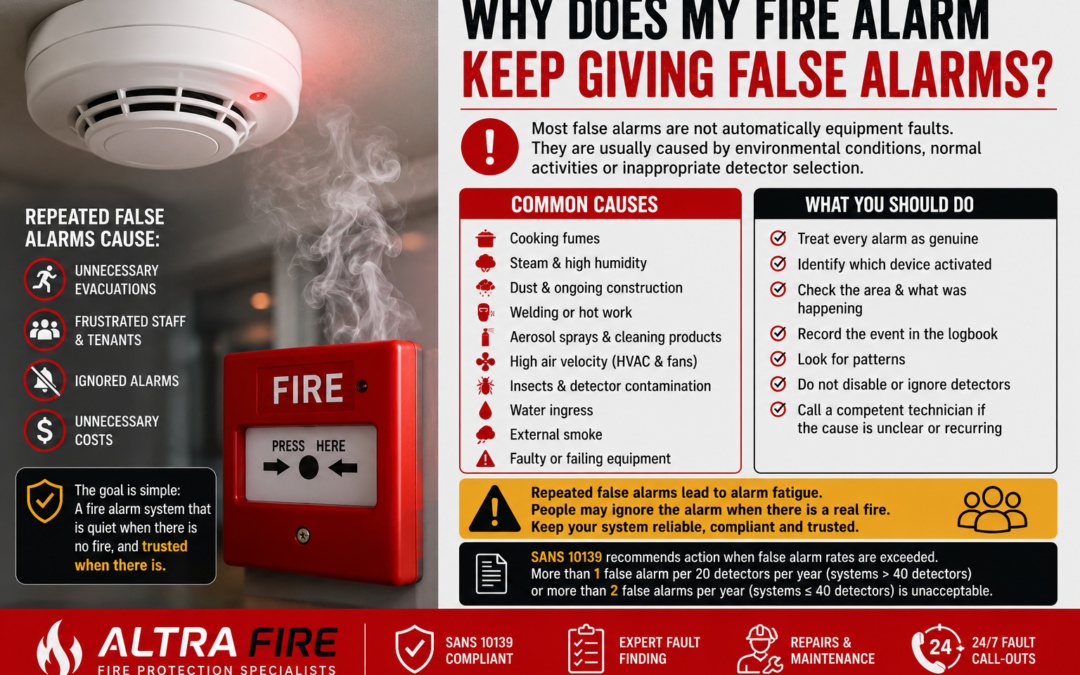
Does your fire alarm keep going off when there is no fire?
Repeated false alarms are more than just annoying.
They interrupt work, disrupt tenants, cause unnecessary evacuations, frustrate security staff and can eventually create something even more dangerous:
people stop trusting the fire alarm.
When occupants have experienced several false alarms, they may begin to assume that the next alarm is also false.
That is exactly what a properly designed and maintained fire detection system should avoid.
The goal is not to make the fire alarm less sensitive. The goal is to make it reliably detect real fires without repeatedly reacting to normal activities in the building.
Why Does a Fire Alarm Give False Alarms?
Many people assume that a false alarm automatically means that the fire alarm equipment is faulty.
That is not always the case.
SANS 10139 specifically notes that most false alarms are caused by a combination of:
- environmental influences;
- fire-like phenomena;
- normal activities in the building;
- inappropriate actions by people;
- accidental damage; and
- in some cases, actual equipment faults.
This means the correct solution depends on understanding what caused the detector to operate.
Not Every False Alarm Is the Same
SANS 10139 separates false alarms into different categories.
Understanding the category helps determine the correct solution.
1. Unwanted Alarm
An unwanted alarm occurs when the fire alarm system responds to something that resembles a fire condition even though there is no actual fire.
Examples include:
- steam;
- dust;
- cooking fumes;
- aerosol sprays;
- welding smoke;
- high humidity; or
- external smoke entering the building.
2. Equipment False Alarm
This occurs when the alarm is caused by a fault or malfunction within the fire detection system itself.
Possible examples include:
- a failing detector;
- damaged electronics;
- water ingress;
- electrical interference;
- damaged cabling;
- faulty modules; or
- other equipment problems.
3. Malicious False Alarm
This occurs when someone deliberately activates the fire alarm while knowing there is no fire.
This commonly involves manual call points in places such as:
- shopping centres;
- schools;
- universities;
- public buildings;
- parking areas; and
- entertainment venues.
4. False Alarm With Good Intent
This happens when someone genuinely believes there is a fire and activates the system, but there is actually no fire.
This should not be confused with malicious activation.
People should never be discouraged from activating a manual call point when they genuinely believe a fire exists.
What Are the Most Common Causes of False Fire Alarms?
SANS 10139 identifies a wide range of environmental and operational conditions that can result in false alarms.
Cooking Fumes
Smoke detectors installed too close to:
- kitchens;
- toasters;
- ovens;
- canteens; or
- cooking areas
can respond to normal cooking fumes.
The problem may not be that the detector is defective.
The problem may be that the detector type or detector location is unsuitable for the environment.
Steam
Steam can cause certain smoke detectors to activate.
This can happen near:
- bathrooms;
- showers;
- commercial kitchens;
- laundries;
- industrial processes; and
- boiler areas.
Dust
Dust is a major false-alarm problem in:
- factories;
- warehouses;
- workshops;
- construction areas;
- woodworking environments;
- mineral processing areas; and
- buildings undergoing renovations.
A smoke detector installed in a dusty environment can gradually become contaminated or may respond directly to airborne particles.
Renovation and Construction Work
Building work is one of the most common causes of temporary false-alarm problems.
Activities such as:
- drilling;
- cutting;
- sanding;
- ceiling installation;
- painting;
- grinding;
- welding; and
- general construction work
can introduce dust, fumes or aerosols into smoke detectors.
The facilities manager should coordinate building work with the fire alarm maintenance company before work begins.
Welding and Hot Work
Welding, cutting and grinding can produce:
- smoke;
- heat;
- sparks;
- airborne particles; and
- other fire-like conditions.
These activities can activate automatic fire detectors even when the work is being carried out under controlled conditions.
Aerosol Sprays
Products such as:
- deodorants;
- cleaning sprays;
- air fresheners;
- insect sprays; and
- other aerosols
can trigger some smoke detectors.
High Humidity
High humidity can influence detector performance, particularly in environments where condensation occurs.
Water Ingress
Water entering:
- detectors;
- junction boxes;
- modules;
- cabling; or
- control equipment
can create faults or unwanted alarm conditions.
Insects
Small insects entering detector chambers can sometimes interfere with optical detection systems.
High Air Velocity
Strong airflow from:
- air-conditioning outlets;
- ventilation systems;
- large fans;
- industrial extraction systems; or
- pressurised air
can affect detector operation and the movement of smoke-like particles.
External Smoke
A fire alarm may activate even though the fire is outside the building.
Examples include:
- veld fires;
- neighbouring property fires;
- bonfires;
- diesel exhaust;
- generator exhaust; or
- industrial smoke entering through ventilation openings.
Could the Wrong Detector Have Been Installed?
Yes.
This is one of the most important questions when a particular detector repeatedly causes alarms.
The fastest detector is not always the most suitable detector for every environment.
Detector selection should consider:
- the likely type of fire;
- the speed of detection required;
- normal environmental conditions;
- dust;
- steam;
- temperature;
- humidity;
- air movement;
- work processes;
- potential sources of false alarms; and
- the fire-safety objective.
SANS 10139 includes detector-selection guidance that specifically considers false-alarm risks such as:
- steam;
- cooking;
- dust;
- smoking;
- aerosol spray; and
- hot work.
If the same detector keeps activating because of normal conditions in the room, simply replacing it with another identical detector may not solve the problem.
Could a Heat Detector Be Better Than a Smoke Detector?
Possibly, depending on the fire risk and system category.
Heat detectors are often less susceptible to smoke-like contaminants such as dust and steam.
However, heat detectors generally provide slower warning than smoke detection for many types of fire.
They should therefore not simply be substituted for smoke detectors to eliminate false alarms without considering the required fire-safety objective.
Could a Multi-Sensor Detector Help?
In some environments, yes.
Multi-sensor detectors analyse more than one fire characteristic, such as combinations of:
- smoke;
- heat; and
- carbon monoxide.
This can allow the system to distinguish more effectively between real fire conditions and environmental influences.
But multi-sensor technology is not a universal solution.
The detector must still be suitable for the environment and the expected fire.
Is the Detector Dirty?
Detector contamination is another common cause of repeated alarms or pre-alarm conditions.
Over time, smoke detector chambers can accumulate:
- dust;
- dirt;
- industrial contamination;
- insects; or
- other airborne material.
Some addressable systems monitor detector contamination and may provide maintenance or pre-alarm indications before the detector reaches an alarm threshold.
A contaminated detector should be inspected and dealt with according to the manufacturer’s maintenance procedures.
Why Does the Same Detector Keep Going Into Alarm?
This is one of the most useful clues in false-alarm investigation.
If the same detector or detector location repeatedly causes alarms, possible explanations include:
- the wrong detector type;
- poor detector positioning;
- steam or fumes reaching that location;
- air-conditioning airflow;
- dust contamination;
- water ingress;
- a faulty detector;
- insects;
- process-related smoke;
- electrical interference; or
- a local environmental condition.
The history of the alarms should be studied before simply replacing equipment.
What Does SANS 10139 Say About Repeated False Alarms?
SANS 10139 recognises that completely eliminating every false alarm is unrealistic, particularly in large systems.
However, repeated false alarms should not simply be accepted as normal.
The objective is to keep the false-alarm rate as low as reasonably achievable through:
- correct system design;
- suitable detector selection;
- appropriate detector positioning;
- proper maintenance;
- good building management; and
- investigation of recurring alarm causes.
How Many False Alarms Are Too Many?
SANS 10139 provides useful benchmarks.
Systems With More Than 40 Automatic Fire Detectors
For systems with more than 40 automatic detectors, a rate exceeding approximately one false alarm per 20 detectors per year is regarded as unacceptable.
The user should arrange an in-depth investigation if:
- the average false-alarm rate exceeds one per 20 automatic detectors per year; or
- three or more false alarms arise from one manual call point, detector or detector location within a rolling 12-month period.
Systems With 40 Automatic Detectors or Fewer
For systems with 40 detectors or fewer, more than two false alarms in a rolling 12-month period is regarded as unacceptable.
Three or more false alarms should therefore trigger an in-depth investigation.
These figures should not be interpreted as permission to ignore false alarms below the threshold. Every false alarm should still be investigated sufficiently to understand the cause and reduce the chance of recurrence.
When Should the Maintenance Company Investigate False Alarms?
SANS 10139 also provides triggers for preliminary investigation during servicing.
Examples include:
- the false-alarm rate exceeding one alarm per 25 detectors per year;
- 11 or more false alarms since the previous service visit;
- two or more false alarms from the same detector, manual call point or detector location since the previous service visit;
- a persistent identifiable cause of false alarms; or
- more than two unwanted fire alarm signals in the previous 12 months.
The purpose of the investigation is to determine whether changes can reduce the likelihood of further false alarms.
Why the Fire Alarm Logbook Is Critical
If your building has repeated false alarms, the first thing the fire alarm technician should ask for is the system logbook.
The logbook should help answer:
- When did the alarm occur?
- Which detector activated?
- Where was the detector located?
- What was happening in the area?
- Was there cooking, steam, welding or dust?
- Was construction work taking place?
- Was the alarm caused by a manual call point?
- Was there a weather or humidity pattern?
- Was the alarm linked to a particular shift or process?
- Has the same detector activated before?
This can turn random-looking alarms into a clear pattern.
What Should Be Recorded After Every False Alarm?
The responsible person should record as much information as reasonably possible, including:
- date;
- time;
- device or detector address;
- detector location;
- alarm zone;
- activities occurring nearby;
- possible cause;
- whether the fire brigade or alarm receiving centre was notified;
- action taken;
- whether maintenance was called; and
- the final cause if it was established.
If the cause cannot be identified, record it as unknown.
Do not automatically record every unexplained alarm as an equipment fault.
Why Does the Logbook Matter So Much?
Imagine a detector activates:
- every Monday morning;
- at approximately 06:30;
- in the warehouse receiving area.
Without a logbook, these incidents may look unrelated.
With proper records, the facilities manager may discover that:
the alarm occurs every time the cleaning contractor uses compressed air to clean the area.
That is far easier to solve than repeatedly replacing detectors.
Should We Disable the Detector That Keeps Causing Alarms?
This is one of the most dangerous responses to repeated false alarms.
A facilities manager may eventually say:
“That detector keeps causing trouble. Just disable it.”
Doing this can leave part of the building without the automatic detection that the fire alarm system was designed to provide.
Disabling a detector should therefore not be used as a permanent solution to a false-alarm problem.
The cause should be identified and corrected.
Can We Reduce the Detector Sensitivity?
Some addressable fire detection systems allow detector sensitivity or response characteristics to be adjusted.
However, reducing sensitivity simply to stop nuisance alarms can compromise the system’s ability to detect a genuine fire.
Any changes to detector sensitivity should be based on:
- the fire risk;
- system category;
- manufacturer requirements;
- the detector’s approved operating modes; and
- the original design objective.
Any relevant changes should also be properly documented.
Can We Use a Delay Before the Building Evacuates?
Some fire alarm systems use investigation periods, staged alarms or other cause-and-effect arrangements.
These can sometimes reduce unnecessary evacuation or automatic fire brigade calls.
But alarm delays should never be introduced simply because the system gives too many false alarms.
The building’s evacuation strategy, system category, fire risk and approved design must be considered.
Can Coincidence Detection Reduce False Alarms?
In certain applications, requiring two independent detection signals before activating a specific output can reduce the consequences of a single unwanted detector activation.
This is often referred to as coincidence detection.
However, coincidence logic is not a substitute for fixing a badly selected or badly located detector.
The primary objective must still be reliable fire detection.
Do False Alarms Mean the Fire Alarm System Needs to Be Replaced?
Not necessarily.
Many false-alarm problems can be resolved by:
- cleaning detectors;
- replacing a defective detector;
- changing detector type;
- relocating detectors;
- adjusting HVAC airflow;
- improving building procedures;
- controlling dust-producing work;
- improving detector protection during renovations;
- changing manual call point protection; or
- correcting programming or cause-and-effect arrangements.
However, system replacement may become appropriate where false alarms form part of a wider problem involving:
- obsolete detectors;
- ageing panels;
- poor original design;
- inappropriate detector technology;
- multiple system faults;
- unavailable spare parts;
- undocumented alterations; or
- a building that has changed significantly since the system was installed.
What If False Alarms Started After the Building Layout Changed?
This is an important clue.
Changes such as:
- new partitions;
- new kitchens;
- new machinery;
- new HVAC systems;
- changes in warehouse storage;
- tenant fit-outs;
- new production processes; or
- changes in occupancy
can change the environment in which detectors operate.
A detector that worked correctly for ten years may suddenly become unsuitable because the building around it has changed.
Can Air Conditioning Cause False Alarms?
Yes.
High air velocity or altered air movement can affect detector performance.
Air-conditioning systems can also move:
- dust;
- steam;
- smoke;
- aerosols; and
- other particles
towards detectors that would not otherwise be exposed to them.
The relationship between detector location and air-conditioning outlets should therefore be considered during investigation.
Can Cleaning Contractors Cause False Alarms?
Yes.
Common cleaning-related causes include:
- aerosol cleaning products;
- steam cleaning;
- dusting;
- compressed air;
- high-pressure cleaning;
- chemical sprays; and
- accidental damage to manual call points.
Facilities managers should ensure cleaning contractors understand that automatic fire detectors can respond to some of these activities.
Can a Smoke Detector Be Too Close to a Kitchen?
Yes.
If normal cooking fumes regularly reach a smoke detector, the installation needs to be assessed.
The solution might involve:
- detector relocation;
- a different detector technology;
- changes to extraction or ventilation;
- better separation between areas; or
- another engineered solution.
The correct answer depends on the required level of fire protection.
What If a Manual Call Point Keeps Being Activated?
Repeated manual call point activations can result from:
- malicious operation;
- accidental impact;
- poor location;
- people mistaking the device for a door-release button; or
- poor signage.
Possible solutions can include improved signage, protective covers or other suitable measures, depending on the application.
What Should a Facilities Manager Do After a False Alarm?
- Treat every alarm as genuine until proven otherwise.
- Follow the building’s fire procedure.
- Identify which device initiated the alarm.
- Inspect the area.
- Determine what activity was taking place nearby.
- Record the incident in the fire alarm logbook.
- Do not simply blame the detector without evidence.
- Look for repeated patterns.
- Call the maintenance company when the cause is unclear or repeated.
- Make sure corrective action addresses the root cause.
What Should You Not Do?
- Do not tell occupants to ignore future alarms.
- Do not permanently disable troublesome detectors.
- Do not switch the fire alarm panel off.
- Do not remove smoke detectors during normal operation.
- Do not keep resetting the system without recording the cause.
- Do not repeatedly replace the same detector without investigating the environment.
- Do not assume every false alarm is caused by faulty equipment.
- Do not change detector sensitivity without understanding the fire-safety consequences.
Why Repeated False Alarms Are Dangerous
The biggest danger may not be the unnecessary evacuation.
It is alarm fatigue.
If staff hear the fire alarm frequently and nothing ever happens, they begin to treat it as background noise.
You start hearing comments such as:
“Don’t worry, it does this all the time.”
That is a serious fire-safety problem.
The purpose of the fire alarm system is to create an immediate response when a genuine fire occurs.
A system that occupants no longer trust has lost part of its effectiveness, even if every detector is technically operating.
The Dream Outcome: A Fire Alarm People Trust
A well-designed and maintained fire alarm system should:
- detect genuine fires quickly;
- minimise false alarms;
- provide clear information about where the alarm originated;
- remain suitable for the environment;
- be properly maintained;
- have an accurate logbook;
- be understood by responsible personnel; and
- be trusted by the people who depend on it.
That is the real objective.
Not a system that never makes noise — a system that makes noise when it matters.
False Alarm Investigation Checklist
- Which detector or call point initiated the alarm?
- Has the same device activated before?
- What time did the alarm occur?
- What activity was taking place nearby?
- Was there cooking?
- Was there steam?
- Was there dust?
- Was construction work taking place?
- Was there welding or hot work?
- Were aerosol products being used?
- Was an HVAC system operating?
- Was there unusual humidity?
- Was there water ingress?
- Was smoke entering from outside?
- Is the detector contaminated?
- Is the detector type suitable for the environment?
- Is the detector correctly positioned?
- Has the building use changed?
- Is the event recorded in the logbook?
- Is there a recurring pattern?
Frequently Asked Questions
Why does my fire alarm keep going off when there is no fire?
Common causes include dust, steam, cooking fumes, aerosols, insects, hot work, high humidity, water ingress, external smoke, inappropriate detector selection or equipment faults.
Does a false alarm mean the detector is faulty?
No. Many false alarms are caused by environmental conditions rather than equipment failure. The cause should be investigated before the detector is replaced.
Can dust trigger a smoke detector?
Yes. Dust can enter or contaminate smoke detectors and can result in unwanted alarms, particularly in workshops, factories, warehouses and construction areas.
Can steam activate a smoke detector?
Yes. Certain smoke detection technologies can respond to steam, which is why detector selection and positioning are important near bathrooms, kitchens and industrial steam processes.
How many false alarms are acceptable?
SANS 10139 provides investigation thresholds based on the number of automatic detectors in the system. Repeated false alarms should never simply be accepted as normal, even when the numerical threshold has not yet been exceeded.
Can I disable a detector that keeps causing false alarms?
Permanent disablement is not an appropriate solution because it can leave the area without the intended automatic fire detection. The underlying cause should be identified and corrected.
Can the detector sensitivity be reduced?
Some systems allow sensitivity changes, but these changes should only be made as part of a proper fire detection design decision. Reducing sensitivity can delay genuine fire detection.
Should every false alarm be written in the logbook?
Yes. Recording the detector, location, time, suspected cause and circumstances helps identify patterns and is important for effective investigation.
Why is the same detector always causing alarms?
The detector may be unsuitable for the environment, poorly positioned, contaminated, affected by airflow, exposed to steam or dust, or defective. Repeated alarms from the same location should be investigated.
Do repeated false alarms mean I need a new system?
Not automatically. Many false-alarm problems can be corrected through maintenance, detector replacement, detector relocation or changes to the building environment. Replacement may become appropriate where the problem forms part of wider system deterioration or poor design.
Does Your Fire Alarm Keep Giving False Alarms?
Altra Fire provides fault finding, false-alarm investigation, servicing and compliance assessment of commercial and industrial fire detection systems.
We can investigate:
- repeated smoke detector activations;
- detector contamination;
- incorrect detector selection;
- dust and steam-related alarms;
- HVAC-related problems;
- water ingress;
- manual call point activations;
- environmental false alarms;
- equipment faults;
- system programming;
- detector positioning; and
- whether the existing system remains suitable for the building.
Stop Resetting the Panel — Find Out Why It Keeps Going Into Alarm
If your fire alarm keeps activating when there is no fire, the answer is not to disable detectors or teach staff to ignore the alarm.
Altra Fire can investigate the alarm history, detector locations, environmental conditions and system design to identify the real cause.
Complete the form below and tell us how often the false alarms are occurring and which area of the building is affected.
Related Altra Fire Guides
-
Fire Alarm Panel Showing Open Circuit: What Does It Mean?
-
Fire Alarm Panel Showing Supply Fault: What Does It Mean?
-
Fire Detection Systems – Design, Installation, Commissioning and Maintenance
-
Commercial Fire Detection Systems in South Africa: A Practical 2026 Buying Guide
-
Is Your Fire Alarm System SANS 10139 Compliant? 6 Questions to Ask
-
Fire Detection System Service and Maintenance Requirements
Technical note: False alarms can arise from environmental conditions, human activity, equipment faults, detector selection, system design or combinations of these factors. This article provides general guidance based on SANS 10139:2021. Repeated false alarms should be investigated by a competent person familiar with the fire detection system, its design objectives, the building environment and the equipment manufacturer’s requirements.