
Your fire alarm has another fault. The technician can repair it — but this is the third or fourth repair in the last year.
At some point, every facilities manager responsible for an ageing fire detection system asks the same question:
“Should we repair this system again, or is it time to replace it?”
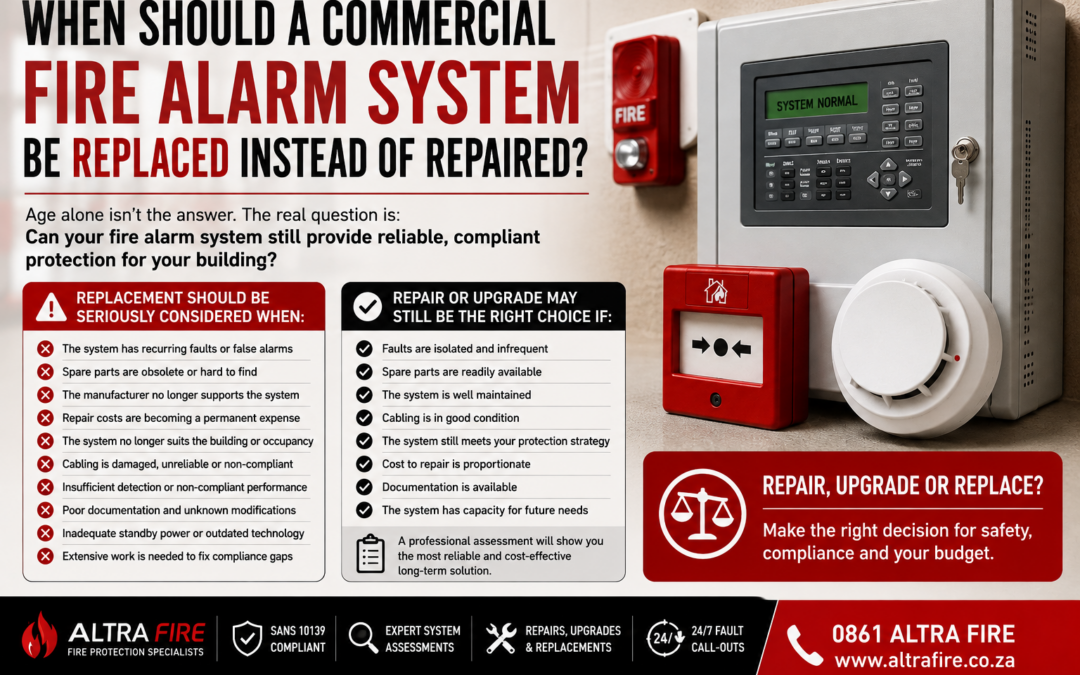
There is no universal age at which a commercial fire alarm system automatically has to be replaced.
A 15-year-old system that is properly designed, supported by the manufacturer, well maintained and operating reliably could potentially remain serviceable.
Another system of similar age may have:
- obsolete equipment;
- unavailable spare parts;
- recurring wiring faults;
- inadequate detection;
- poor documentation;
- unreliable standby batteries;
- numerous undocumented alterations; or
- no longer be suitable for the way the building is being used.
In that situation, continuing to repair individual faults may no longer be the best decision.
The right question is not “How old is the fire alarm?” It is “Can this system still provide reliable, maintainable and appropriate fire protection for this building?”
Does SANS 10139 Say How Old a Fire Alarm System May Be?
No.
SANS 10139 does not prescribe a universal expiry date after which a fire detection system must automatically be replaced.
The standard deals with the:
- design;
- installation;
- commissioning;
- maintenance;
- modification; and
- ongoing operation
of fire detection and alarm systems in non-domestic premises.
Older equipment therefore does not automatically mean that the whole installation must be replaced.
However, age often brings other problems that can eventually make replacement the more sensible option.
When Is Repair Usually the Better Option?
Repair can make good sense where:
- the fault is isolated;
- the system is otherwise reliable;
- replacement parts remain readily available;
- the manufacturer still supports the equipment;
- the existing cabling is in good condition;
- the system remains suitable for the building;
- the system can still achieve its intended fire detection category;
- documentation is available;
- the cost of repair is proportionate; and
- there is no pattern of repeated failures.
For example, one failed detector does not normally justify replacing an entire addressable fire detection system.
Likewise, one damaged cable section or faulty battery charger can often be repaired economically.
When Should Replacement Be Seriously Considered?
Replacement becomes more attractive when several problems begin appearing together.
1. The Fire Alarm Keeps Developing New Faults
A single fault can happen on any system.
Repeated unrelated faults are more concerning.
You may experience:
- open circuits;
- earth faults;
- short circuits;
- power supply faults;
- communication faults;
- detector failures;
- loop faults; or
- intermittent faults.
If the maintenance company is repeatedly repairing different parts of the system, the problem may no longer be one defective component.
It may indicate deterioration across the installation.
Recurring Faults Are a Pattern — Not Separate Events
This is why the system logbook is so important.
Consider a system where the following happened during one year:
- February — loop open circuit;
- April — battery failure;
- June — intermittent earth fault;
- August — three detectors replaced;
- October — another cable fault;
- December — panel communication fault.
Individually, every fault may be repairable.
Collectively, they tell a different story.
The facilities manager should now be asking whether continuing repairs represents good value.
2. Spare Parts Are Becoming Difficult to Find
This is one of the strongest reasons to start planning replacement.
Fire alarm manufacturers periodically discontinue:
- control panels;
- loop cards;
- detectors;
- modules;
- display boards;
- power supplies; and
- other components.
Once original replacement parts become unavailable, maintaining the system becomes increasingly difficult.
You may eventually find that a relatively simple component failure cannot be repaired because the correct part no longer exists.
If your fire alarm system depends on finding second-hand or salvaged parts every time something fails, you should already be planning its replacement.
3. The Manufacturer No Longer Supports the System
Availability of hardware is only part of the problem.
Modern addressable systems can also depend on:
- programming software;
- firmware;
- manufacturer configuration tools;
- special programming interfaces;
- technical support; and
- trained technicians familiar with the product.
If the equipment is no longer supported, making future modifications can become progressively more difficult.
4. Repair Costs Are Becoming a Permanent Budget Item
Facilities managers should look beyond the cost of the latest repair.
Consider the total amount spent over the previous 12 to 24 months on:
- call-outs;
- replacement detectors;
- cable repairs;
- batteries;
- power supplies;
- loop cards;
- programming;
- temporary repairs; and
- repeat fault investigations.
Then compare that with the cost and expected service life of a properly designed replacement system.
A cheap repair repeated ten times may become more expensive than replacement.
5. The System Has Persistent False Alarms
Repeated false alarms can sometimes be solved by:
- cleaning detectors;
- changing detector types;
- relocating detectors;
- changing system programming;
- improving maintenance; or
- addressing environmental conditions.
However, if the system uses old detector technology and continues producing unwanted alarms despite appropriate corrective action, an upgrade may be justified.
Read more:
Why Does My Fire Alarm Keep Giving False Alarms?
6. The Existing Detection No Longer Matches the Building
Buildings change.
Fire alarm systems often do not.
Over the years a building may have:
- new offices added;
- partitions installed;
- warehouses re-racked;
- storage heights increased;
- new tenants;
- new kitchens;
- additional machinery;
- new mezzanine floors;
- new ceilings;
- different production processes; or
- a completely different occupancy.
SANS 10139 recognises that changes in the use, layout or construction of a building can affect the effectiveness of the fire detection system.
The correct solution might be modification.
But if the changes are extensive, replacing or significantly redesigning the system may make more sense than continually adapting an installation that was designed for a different building layout.
7. The System Cannot Provide the Required Detection Coverage
One of the major issues that should be identified during an assessment of an existing system is inadequate fire detection for the category the system is intended to achieve.
This can happen when:
- rooms were added without detectors;
- roof voids were never protected where protection is required;
- partitions changed detector coverage;
- detector spacing is inappropriate;
- high-rack storage was added;
- new risk areas were introduced; or
- devices have simply been removed over the years.
If correcting these issues requires extensive new cabling and equipment, replacement may be commercially preferable.
8. The Fire Alarm Cabling Is in Poor Condition
A control panel can be replaced relatively easily.
The hidden cabling throughout a building can be much more significant.
Warning signs include:
- repeated open circuits;
- recurring earth faults;
- damaged insulation;
- poor joints;
- water-damaged cables;
- unsupported cabling;
- mechanically damaged routes;
- incorrect cable types; or
- years of undocumented modifications.
If the cable infrastructure itself is unreliable, replacing only the panel may simply connect new equipment to an old problem.
Open-Circuit Faults
If your system currently has an open circuit, read:
Fire Alarm Panel Showing Open Circuit: What Does It Mean?
Earth Faults
Repeated earth faults can indicate damaged cabling, moisture or other electrical integrity problems.
Read:
Fire Alarm Panel Showing Earth Fault: What Does It Mean?
9. The Standby Power System Can No Longer Meet the Required Performance
A fire detection system must continue operating when normal mains power fails.
If the system has:
- undersized batteries;
- repeated battery failures;
- a defective charger;
- additional equipment that was added without recalculating standby capacity; or
- obsolete power supply equipment,
the standby power arrangement should be assessed.
A battery problem alone usually does not justify replacing the entire system.
But if it forms part of a wider pattern of ageing and unsupported equipment, it adds weight to the replacement decision.
Read more:
Fire Alarm Panel Showing Supply Fault: What Does It Mean?
10. Nobody Knows What Has Been Modified Over the Years
This is extremely common in older buildings.
One contractor adds detectors.
Another moves devices during a renovation.
A tenant installs new partitions.
An electrician moves cables.
Another fire company replaces the panel.
Twenty years later, nobody can confidently explain how the system was originally designed or what has been changed.
Warning signs include missing:
- as-installed drawings;
- device schedules;
- cause-and-effect documentation;
- design information;
- system category information;
- commissioning records;
- modification records; and
- logbooks.
Does Missing Documentation Automatically Mean the System Must Be Replaced?
No.
Missing documentation does not automatically mean replacement.
It means the existing installation needs to be properly assessed.
The current configuration can potentially be surveyed and documented, after which the system’s condition and suitability can be evaluated.
11. The Existing Panel Does Not Have Enough Capacity for Further Expansion
A building may need additional:
- detectors;
- manual call points;
- sounders;
- interfaces;
- loops;
- zones; or
- networked panels.
If the existing panel has reached its technical capacity, expanding the current system may not be practical.
Replacement with a scalable platform can then provide a better long-term solution.
12. The Existing System Cannot Support Required Interfaces
Modern fire detection systems increasingly interface with other building systems such as:
- air-conditioning shutdown;
- fire dampers;
- smoke control systems;
- lifts;
- access control;
- gas suppression;
- fire pumps;
- generator controls;
- alarm receiving centres; and
- building management systems.
An older system may not have the inputs, outputs, programming capability or reliability needed for the required cause-and-effect strategy.
13. The System Has Major Compliance Gaps
SANS 10139 identifies several issues that should be regarded as major areas of non-compliance during a special inspection of an existing system.
These include problems relating to:
- insufficient manual call points;
- inadequate automatic fire detection;
- insufficient alarm sound levels;
- inadequate standby power;
- unsuitable fire alarm cabling;
- inadequate circuit monitoring;
- electrical safety;
- unacceptable false alarm performance;
- building changes affecting system effectiveness; and
- absence of a suitable zone plan.
One defect does not automatically justify replacement.
But when several major deficiencies exist simultaneously, correcting them individually can effectively become a complete system rebuild.
Repair, Upgrade or Replace?
There are actually three possible decisions — not two.
Option 1: Repair
Repair is appropriate when the system remains fundamentally suitable and there is an isolated fault.
Option 2: Upgrade or Modify
An upgrade may be suitable when the main system remains serviceable but requires changes such as:
- additional detectors;
- different detector types;
- additional alarm devices;
- new interfaces;
- updated cause-and-effect;
- new loop cards;
- replacement power supplies; or
- extensions to new areas.
SANS 10139 recognises modifications for changes in occupancy, false alarms and changes to building layout.
Because modification involves an element of redesign, it should be undertaken with appropriate design competence.
Option 3: Replace
Replacement becomes more appropriate where the existing system is fundamentally:
- unreliable;
- unsupported;
- unsuitable;
- too restricted for future needs;
- extensively non-compliant; or
- uneconomical to maintain.
Don’t Replace a System Just Because Someone Wants to Sell You a New One
Facilities managers should be cautious of a contractor who looks at an older fire alarm panel and immediately says:
“This system is old. You need a complete new system.”
The correct starting point is an assessment.
The contractor should be able to explain:
- what is wrong;
- what remains serviceable;
- what parts are obsolete;
- what cannot be repaired;
- what compliance gaps exist;
- whether existing cabling can be retained;
- what modifications are possible;
- what risks remain if repairs continue; and
- why replacement provides a better outcome.
Likewise, Don’t Keep Repairing a System Simply Because It Can Still Be Repaired
Technically repairable does not always mean economically sensible.
If each month produces another problem, management needs to consider the total cost of ownership.
This includes more than parts and labour.
Also consider:
- business disruption;
- security staff time;
- false evacuations;
- emergency call-out costs;
- difficulty finding spares;
- temporary system impairments;
- tenant complaints;
- management time;
- future expansion requirements; and
- the risk of a major failure.
Can the Existing Fire Alarm Cabling Be Reused?
Possibly.
Replacing the fire alarm control equipment does not automatically mean every metre of cable must be replaced.
Existing cabling needs to be assessed for factors such as:
- cable type;
- fire resistance;
- condition;
- routing;
- mechanical protection;
- circuit configuration;
- insulation integrity;
- compatibility with the proposed system; and
- compliance with the new design.
Retaining suitable existing cabling can significantly reduce replacement cost.
Retaining defective or unsuitable cabling can also transfer old problems into the new system.
Can We Replace the Panel and Keep the Existing Detectors?
Sometimes, but compatibility must be established.
In addressable systems, detectors and modules often communicate using manufacturer-specific protocols.
A new panel may therefore not be compatible with old field devices.
The complete system architecture should be evaluated rather than assuming components can be mixed.
Can We Replace the System in Stages?
Yes, in many larger commercial or industrial buildings, phased replacement can be considered.
For example:
- one building at a time;
- one loop at a time;
- one floor at a time;
- one tenant area at a time; or
- one section of a warehouse at a time.
However, a phased replacement requires careful planning.
The fire strategy must remain effective throughout the changeover and the interaction between the old and new systems must be understood.
What Should Be Checked Before Making the Decision?
A proper existing-system assessment should consider at least:
- system manufacturer and model;
- age of equipment;
- manufacturer support status;
- availability of spare parts;
- fault history;
- false alarm history;
- detector condition;
- panel condition;
- loop and zone integrity;
- cable condition;
- standby power;
- alarm audibility;
- detector coverage;
- manual call point provision;
- building layout;
- current occupancy;
- system category;
- interfaces;
- maintenance records;
- system documentation; and
- future expansion requirements.
A Simple Repair vs Replace Decision
| Condition | Repair / Upgrade More Likely | Replacement More Likely |
|---|---|---|
| Fault history | Occasional isolated fault | Repeated faults across system |
| Spare parts | Readily available | Obsolete or difficult to source |
| Manufacturer support | Fully supported | Product discontinued |
| Cabling | Good condition and suitable | Repeated faults or unsuitable installation |
| Building changes | Minor alterations | Major layout or occupancy changes |
| System capacity | Enough capacity for expansion | No practical expansion capacity |
| Repair costs | Low and infrequent | High and recurring |
| System suitability | Still meets intended protection strategy | Fundamentally unsuitable for current building |
The Question Management Should Ask
Instead of asking:
“Can you repair it?”
ask:
“After this repair, will we have a reliable, maintainable fire detection system that remains suitable for the building?”
Those are very different questions.
Frequently Asked Questions
How old can a commercial fire alarm system be?
There is no universal replacement age prescribed by SANS 10139. Condition, reliability, manufacturer support, availability of spares, system suitability and maintenance history are more important than age alone.
Does an old fire alarm automatically need replacing?
No. An older system may remain serviceable if it is properly maintained, supported and suitable for the building.
When should I replace my fire alarm panel?
Replacement should be considered when the panel is obsolete, repeatedly failing, unsupported, cannot be expanded, cannot support the required system functions or is becoming uneconomical to maintain.
Can a fire alarm system be upgraded instead of replaced?
Often yes. The answer depends on equipment condition, spare-parts availability, system capacity, cabling, required protection, building changes and the extent of corrective work required.
Can I reuse existing fire alarm cables when installing a new system?
Possibly. The cables need to be inspected and assessed for condition, fire performance, routing, mechanical protection and compatibility with the new system design.
Do repeated fire alarm faults mean I need a new system?
Not automatically, but repeated unrelated faults can indicate wider deterioration. The overall fault history should be reviewed rather than treating every repair as an isolated incident.
Do recurring false alarms justify system replacement?
Not automatically. The root cause should first be investigated. Detector selection, positioning, contamination, environmental conditions and programming may be correctable without replacing the complete system.
Does missing fire alarm documentation mean the system must be replaced?
No. Missing documentation should trigger an assessment of the current installation. The existing system may be capable of being surveyed, documented and corrected.
Who should decide whether the system should be repaired or replaced?
The decision should be based on an assessment by competent persons who understand fire detection design, installation, maintenance, the existing equipment and the building’s fire protection requirements.
Before Spending More Money on Repairs, Assess the Whole System
If your fire alarm has developed one isolated fault, repairing it may be the obvious answer.
If the system has:
- recurring faults;
- obsolete equipment;
- unavailable spares;
- poor cabling;
- repeated false alarms;
- major building changes;
- missing documentation; and
- increasing maintenance costs,
another individual repair may simply postpone the bigger decision.
Repair It, Upgrade It or Replace It?
Altra Fire can assess the existing fire detection system before you commit to another repair or a complete replacement.
We can identify:
- what is still serviceable;
- what needs repair;
- what equipment is obsolete;
- whether the existing cabling can be retained;
- what compliance gaps exist;
- whether an upgrade is practical; and
- whether full replacement provides the better long-term solution.
Complete the form below and tell us what problems you are currently experiencing with your fire alarm system.
Related Altra Fire Guides
-
Fire Alarm Panel Showing Open Circuit: What Does It Mean?
-
Fire Alarm Panel Showing Supply Fault: What Does It Mean?
-
Fire Alarm Panel Showing Earth Fault: What Does It Mean?
-
Why Does My Fire Alarm Keep Giving False Alarms?
-
Commercial Fire Detection Systems in South Africa: A Practical 2026 Buying Guide
-
Is Your Fire Alarm System SANS 10139 Compliant? 6 Questions to Ask
-
Fire Detection Systems
-
Fire Detection System Service and Maintenance Requirements
Technical note: SANS 10139 does not prescribe a universal age at which an existing fire detection system must be replaced. Repair, modification, upgrade or replacement should be determined from the condition and suitability of the installed system, its maintenance and fault history, manufacturer support, system documentation, the current building layout and occupancy, and the extent of corrective work required.