
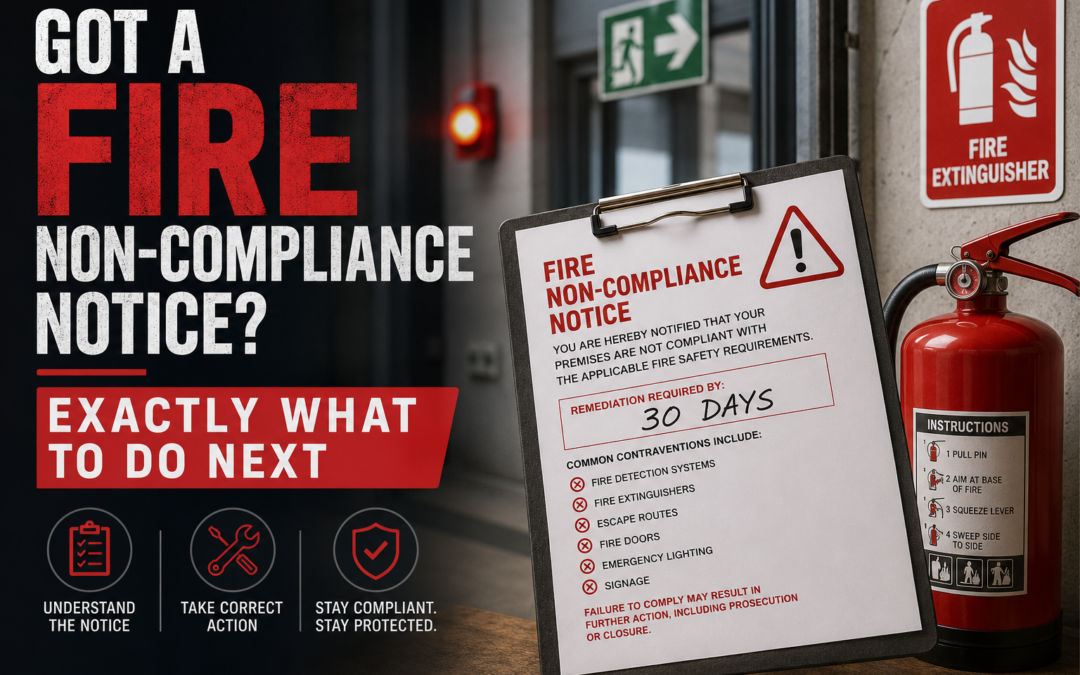
Direct answer: A fire non-compliance notice means a municipal fire department, the Department of Employment and Labour, or your insurer has identified that your building or workplace fails to meet fire safety requirements under the Fire Brigade Services Act 99 of 1987, the OHS Act, or SANS 10400-T. You'll be given a written remediation period (often 14–30 days, but it varies by authority and risk level). Acting immediately — not contesting the notice — is almost always the fastest route back to compliant.
What Exactly Is a Fire Non-Compliance Notice?
A fire non-compliance notice is a formal written instruction from an authority with legal power to enforce fire safety standards, stating that your premises has failed an inspection or audit and requires specific corrective action within a stated period. It is not a fine on its own, though failure to act within the period can lead to further legal consequences, including prosecution, closure instructions, or insurance complications.In South Africa, three different bodies can issue a notice that affects your fire compliance status, and each has a different legal basis and scope. Confusing them is one of the most common mistakes building owners make, and it often delays the correct response.
Who Can Issue One, and What Authority Do They Have?
The municipal fire department is the primary fire compliance authority in South Africa, operating under the Fire Brigade Services Act 99 of 1987. A fire chief or authorised fire officer can inspect a building, identify contraventions of the National Building Regulations (via SANS 10400-T), and issue a written notice requiring remedial work within a specified timeframe. In serious cases involving immediate danger to life, they have the power to instruct evacuation or restrict occupancy.The Department of Employment and Labour operates under the OHS Act 85 of 1993, which governs general workplace safety — not building fire design. A DOL inspector can issue a notice relating to workplace fire risk factors such as inadequate fire extinguisher provision, blocked escape routes, untrained fire wardens, or absent emergency procedures. This is a narrower scope than the fire department's authority over the building itself.Your insurer is not a statutory authority and cannot issue a legal compliance notice, but a risk survey finding non-compliance can trigger a formal requirement in your policy terms, with a deadline to remediate or face reduced cover, increased premiums, or claim repudiation. This is a contractual matter, not a legal one — but the financial consequences can be just as serious.
| Issuing Body | Legal Basis | Typical Scope | Power If Ignored |
|---|---|---|---|
| Municipal Fire Department | Fire Brigade Services Act 99 of 1987 / SANS 10400-T | Building fire protection systems, escape routes, occupancy risk | Prosecution, occupancy restriction, closure instruction |
| Department of Employment and Labour | OHS Act 85 of 1993 | Workplace fire risk: extinguisher provision, training, procedures | Prohibition or contravention notice, prosecution, fines |
| Insurer (risk survey) | Policy terms (contractual, not statutory) | Any condition affecting insured fire risk | Reduced cover, premium increase, claim repudiation |
What Should You Do in the First 48 Hours?
- Read the notice in full and identify the issuing authority. The required response, timeframe, and consequences differ depending on whether it came from the fire department, the DOL, or your insurer.
- Note the exact remediation deadline. Don't assume a standard period — deadlines are set by the inspecting officer based on the severity of the contravention and can range from immediate (for life-safety risks) to 30 days or more for administrative items.
- Do not ignore or dispute the notice without first understanding it. Disputing a notice you don't fully understand wastes time you don't have. If something is factually incorrect, that's worth raising — but most notices reflect genuine, fixable gaps.
- Get a written scope of the required work. Engage a fire compliance provider to assess every item listed on the notice and quote the corrective work, rather than addressing items piecemeal.
- Keep a paper trail. Photograph the non-compliant areas, retain the notice, and log every communication and remediation step with dates. This record matters if you need to demonstrate good-faith action to the authority or your insurer later.
Common mistake: Treating a fire department notice and a DOL notice as interchangeable. A fire department notice usually relates to the building's fixed fire protection systems (detection, suppression, escape routes, fire doors) under SANS 10400-T. A DOL notice usually relates to portable equipment, training, and procedures under the OHS Act. You may need to address both separately, even if they were triggered by the same underlying inspection.
How Long Do You Have to Respond?
There is no single fixed period set in law for every contravention — the timeframe is set by the inspecting officer on the notice itself, in proportion to the risk. As a general pattern:
- Immediate or life-safety risks (blocked escape routes, non-functional detection in occupied buildings) may require same-day or immediate action, sometimes with occupancy restrictions imposed until resolved.
- Significant contraventions (missing or non-serviced fire equipment, non-compliant fire doors, absent escape plans) are commonly given 14–30 days.
- Administrative or documentation gaps (missing service certificates, incomplete fire files) may be given a longer period, particularly if remedial work is already underway.
What Happens If You Don't Respond in Time?
Consequences escalate depending on the issuing authority and the severity of the contravention:
- From the fire department: potential prosecution under the Fire Brigade Services Act and the offences provisions of SANS 10400-T (Regulation T2), occupancy restriction, or in extreme cases a closure instruction until the building is brought into compliance.
- From the DOL: escalation from a contravention notice to a prohibition notice (which can halt specific work activities), and potential prosecution under the OHS Act.
- From your insurer: reduced or voided cover for fire-related losses, and a materially higher risk of claim repudiation if a fire occurs while the noted contravention remains unresolved. This is one of the most common reasons fire insurance claims are rejected in South Africa.
Can You Appeal or Dispute a Notice?
Yes, but appeal routes differ by authority and should not be your default response. A municipal fire department decision can, in certain cases, be taken on appeal to the Review Board as contemplated under the National Building Regulations and Building Standards Act 103 of 1977. A DOL notice can be objected to through the Department's own internal review process. In both cases, an appeal only makes sense where there is a genuine factual or procedural dispute — not as a delay tactic, since the underlying risk (and your legal exposure) remains unresolved while an appeal is pending.In most cases, the faster and lower-risk path is straightforward remediation, supported by a competent fire compliance provider who can document exactly what was done and why it satisfies the relevant standard.
How Do You Get Back to Compliant Quickly?
The fastest path is a single, structured assessment against the specific items listed on the notice, rather than a general compliance review. A competent provider should:
- Map every item on the notice against the relevant standard (SANS 10400-T, SANS 1475, SANS 10139, SANS 23601, SANS 1253, or others depending on the contravention).
- Quote and schedule the corrective work with a realistic timeline against the notice deadline.
- Issue compliant certification (service certificates, modification certificates, or compliance reports as applicable) for every corrected item.
- Provide a written summary you can submit back to the issuing authority showing remediation is complete.
Frequently Asked Questions
Is a fire non-compliance notice the same as a fine?
No. A notice is an instruction to remediate within a set period. A fine or prosecution is a separate, further step that can follow if you fail to act within that period or ignore the notice entirely.Who is responsible for responding to the notice — the owner or the tenant?
This depends on lease terms and the nature of the contravention. Base-building fire protection systems are typically the owner's responsibility, while workplace-specific items (extinguisher provision, fire wardens, evacuation procedures) often fall to the tenant or employer. See our guide on who is legally responsible for fire compliance for a full breakdown.Can my building be closed down over a non-compliance notice?
Yes, in serious cases involving immediate risk to life, a fire department officer has the authority to restrict occupancy or instruct closure until the risk is resolved. This is reserved for significant contraventions, not minor administrative gaps.Will fixing the problem after a fire still protect my insurance claim?
No. Insurers assess your compliance status at the time of loss. A contravention that existed when the fire occurred can still result in claim repudiation, even if it was later corrected.Do I need a lawyer to respond to a fire non-compliance notice?
Most notices are resolved through straightforward technical remediation, not legal process. Legal advice becomes relevant if you intend to formally dispute the notice, or where prosecution has already been initiated. This article is general guidance, not legal advice.Related reading
This article provides general guidance on fire compliance notices in South Africa and is not legal advice. For matters involving formal disputes, prosecution, or legal liability, consult a qualified attorney. Always verify current requirements with the relevant municipal fire department, the Department of Employment and Labour, or your insurer.