
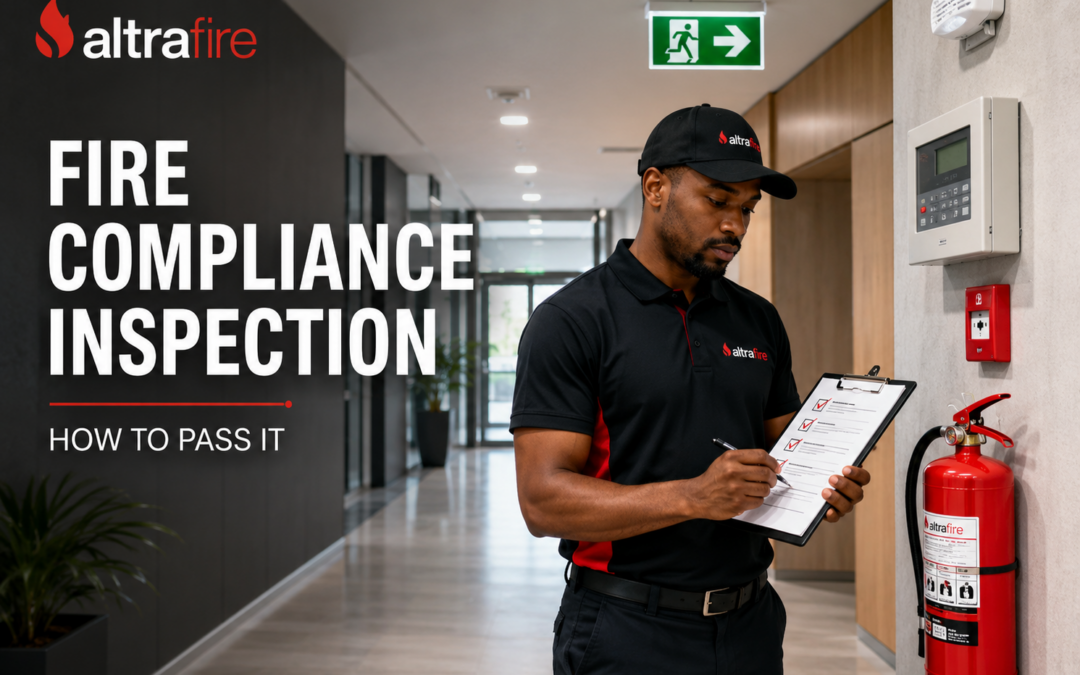
Who inspects fire compliance in South Africa — and why it matters
Many business owners and facilities managers assume there is a single inspection authority for fire compliance. In practice, three parties can scrutinise your fire compliance status — each with different legal powers, different checklists, and different consequences for non-compliance.
- Municipal fire department — the primary fire compliance authority. Inspects buildings under the Fire Brigade Services Act 99 of 1987 and local municipal by-laws, with reference to the National Building Regulations (SANS 10400-T). Issues compliance notices, withholds or withdraws fire compliance certificates, and can order premises closed where there is immediate risk to life or property.
- Insurance companies and loss adjusters — a practical enforcement driver that many businesses underestimate. Insurers conduct risk surveys as a condition of issuing or renewing commercial fire cover. Non-compliance discovered during a survey can trigger requirements to remediate, result in exclusions in your policy, increase your premium, or lead to claim repudiation after a fire. Unlike the fire department, an insurer does not need a court order to act — they simply decline to pay.
- Department of Labour (DOL) — inspects general occupational health and safety compliance under the Occupational Health and Safety Act 85 of 1993 (OHSA). A DOL inspector's mandate is broad workplace safety, not fire compliance specifically. They may note obvious fire safety failures — a missing or discharged extinguisher, a blocked escape route — as part of a general OHS inspection and refer these or include them in a compliance notice. However, specialist fire compliance assessment is conducted by the fire department, not the DOL.
What happens during a municipal fire department inspection?
Municipal fire officers are authorised under the Fire Brigade Services Act 99 of 1987 and local by-laws to enter any building without prior notice, inspect fire protection equipment and systems, and take enforcement action. Fire department inspections are typically triggered by one of the following:
- Routine scheduled inspections — particularly for higher-risk occupancies such as factories, warehouses, hospitals, schools, shopping centres, and places of public assembly.
- An application for a fire compliance certificate, or the renewal cycle for an existing certificate.
- A complaint by an occupant, employee, or member of the public.
- Following a fire incident on the premises.
- A change of use or significant alteration to the building.
What the fire officer checks
The fire officer assesses the building against SANS 10400-T (National Building Regulations Part T: Fire Protection) and applicable municipal by-laws. Their inspection typically covers:
- Fire extinguishers — correct type for the occupancy fire class risk, SABS-approved, correctly positioned, current annual service sticker from a SAQCC Fire-registered company, safety seal intact. Non-SABS-approved units will be flagged for replacement — they cannot be serviced and must be condemned.
- Fire hose reels and hydrants — SABS-approved, operational, hose physically capable of reaching the furthest point in the area served, current service record. See our hose reel and hydrant compliance guide.
- Fire detection and alarm system — panel showing no faults, all detectors and sounders functional, detection category appropriate for the building use per SANS 10139, current commissioning and annual service certificate. See our SANS 10139 categories guide.
- Emergency lighting and exit signage — all emergency luminaires functional, exit signs illuminated and visible, test records current.
- Escape routes — clear of all obstruction, escape doors operational and openable from inside without a key. Under SANS 10400-T Regulation T2(2), obstructing an escape route is a criminal offence for any person.
- Fire doors — self-closing mechanism functional, intumescent seals intact, not wedged open or modified, rating appropriate. See our fire door compliance guide.
- SANS 23601 escape plans — correctly positioned on each floor, current, legible, and compliant with SANS 23601. See our escape plan compliance guide.
- Smoke ventilation systems (AOVs) — where installed, operational and tested. See our AOV compliance guide.
- Gas suppression systems — where installed, current commissioning certificate and service records. See our gas suppression guide.
- Fire compliance certificate — current, available on site. An expired or absent certificate where one is required is itself a compliance failure.
- General housekeeping and fire loading — accumulation of combustible waste, storage blocking sprinkler heads or detectors, or fire loading that was not accounted for in the building's fire protection design.
What happens during an insurance fire risk survey?
Insurance companies — through their own risk surveyors or appointed loss control consultants — conduct fire risk surveys as a standard part of underwriting commercial fire insurance. For most South African businesses, this is the inspection they will encounter most regularly, and the one with the most immediate financial consequences.
A risk survey can be triggered by a new policy application, an annual renewal, a significant change in operations or premises, or following a fire claim. Surveyors are not bound by the same standards as fire officers — they apply their insurer's own underwriting criteria, which are often more detailed than the minimum statutory requirements.
What an insurance surveyor typically assesses
- Fire equipment type, quantity, and currency of service — surveyors check whether extinguishers, hose reels, and suppression systems are appropriate for the risk and properly maintained. Overdue service is a common finding that can result in a survey requirement or policy condition.
- Fire detection and alarm system — whether a system is installed, its category, whether it is monitored (connected to an alarm receiving centre), and whether it is current on service. Many insurers require monitored detection for commercial premises above a certain size or value threshold.
- Sprinkler systems — for higher-value premises or high fire-loading occupancies, surveyors assess sprinkler coverage, last inspection date, and water supply adequacy.
- Compartmentation and fire spread control — fire doors, fire-rated walls and floors, and the general ability of the building to contain a fire and limit spread to adjacent sections or buildings.
- Hot work controls — whether welding, cutting, or other hot work is conducted on premises, and whether a formal permit-to-work system is in place.
- Housekeeping and waste management — accumulation of combustible material, waste storage, and general fire loading relative to the building's protection.
- Business continuity and fire action plans — whether staff know what to do in a fire, and whether there are documented procedures.
- Fire compliance certificate — surveyors will check whether the premises hold a current fire compliance certificate. Absence of a certificate where one is required will typically be noted as a survey requirement.
What about DOL and OHSA fire safety obligations?
The Department of Labour inspects workplaces under the Occupational Health and Safety Act 85 of 1993. A DOL inspector's mandate covers general workplace safety broadly — not fire compliance specifically. However, OHSA imposes its own set of fire-related obligations on employers that sit alongside (and do not replace) the building compliance obligations inspected by the fire department.
The OHSA obligations that fall on the employer — and that a DOL inspector will check as part of a general OHS inspection — include:
- Documented fire risk assessment — a written assessment of fire risks in the workplace, identifying hazards and the control measures in place. This must be current and available on site.
- Section 16.2 appointee — a named person appointed in writing to carry out OHSA duties on behalf of the employer, including oversight of fire safety management. See our post on who carries fire compliance responsibility.
- Fire warden appointments — written appointment letters for all fire wardens/marshals, in numbers appropriate for the size and occupancy of the workplace. See our guide on how many fire wardens your workplace legally needs.
- Accredited fire warden training — proof that appointed wardens have completed HWSETA/QCTO-accredited fire warden training. For accredited training, Altrafire's sister company Altramed offers HWSETA/QCTO-accredited fire warden and firefighting training.
- Fire drill records — documented records of drills conducted, including date, participants, evacuation time, and observations.
- Emergency evacuation procedure — a documented and communicated procedure for how the building will be evacuated in a fire.
- OHS / fire safety file — all of the above consolidated and immediately producible on request.
These obligations are the employer's responsibility regardless of whether the building's fire compliance certificate is current. A tenant in a fully fire-compliant building can still receive a DOL compliance notice if their internal OHSA fire safety management is not in order.
Who inspects what — quick reference
| Factor | Municipal fire department | Insurance surveyor | Department of Labour (DOL) |
|---|---|---|---|
| Legal authority | Fire Brigade Services Act 99 of 1987; NBR Act 103 of 1977; Municipal by-laws | Policy contract / insurer underwriting requirements | Occupational Health and Safety Act 85 of 1993 |
| Primary focus | Building fire protection systems, equipment, escape routes, fire compliance certificate | Overall fire risk profile of the insured premises relative to the cover provided | General workplace safety management — fire-related OHSA obligations included |
| Duty-holder | Building owner / body corporate | Policyholder (typically owner or occupier) | Employer / tenant |
| Can arrive unannounced? | Yes | Usually by appointment; rights defined in policy | Yes |
| Key items checked | Equipment service records, fire compliance certificate, escape routes, fire doors, detection system, escape plans | Equipment, detection, sprinklers, compartmentation, hot work controls, housekeeping, fire certificate | Risk assessment, Section 16.2 appointment, warden appointments and training, drill records, OHS file |
| Enforcement consequence | Compliance notice; closure order; criminal prosecution under NBR Act | Survey requirement; premium increase; policy exclusion; claim repudiation | Compliance notice; prohibition notice (stop work); criminal prosecution under OHSA |
| Can close premises? | Yes — closure order for immediate risk to life or property | No direct power; but can cancel cover leaving premises uninsured | Yes — prohibition notice for imminent danger to employees |
Pre-inspection checklist: what to have in order
The safest approach is continuous compliance rather than reactive preparation. The checklist below covers all three inspection scenarios.
| Item | What to check | Relevant to |
|---|---|---|
| Fire Equipment | ||
| Fire extinguishers | SABS-approved, current annual service sticker, safety seal intact, correct type for each area's fire risk, unobstructed access | Fire dept / insurer |
| Fire hose reels | SABS-approved, operational, hose reaches furthest point in covered area, current service record | Fire dept / insurer |
| Fire hydrants | Operational, unobstructed, caps in place, current service record | Fire dept / insurer |
| Fire detection and alarm system | No panel faults, all detectors and sounders functional, current annual service certificate | Fire dept / insurer |
| Gas suppression system | Current commissioning certificate, agent within spec, service record current | Fire dept / insurer |
| Building Infrastructure | ||
| Escape routes | Clear of all obstruction, escape doors operational and openable without a key from inside | Fire dept / insurer |
| Emergency lighting | All luminaires functional, test records current | Fire dept / insurer |
| Exit signage | Illuminated, visible, unobstructed, correct direction | Fire dept / insurer |
| Fire doors | Self-closing functional, intumescent seals intact, not wedged open, rating appropriate | Fire dept / insurer |
| SANS 23601 escape plans | Posted on each floor, current, legible, SANS 23601-compliant | Fire dept |
| Smoke ventilation (AOVs) | Operational, last test recorded, no fault indicators | Fire dept / insurer |
| Fire compliance certificate | Current and available on site | Fire dept / insurer |
| General housekeeping | No combustible waste accumulation, storage clear of detection heads and sprinklers | Fire dept / insurer |
| OHSA / Workplace Fire Safety | ||
| Fire risk assessment | Documented, current, covers all work areas and identified fire hazards | DOL / insurer |
| Section 16.2 appointment | Written letter on file, signed by CEO and appointee | DOL |
| Fire warden appointment letters | One per warden, signed, current, numbers appropriate for occupancy | DOL |
| Fire warden training certificates | HWSETA/QCTO-accredited, one per warden, current | DOL |
| Fire drill records | At least one per year, documented with date, participants, evacuation time, and observations | DOL / insurer |
| Emergency evacuation procedure | Documented, communicated to all staff, posted in the workplace | DOL / insurer |
| OHS / fire safety file | All above documents consolidated and immediately producible on request | DOL |
The most common reasons premises fail fire inspections
- Extinguisher service overdue — the single most common finding. Annual service by a SAQCC Fire-registered company is required. An expired service sticker is an immediate compliance failure with both the fire department and insurers.
- Non-SABS-approved equipment — extinguishers and hose reels without the SABS mark cannot legally be serviced and must be replaced. A frequent finding in premises that bought on price without checking approval status.
- No current fire compliance certificate — for premises required to hold one, an absent or expired certificate is a compliance failure. Insurers also routinely require the certificate as a condition of cover.
- Escape routes obstructed — storage, equipment, or furniture in corridors, stairwells, or in front of fire doors. One of the most common fire department findings across all occupancy types.
- Fire doors wedged open or modified — self-closers removed, doors propped open, vision panels boarded over. Each modification is a separate compliance failure.
- Fire detection panel showing faults — a panel in fault condition means the system is not fully operational. Fire officers and insurers treat this seriously.
- SANS 23601 escape plans missing or outdated — plans that no longer reflect the current layout, or premises where plans were never installed.
- No documented fire risk assessment — the most common DOL-related finding. Having fire equipment is not a substitute for the documented OHSA risk assessment.
- Fire wardens not formally appointed or trained — verbal arrangements do not satisfy OHSA. Written appointment letters and HWSETA/QCTO-accredited training certificates are required.
- No fire drill records — drills conducted but not documented. An inspector who cannot see records will treat this as non-compliant.
Frequently asked questions
Who conducts fire compliance inspections in South Africa?
Fire compliance inspections are conducted by municipal fire departments under the Fire Brigade Services Act 99 of 1987. Fire officers inspect the building's fire protection equipment, systems, escape routes, and fire compliance certificate. Insurance companies conduct separate risk surveys as a condition of commercial fire cover. The Department of Labour inspects general occupational health and safety under OHSA and may note obvious fire safety deficiencies as part of a broader OHS inspection, but fire compliance is the fire department's mandate.
Can a fire officer enter my premises without notice?
Yes. Municipal fire officers authorised under the Fire Brigade Services Act and local by-laws have the power to enter any building at any reasonable time without prior notice to inspect fire protection provisions. You cannot refuse entry. Fire officers must identify themselves on request.
What can a fire officer do if my building fails inspection?
The fire officer can issue a compliance notice specifying the deficiencies and a timeframe to remediate them. For serious deficiencies posing immediate risk to life or property, they can issue a closure order on the spot, requiring the premises to cease operations until the risk is resolved. Failure to comply with a compliance notice is a criminal offence under the National Building Regulations Act.
Can my insurer reject a fire claim because of non-compliance?
Yes — this is one of the most significant financial risks of fire non-compliance. If a fire occurs and the insurer's investigation reveals that fire equipment was not maintained, the fire compliance certificate had lapsed, or known survey requirements were unresolved, the insurer has grounds to repudiate the claim on the basis that the risk was not maintained as warranted under the policy. See our post on why fire insurance claims get rejected for a full breakdown.
Does the DOL inspect fire equipment?
Not specifically. The Department of Labour inspects general occupational health and safety under OHSA. A DOL inspector may note obviously deficient fire equipment — a discharged extinguisher, a blocked escape route — as part of a general OHS inspection. However, specialist fire compliance inspection of buildings, equipment, and systems is the mandate of the municipal fire department, not the DOL.
How often do fire departments inspect commercial buildings in South Africa?
Inspection frequency varies by municipality, occupancy type, and risk classification. High-risk premises such as factories, warehouses, hospitals, schools, and places of public assembly are typically inspected more frequently. Most municipalities require fire compliance certificate renewals annually or every two to three years, which triggers a formal inspection. Complaints and fire incidents can trigger inspections at any time regardless of the scheduled cycle.
This article is general guidance only and does not constitute legal advice. Inspection processes, enforcement powers, and by-law requirements vary by municipality. Consult a qualified fire compliance professional for advice specific to your premises and jurisdiction. Written by Jaco Coetzer — Altrafire. Last updated June 2026.