
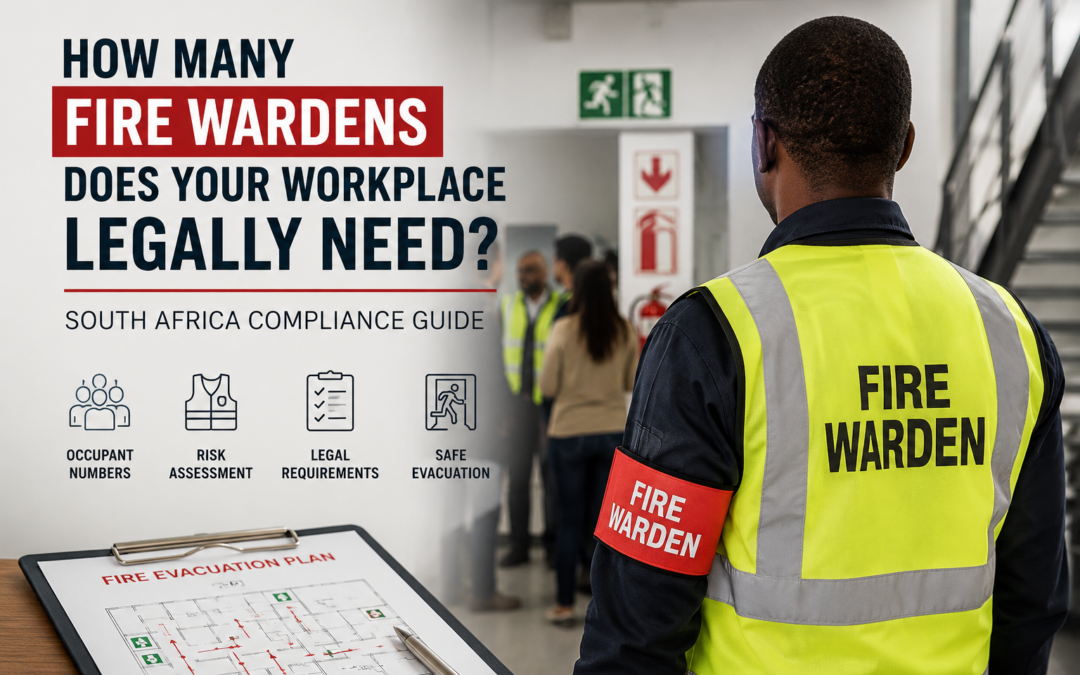
The OHS Act doesn’t set a fixed number of fire wardens — it requires employers to provide “adequate” trained personnel for fire fighting and evacuation under the General Safety Regulations. In practice, the benchmark most South African workplaces use is the same ratio the Act applies to health and safety representatives: roughly one trained fire warden per 50 employees, per floor, per shift.
Search this question and you’ll find dozens of sites stating a hard “1 in 50” or “1 in 25” legal rule, citing the OHS Act as if it spells out a fire warden headcount formula. It doesn’t — and several HSE practitioners have publicly asked for the exact clause and never gotten an answer, because there isn’t one. What the Act actually requires, and what that means practically for your headcount, floor plan and shift pattern, is below.
Is there a legal minimum number of fire wardens in South Africa?
Not a fixed headcount written into the OHS Act, no. Section 8 requires employers to provide and maintain a working environment that is safe and without risk to health, and the General Safety Regulations and Environmental Regulations for Workplaces require adequate fire-fighting equipment and trained personnel to use it — but neither specifies an exact ratio of wardens to employees the way the Act does for some other appointments.
The Act does specify a ratio elsewhere, though, and it’s the one virtually every accredited training provider and risk consultant in South Africa borrows for fire wardens: Section 17’s requirement for Health and Safety Representatives — at least one per 100 employees in shops and offices, or one per 50 employees in other workplaces. Since there’s no dedicated fire warden ratio, this is the closest thing to an official benchmark, and it’s what a DoEL inspector, auditor or insurer will generally expect to see reflected in your appointments.
What’s the difference between a Fire Warden, a Fire Marshal and an Evacuation Marshal?
In South African practice the titles “Fire Warden” and “Fire Marshal” are generally used interchangeably for the same appointment: a member of the workplace fire-fighting team who reports to the Fire Fighting Coordinator, raises the alarm, uses available equipment to fight a fire only while it’s safe to do so, and withdraws the moment emergency services arrive. An Evacuation Marshal is a narrower role focused purely on getting people out — sweeping a floor or zone, directing staff to exits, and accounting for everyone at the assembly point.
Many smaller businesses combine both functions into one appointment per area, which is permitted — the OHS Act doesn’t prohibit one person holding multiple safety appointments. Larger or higher-risk sites usually separate them, since a person actively fighting a fire can’t simultaneously be running a floor evacuation.
How many fire wardens does my workplace actually need?
The table below is a practical benchmark, not a quoted legal clause — there isn’t one to quote. It applies the Act’s own Section 17 ratio to fire wardens, the way most South African employers, training providers and risk assessors do in practice.
| Employees on site (per floor / per shift) | Practical minimum trained fire wardens | Basis |
|---|---|---|
| 1 – 50 | 1 | Mirrors the OHS Act’s Section 17 ratio for other-than-shop/office workplaces |
| 51 – 100 | 2 | Maintains the 1:50 ratio |
| 101 – 150 | 3 | Maintains the 1:50 ratio |
| Each additional 50 (or part thereof) | +1 | Maintains the 1:50 ratio |
| Shops & offices specifically | 1 per 100 (minimum) | Section 17’s shop/office ratio — many employers still apply 1:50 for fire risk regardless |
| Higher fire-risk occupancy (e.g. warehousing, workshops, flammable liquid storage) | Increase the ratio (e.g. 1 per 25) | Faster response needed; reflects the occupancy’s SANS 10400-T risk classification |
| Multi-storey building | At least 1 per occupied floor, regardless of headcount | Someone must be present to coordinate evacuation on every floor |
| Multi-shift operation (incl. night shift) | Trained wardens on every shift the building is occupied | Coverage can’t lapse outside normal office hours |
These numbers are widely-used industry practice, not a statutory formula. A formal fire risk assessment — covering your actual building layout, occupancy classification and evacuation times — is the only way to confirm the right number for your specific premises.
Do I need fire wardens on every floor and every shift?
Yes. A fire warden appointed for the day shift provides no coverage at all on the night shift, and a warden based on the ground floor can’t coordinate an evacuation on the third floor. Coverage has to exist for every period the building is occupied and for every area that could need an independent evacuation response — which is exactly the gap a DoEL inspection or an insurer’s post-incident review will look for first.
How often must fire warden training be renewed?
The OHS Act doesn’t prescribe an exact validity period for fire warden or evacuation marshal training, which is why you’ll see 1, 2 and 5-year claims floating around online with no single answer being definitive. In practice, accredited training providers commonly recommend refresher training every 1–2 years to keep skills current, and refresher training should always be triggered immediately by any building alteration, occupancy change, or change in the warden’s area of responsibility — regardless of how long the original certificate has left to run.
Who can train and appoint fire wardens in South Africa?
The appointment itself is made by the employer, in writing, naming the individual and their area of responsibility — this letter, alongside the training certificate, is what an inspector or auditor will ask to see. The training should come from an accredited provider; our sister company Altramed delivers HWSETA- and QCTO-accredited fire warden, evacuation marshal and first aid training across South Africa, so the same group that assesses your building’s compliance can also train the people responsible for it.
Frequently asked questions
Is it a legal requirement to appoint a fire warden in South Africa?
Yes, in substance — the OHS Act requires employers to provide adequate trained personnel for fire fighting and evacuation, and this duty is generally discharged by appointing and training fire wardens, even though the Act doesn’t use that exact job title or fix a headcount.
Can one person hold the Fire Warden and First Aider appointments at the same time?
Yes, the OHS Act doesn’t prohibit one employee holding multiple safety appointments, and this is common in smaller businesses. For larger or higher-risk sites, spreading appointments across more people gives better coverage when someone is absent.
Do small businesses need a fire warden?
Yes — there’s no employee-count threshold below which fire warden appointments aren’t needed, unlike some other OHS Act appointments. Even an 8-person office needs at least one trained, appointed person responsible for fire fighting and evacuation.
What’s the difference between a Fire Warden and a Fire Marshal?
In South African practice the terms are generally used interchangeably for the same fire-fighting team appointment. An Evacuation Marshal is a distinct, narrower role focused only on safely evacuating an area.
How long is fire warden training valid for?
The OHS Act doesn’t prescribe a fixed validity period. Most accredited providers recommend refresher training every 1–2 years, and immediately after any change to the building or the warden’s area of responsibility.
Where can I get accredited fire warden training?
Our sister company Altramed provides HWSETA- and QCTO-accredited fire warden, evacuation marshal and first aid training. Always confirm a provider’s accreditation before booking, since a certificate from an unaccredited trainer carries no weight with an inspector or insurer.
This article provides general guidance on OHS Act fire warden requirements in South Africa and is not legal advice. The benchmark numbers above are industry practice, not a quoted statutory formula — get a formal fire risk assessment for numbers specific to your premises.
Not sure if your fire warden coverage actually holds up?
We’ll check your building’s fire compliance against SANS 10400-T and tell you exactly where the gaps are — including whether your warden coverage matches your floor plan and shift pattern. Call 0861 111 504 or use the free compliance check below.
Keep reading:
- The Complete Fire Compliance Guide for South African Businesses
- Fire Compliance Certificate in South Africa: What It Is, Who Needs One & How to Get It
- Why Fire Insurance Claims Get Rejected in South Africa (and How to Protect Yours)
- How Often Must Fire Equipment Be Serviced in South Africa? The Full SANS Schedule
- Altrafire Compliance Hub | Free Fire Compliance Check