
Why fire compliance responsibility causes so much confusion
Walk into any property dispute in South Africa and you will find a version of the same argument: the landlord says it is the tenant's problem, the tenant says the building was not compliant when they moved in, and the body corporate insists it only covers shared areas. Everyone believes they have shifted the risk — and in a fire, everyone discovers they were wrong.
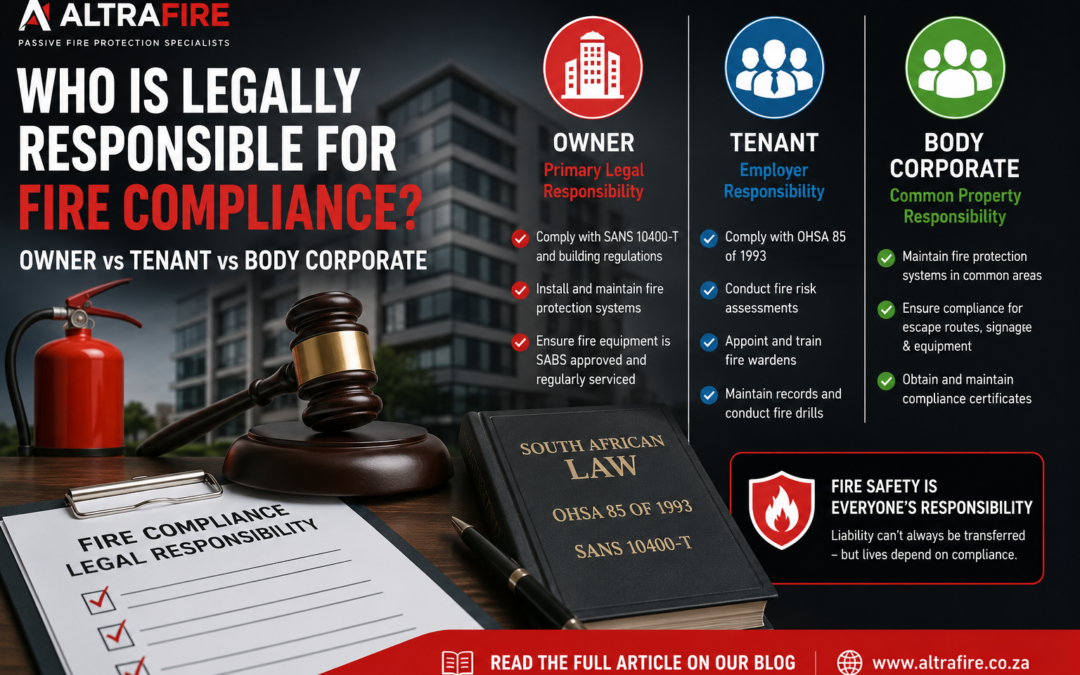
The confusion arises because fire compliance responsibility is split across three separate legal frameworks, each with its own scope and duty-holder:
- National Building Regulations and Building Standards Act 103 of 1977 (implemented via SANS 10400-T) — governs the building itself and its passive and active fire protection systems.
- Occupational Health and Safety Act 85 of 1993 (OHSA) — governs fire safety in the workplace, placing duties on employers and their appointed representatives.
- Fire Brigade Services Act 99 of 1987 — empowers municipal fire departments to inspect premises and issue compliance notices.
These frameworks interact but do not replace each other. An owner can comply with the building regulations yet still expose a tenant-employer to an OHSA violation — or vice versa. Understanding which law applies to whom is the starting point for getting this right.
What does the law say the building owner must do?
SANS 10400-T (the technical standard that gives effect to Part T of the National Building Regulations) is unambiguous: the obligation to design, construct, and equip a building for fire safety falls on the owner. Regulation T2 of the National Building Regulations goes further — it makes it a criminal offence for an owner to fail to provide sufficient SABS-approved fire extinguishers or to fail to maintain any other fire protection provision.
In plain terms, building owner obligations include:
- Ensuring the building has the correct fire protection systems installed (extinguishers, hose reels, detection, emergency lighting, escape signage, fire doors, and where required, suppression systems).
- Keeping all fire equipment SABS-approved and maintained — non-SABS-marked equipment cannot legally be serviced or reconditioned by a SAQCC Fire-registered technician and must be condemned and replaced.
- Ensuring that all fire equipment is inspected and serviced at the intervals required by the relevant SANS standards (see our full fire equipment service schedule guide).
- Ensuring escape routes remain clear and effective at all times. Regulation T2(2) makes it a criminal offence for any person — including a tenant — to obstruct an escape route.
- Holding or producing a fire compliance certificate when required by the local authority or fire department.
What are the employer's (tenant's) obligations under OHSA?
Where the tenant is also the employer on the premises, the Occupational Health and Safety Act creates a separate and parallel set of obligations. Section 8 of OHSA requires every employer to provide and maintain a working environment that is safe and without risk to the health of employees — and fire safety is explicitly part of this duty.
For practical fire compliance purposes, the employer-tenant must:
- Conduct a fire risk assessment of the workplace.
- Appoint a Section 16.2 representative in writing to carry out OHSA duties on behalf of the employer (including fire safety oversight).
- Appoint sufficient fire wardens (marshals) for the workplace — see our detailed guide on how many fire wardens your workplace legally needs.
- Ensure that fire wardens and other relevant staff receive accredited fire warden and firefighting training (accredited by HWSETA and QCTO — for this, Altrafire's sister company Altramed offers accredited fire warden and firefighting training).
- Maintain a fire safety file and keep records of all inspections, drills, and training.
- Conduct regular fire drills.
Importantly, OHSA obligations sit with the employer regardless of the building owner's compliance status. A tenant in a fully compliant building can still receive a DOL (Department of Labour) enforcement notice if their internal fire safety management — risk assessments, wardens, training, drills — is not in order.
How does a commercial lease affect fire compliance responsibility?
Commercial leases in South Africa frequently contain clauses that attempt to shift fire compliance responsibility from landlord to tenant. These clauses are common, and they create real obligations for tenants — but they have important limits.
What a lease clause can do
- Require the tenant to maintain fire equipment within the leased premises at their own cost.
- Require the tenant to obtain and hold fire compliance certificates for the leased space.
- Require the tenant to conduct fire risk assessments and appoint fire wardens.
- Hold the tenant liable for fines or costs arising from their non-compliance.
What a lease clause cannot do
- Remove the owner's criminal liability under the National Building Regulations for equipment failures in the building structure (e.g., fire detection systems, suppression systems, escape routes forming part of the building).
- Remove the owner's obligation to provide a building that meets the fire protection requirements of SANS 10400-T at the time of occupation.
- Shift the owner's obligation under the Fire Brigade Services Act — the fire department will hold the owner accountable for building-wide deficiencies.
Who is responsible in a sectional title scheme or office park?
Sectional title schemes and multi-tenant office parks add a third layer of complexity: the body corporate (or managing entity).
Common property: body corporate's responsibility
The body corporate holds the equivalent of an owner's responsibility for all common property — including shared corridors, stairwells, basement parking, fire detection and suppression systems serving common areas, fire hydrants in the common property, and escape routes through shared spaces. Fire equipment in these areas must be correctly installed, SABS-approved, and serviced at the required SANS intervals.
A body corporate that neglects fire compliance on common property exposes all unit owners to risk — and may face municipal enforcement action as well as civil claims from occupants if a fire causes injury or loss.
Individual units: unit owner's responsibility
Each unit owner is responsible for fire compliance within their individual section. If a unit is leased, the lease allocation of responsibility follows the same principles as a standalone commercial lease described above.
Where the lines blur
Fire detection and suppression systems often serve both private sections and common areas from a single centralised system. Responsibility for such integrated systems should be clearly documented in the scheme's rules and maintenance plan — failing which, disputes between unit owners and the body corporate about who services what are almost inevitable.
Quick-reference: who is responsible for what
| Compliance requirement | Primary duty-holder | Governing law / standard | Notes |
|---|---|---|---|
| Building Structure & Passive Protection | |||
| Fire-rated building construction (walls, floors, doors) | Building owner | SANS 10400-T / NBR Act 103 of 1977 | Must meet requirements at time of construction and on any alteration |
| Fire doors — installation and maintenance | Building owner | SANS 10400-T; SANS 1253 | See our fire door compliance guide |
| Escape routes — design and maintenance | Building owner | SANS 10400-T Reg T2(2) | Obstructing escape routes is an offence for any person |
| SANS 23601 escape plans — display and currency | Building owner / occupier | SANS 23601 | Plans must be current and correctly positioned; see escape plan compliance guide |
| Smoke ventilation systems (AOVs) | Building owner | SANS 10400-T | See our AOV compliance guide |
| Active Fire Equipment | |||
| Fire extinguishers — supply, installation, servicing | Building owner (can be contracted to tenant by lease) | NBR Reg T2; SANS 10105-1; SANS 1475-1 | Must be SABS-approved; criminal offence if not maintained |
| Fire hose reels and hydrants | Building owner | SANS 10400-T; SANS 10105-2 | Equipment must be SABS-approved; see hose reel compliance guide |
| Fire detection and alarm system | Building owner | SANS 10400-T; SANS 10139 | Category determined by building use and occupancy; see SANS 10139 categories guide |
| Gas suppression system (server rooms etc.) | Building owner / occupier | SANS 14520 | See our gas suppression guide |
| Workplace / Employer Obligations (OHSA) | |||
| Fire risk assessment | Employer / tenant | OHSA s8; s9 | Must be documented and reviewed regularly |
| Section 16.2 appointee designation | Employer | OHSA s16(2) | Must be in writing; appointee carries personal liability |
| Fire warden / marshal appointments | Employer / tenant | OHSA; SANS 10400-T | Number depends on building size and occupancy; see fire warden guide |
| Fire warden training (accredited) | Employer / tenant | OHSA; HWSETA/QCTO accreditation | Training accredited by HWSETA and QCTO — not SAQCC |
| Fire drills | Employer / tenant | OHSA; SANS 10400-T | Minimum annually; more frequently recommended |
| Fire safety documentation / OHS file | Employer / tenant | OHSA | Must be available for DOL inspectors |
| Sectional Title / Multi-Tenanted Buildings | |||
| Common property fire equipment and systems | Body corporate | Sectional Titles Act; SANS 10400-T | Body corporate holds owner-equivalent duties for all common areas |
| Individual unit fire equipment | Unit owner (may be leased to tenant) | As for standalone owner/tenant above | — |
Can an owner be held liable for a tenant's fire safety failures?
The answer, uncomfortably for landlords, is sometimes yes. The National Building Regulations create owner liability for the building's fire protection systems regardless of tenancy. If a fire kills or injures someone and the investigation reveals that the building's extinguishers were overdue for service, the escape route was inadequate, or the fire detection system was not functional, the owner is exposed — even if a lease clause says the tenant was responsible for maintenance.
For insurance purposes, the risk is equally stark. Insurers investigate fire claims carefully and will look at whether fire equipment was maintained, whether the building met regulatory requirements, and whether any non-compliance contributed to the loss. A rejected insurance claim following a fire can be financially catastrophic. See our post on why fire insurance claims get rejected in South Africa for a detailed breakdown.
What should owners, tenants, and body corporates do right now?
If you are a building owner
- Commission an independent fire compliance audit of your building — not just the portable extinguishers, but all systems: detection, suppression, hose reels, hydrants, fire doors, escape routes, and signage.
- Ensure all equipment is SABS-approved and serviced at the correct SANS intervals by a SAQCC Fire-registered company.
- Review your lease agreements and understand what obligations you retain regardless of what the lease says.
- Obtain and maintain your fire compliance certificate.
If you are a tenant / employer
- Conduct a fire risk assessment of your workplace.
- Appoint a Section 16.2 representative in writing.
- Appoint and train the correct number of fire wardens — accredited HWSETA/QCTO training is required.
- Conduct regular fire drills and keep records.
- Establish a fire safety file and keep it current for DOL inspections.
- Check your lease to understand which fire equipment maintenance obligations fall on you, and verify those obligations are being met.
If you are a body corporate or managing agent
- Audit all common property fire equipment and systems annually.
- Ensure that fire protection systems serving both common and private areas have a clearly documented maintenance responsibility.
- Keep records of all inspections, services, and corrective actions for all common-area fire equipment.
- Engage a fire compliance professional to prepare and maintain a building fire compliance register.
Frequently asked questions
Is the landlord or the tenant responsible for fire extinguishers in South Africa?
The building owner (landlord) bears the primary legal obligation under the National Building Regulations (Regulation T2) to provide and maintain fire extinguishers. A commercial lease can contractually transfer maintenance responsibility to the tenant, but this does not remove the owner's criminal liability if extinguishers are not maintained. Both parties should ensure the obligation is being met in practice, not just on paper.
Who must pay for fire compliance upgrades — the landlord or the tenant?
This depends on the nature of the upgrade. Building-level upgrades (new detection system, fire doors, escape route improvements) are typically the landlord's obligation as they relate to the building structure. Equipment maintenance and workplace-level compliance (fire warden training, risk assessments, drills) typically falls on the employer-tenant. Lease terms govern what can be contractually shifted between the parties — but the National Building Regulations set a floor of owner liability that a lease cannot remove.
Can a body corporate shift fire compliance responsibility to individual unit owners?
The body corporate retains legal responsibility for all common property, including shared fire protection systems and escape routes. It can require unit owners to maintain compliance within their individual sections through scheme rules, but it cannot shift its common-property obligations. Where fire systems serve both common and private areas, the maintenance responsibility must be clearly documented in the scheme's rules or maintenance plan.
What law governs employer fire safety obligations in South Africa?
The Occupational Health and Safety Act 85 of 1993 (OHSA) is the primary statute. Section 8 requires employers to provide and maintain a safe working environment, which includes fire safety. OHSA also requires employers to appoint a Section 16.2 representative to carry out compliance duties, including fire safety management, on their behalf.
Does a fire compliance certificate protect the owner from liability?
A fire compliance certificate demonstrates that a building met the required standards at the time of inspection. It does not provide ongoing protection if the owner subsequently allows equipment to lapse or systems to deteriorate. Compliance is a continuous obligation — not a once-off document. Insurers and courts will look at whether compliance was maintained at the time of a loss, not only whether a certificate was ever issued.
Who is the Section 16.2 appointee and why does it matter for fire compliance?
Under OHSA, the chief executive of a company (Section 16.1) may delegate OHSA duties — including fire safety oversight — to a named person in writing. This is the Section 16.2 appointee. The appointee takes on personal liability for the duties delegated to them. In a fire-related DOL inspection or prosecution, the Section 16.2 appointee can be held personally accountable for workplace fire safety failures.
This article is general guidance only and does not constitute legal advice. Fire compliance obligations depend on your specific building, lease, occupancy, and municipal by-laws. Consult a qualified fire compliance professional and, where appropriate, a legal adviser for advice specific to your situation. Written by Jaco Coetzer — Altrafire. Last updated June 2026.