
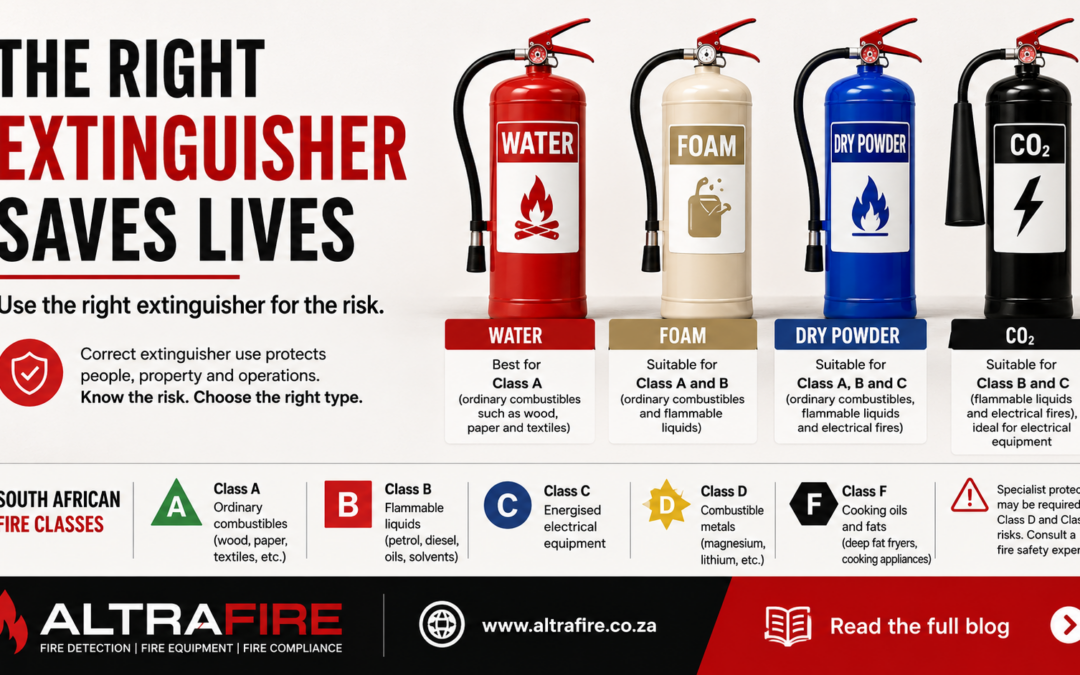
Why getting the right extinguisher type matters — and where SA differs from Europe
Walk into almost any South African office, warehouse, or commercial kitchen and you will find fire extinguishers on the wall. What you will less often find is confident knowledge of which extinguisher to use on which fire — or why the red powder unit near the server room is the worst possible choice for an electrical fire.
Compounding the confusion is a widespread mix-up between the South African fire classification system and the European EN 2 classification used in many international sources. The differences are not trivial:
- In South Africa, Class C = energised electrical equipment fires. In the European EN system, Class C = flammable gas fires. These are completely different fire types.
- In South Africa, Class F = cooking oils and fats. In the European EN system, this is also Class F — but many imported extinguishers and training materials still carry the older EN 3 Class B designation for cooking oils, which creates real confusion at the selection stage.
- South Africa does not use a separate "Class E" for electrical fires — electrical risk is captured in Class C.
The governing standard in South Africa is SANS 10105-1:2021 (Edition 4), which defines fire classes and extinguisher selection requirements. All fire extinguishers supplied in South Africa must be SABS-approved and carry the SABS mark. A SAQCC Fire-registered technician cannot legally service, recharge, or recondition a non-SABS-approved extinguisher — it must be condemned and replaced.
The five South African fire classes explained
Class A — Ordinary combustibles
Class A fires involve ordinary combustible materials: wood, cloth, paper, rubber, and most plastics. These are the most common fires in offices, warehouses, retail spaces, and residential buildings. Class A fires leave an ash or ember residue. The primary extinguishing action required is cooling — which is why water-based agents are most suitable.
Class B — Flammable liquids and gases
Class B fires involve flammable liquids (petrol, diesel, oils, greases, tars, oil-based paints, lacquers) and flammable gases. These fires do not leave a residue. The primary extinguishing action required is smothering — cutting off the oxygen supply to the burning surface. Foam is most suitable for contained liquid fires; dry powder (ABC or BC) is effective across the class. Water is dangerous on Class B fires — it can splash burning liquid and spread the fire.
Class C — Energised electrical equipment
Class C fires involve energised electrical equipment — switchboards, control panels, electrical motors, wiring, and similar. The critical requirement for Class C is that the extinguishing medium must be electrically non-conductive. Using a conductive agent (water, foam, wet chemical) on a live electrical fire creates an electrocution risk for the operator. CO₂ (carbon dioxide) is the most suitable agent for Class C — it is electrically non-conductive, leaves no residue, and does not damage sensitive equipment. ABC dry powder is also suitable but leaves a fine powder residue that can damage electrical components.
Class D — Combustible metals
Class D fires involve combustible metals such as magnesium, lithium, sodium, and potassium. These are rare in typical commercial premises but occur in manufacturing, laboratory, and some industrial environments. Class D fires burn at extremely high temperatures and standard extinguishing agents are ineffective or dangerous on them — water, for example, can react violently with some burning metals. Specialist dry powder formulations designed for Class D fires are required. If your premises handles or stores combustible metals, specialist fire engineering advice is essential.
Class F — Cooking oils and fats
Class F fires involve cooking products — vegetable or animal oils and fats in cooking appliances. These fires burn at very high temperatures, and the burning oil can re-ignite even after the flames appear to be out. Class F is formally defined in SANS 10105-1:2021, and wet chemical is rated the most suitable agent for this class in that standard's suitability table. Water and standard dry powder extinguishers are dangerous on Class F fires — they can cause violent steam explosions or scatter burning oil.
A practical note on legal standing: SANS 10400-T (the National Building Regulations fire protection standard) does not specifically prescribe wet chemical extinguishers for commercial kitchens — it requires "sufficient fire extinguishers of the appropriate type" per SANS 10105-1. Furthermore, SANS 1475-1 (the servicing standard administered by SAQCC Fire) does not currently include a prescribed servicing procedure for wet chemical units. This means if you install wet chemical extinguishers, you should confirm servicing arrangements directly with your supplier, and obtain a fire engineer's input on the appropriate Class F protection strategy for your specific kitchen risk.
Fire extinguisher types available in South Africa
Water extinguishers
Water extinguishers are the most suitable agent for Class A fires. They work by cooling burning material below its ignition temperature. They must never be used on Class B fires (risk of spreading flaming liquid), Class C fires (electrocution risk from conductive water), or Class F fires (steam explosion and oil splash risk). Application should begin at a safe distance from the fire — typically 4 m to 5 m — and directed at the base of the flames.
Foam extinguishers
Foam extinguishers are most suitable for Class B fires and suitable for Class A fires. The foam forms a blanket over burning liquid surfaces, cutting off oxygen and preventing vapour release. On Class B fires, the foam should not be directed directly into burning liquid — it should be applied to the near edge or bounced off a surface to flow over the burning area. Foam is dangerous on Class C fires (conductive) and Class F fires (foam does not cope with the extreme temperatures of burning cooking oils).
CO₂ (carbon dioxide) extinguishers
CO₂ extinguishers are most suitable for Class C (electrical) fires and suitable for Class B fires. CO₂ is electrically non-conductive, leaves no residue, and does not damage sensitive equipment — making it the preferred choice for electrical rooms, server areas, and offices with electronic equipment. It has a limited range and is affected by wind and draughts. CO₂ is less suitable for Class A fires as it does not cool embers and re-ignition can occur. Always hold the insulating horn handle — never the metal parts — to avoid frostbite and static shock. CO₂ is dangerous on Class D and Class F fires.
Dry powder extinguishers (ABC and BC)
Two types of dry powder extinguishers are available in South Africa:
- ABC powder — suitable for Class A, B, and C fires. The most versatile extinguisher type and the most common in general commercial use. However, the powder leaves a fine residue that can damage electrical and electronic equipment, and can be disorienting and hazardous to breathe in an enclosed space.
- BC powder — suitable for Class B and C fires only. Not suitable for Class A fires (ordinary combustibles).
Dry powder is less suitable for Class D fires (specialist Class D powder is needed) and unsuitable for Class F fires. Where possible, consider whether an ABC powder unit is the right choice near sensitive electrical equipment — CO₂ may be preferable despite lower versatility, as it avoids residue damage.
Wet chemical extinguishers
Wet chemical extinguishers are the only agent rated as most suitable for Class F fires in SANS 10105-1:2021 Table A.1. They work by cooling the burning oil and causing it to saponify (solidify into a soap-like layer) that seals the surface and prevents re-ignition. The extinguishing medium is discharged as a fine spray to minimise splash. Wet chemical is unsuitable for all other fire classes.
Clean agent extinguishers
Clean agent extinguishers use electrically non-conductive gaseous or vapourising liquid agents that leave no residue after discharge. They are suitable for Class A, B, and C fires and are used where equipment protection is a priority — clean rooms, archival areas, and high-value electronics. Halon was the original clean agent but has been phased out under the Montreal Protocol as an ozone-depleting substance and should be replaced. Modern clean agent alternatives complying with SANS 1910 are available.
Master quick-reference: extinguisher type vs fire class
The table below is drawn directly from SANS 10105-1:2021 Table A.1 — the definitive South African reference for extinguisher suitability.
S Suitable
LS Less suitable
U Unsuitable
D Dangerous — do not use
| Extinguishing agent | Class A Ordinary combustibles | Class B Flammable liquids & gases | Class C Electrical equipment | Class D Combustible metals | Class F Cooking oils & fats |
|---|---|---|---|---|---|
| Water | MS | D | D | D | D |
| Foam | S | MS | D | D | D |
| Powder ABC | S | MS | S | LS | U |
| Powder BC | U | MS | S | U | U |
| CO₂ gas | LS | S | MS | D | D |
| Wet chemical | U | U | U | U | MS |
Source: SANS 10105-1:2021 Table A.1. ABC powder: used for extinguishing a combination of Class A, B, and C fires. BC powder: used for extinguishing a combination of Class B and C fires.
Which extinguisher types does your premises need?
Most commercial premises carry more than one fire class risk, which means more than one extinguisher type is typically required. SANS 10105-1 requires that the type of fire extinguisher selected matches the occupancy and the risks contained within it — a single ABC powder unit placed at the front door is not adequate compliance for a building with a commercial kitchen, an electrical room, and a warehouse.
| Premises type | Typical fire classes present | Extinguisher types required | Notes |
|---|---|---|---|
| Office & Commercial | |||
| General office | A, C | Water or ABC powder (general areas); CO₂ (server/comms rooms) | CO₂ preferred near electronics to avoid powder residue damage |
| Server room / IT room | C | CO₂; or fixed gas suppression system (SANS 14520) | Fixed suppression strongly recommended for enclosed server rooms |
| Food Service & Hospitality | |||
| Commercial kitchen | A, F (and C for electrical equipment) | Wet chemical (most suitable for Class F per SANS 10105-1); CO₂ for electrical panels | Wet chemical is technically correct for Class F but falls outside SANS 1475-1 servicing scope — confirm servicing arrangements and consult a fire engineer |
| Restaurant / café (front of house) | A, C | ABC powder or CO₂ | Coordinate with kitchen provision |
| Industrial & Warehouse | |||
| General warehouse (combustible goods) | A, B | Water or ABC powder; foam where large liquid fuel risks exist | Consult SANS 10400-T for minimum provision per floor area |
| Flammable liquid store | B | Foam (most suitable); ABC or BC powder | Water is dangerous — never use on Class B |
| Workshop / engineering | A, B, C | ABC powder; CO₂ for electrical panels | Consider wheeled extinguishers for large high-risk areas |
| Healthcare & Specialised | |||
| Medical / clinical area | A, C | CO₂ or clean agent (avoids powder in clinical environments) | CO₂ displaces oxygen — ventilation and evacuation considerations apply |
| Laboratory (combustible metals) | A, B, C, D | Specialist Class D powder in addition to standard provision | Requires specialist fire engineering risk assessment |
SABS approval and servicing requirements
All fire extinguishers supplied and used in South Africa must be SABS-approved and carry the SABS mark. This is not optional — it is a requirement under the National Building Regulations (Regulation T2) and the governing standard SANS 10105-1.
A SAQCC Fire-registered technician cannot legally service, recharge, or recondition an extinguisher that is not SABS-approved. If a non-SABS-approved unit is found during a service inspection, it must be condemned and replaced — not serviced. This has practical consequences for businesses that purchase cheap imported extinguishers without verifying SABS approval status.
All portable extinguishers must be inspected and serviced at the intervals prescribed in SANS 1475-1 and SANS 10105-1. For full service interval details across all fire equipment types, see our comprehensive fire equipment service schedule guide.
Frequently asked questions
What are the fire classes in South Africa?
South Africa uses five fire classes as defined in SANS 10105-1:2021: Class A (ordinary combustibles such as wood, paper, and plastics), Class B (flammable liquids and gases), Class C (energised electrical equipment), Class D (combustible metals such as magnesium and lithium), and Class F (cooking oils and fats in cooking appliances). There is no Class E in the South African system — electrical fires are covered under Class C.
Is Class C fire in South Africa the same as in Europe?
No — this is one of the most important differences to understand. In the South African SAQCC/FPASA/SANS system, Class C refers to fires involving energised electrical equipment. In the European EN 2 classification, Class C refers to flammable gas fires. If you are using imported extinguishers, training materials, or signage referencing EN fire classes, these do not map directly to the South African classification.
What fire extinguisher is recommended for a commercial kitchen in South Africa?
Wet chemical is rated the most suitable agent for Class F fires (cooking oils and fats) in SANS 10105-1:2021, and is technically the correct choice for commercial kitchens. However, SANS 10400-T does not specifically prescribe wet chemical units by name — it requires sufficient extinguishers of the appropriate type per SANS 10105-1. Importantly, SANS 1475-1 (the SAQCC Fire servicing standard) does not include a prescribed procedure for wet chemical units, so servicing falls outside the standard SAQCC framework. Water, foam, and standard dry powder are dangerous on cooking oil fires. Seek input from a qualified fire engineer to determine the correct Class F protection strategy for your specific kitchen, and confirm servicing arrangements with your supplier before purchasing.
Can I use an ABC powder extinguisher on an electrical fire?
ABC powder is rated as "suitable" for Class C (electrical) fires in SANS 10105-1 — it is electrically non-conductive and will extinguish the flames. However, it leaves a fine powder residue that can damage or destroy electrical and electronic equipment. Where equipment protection matters — server rooms, offices, electrical panels — CO₂ is generally preferred over ABC powder for Class C fires, as it is rated "most suitable" and leaves no residue.
Does every fire extinguisher in South Africa need to be SABS-approved?
Yes. All fire extinguishers must be SABS-approved and carry the SABS mark as required by the National Building Regulations and SANS 10105-1. A SAQCC Fire-registered technician cannot service or recharge a non-SABS-approved extinguisher — it must be condemned and replaced. Businesses that purchase extinguishers without verifying SABS approval risk both non-compliance and the expense of full replacement.
What is the difference between ABC powder and BC powder extinguishers?
ABC powder extinguishers are rated for use on Class A, B, and C fires — ordinary combustibles, flammable liquids/gases, and electrical equipment. BC powder extinguishers are rated for Class B and C fires only — they are unsuitable for Class A (ordinary combustible) fires. For general commercial premises where all three risk classes may be present, ABC powder provides broader coverage.
This article is general guidance only and does not constitute legal or technical advice. Fire extinguisher selection must account for the specific risks present in your premises. Always consult a SAQCC Fire-registered fire protection professional to assess your premises and specify the correct equipment. Written by Jaco Coetzer — Altrafire. Last updated June 2026.