
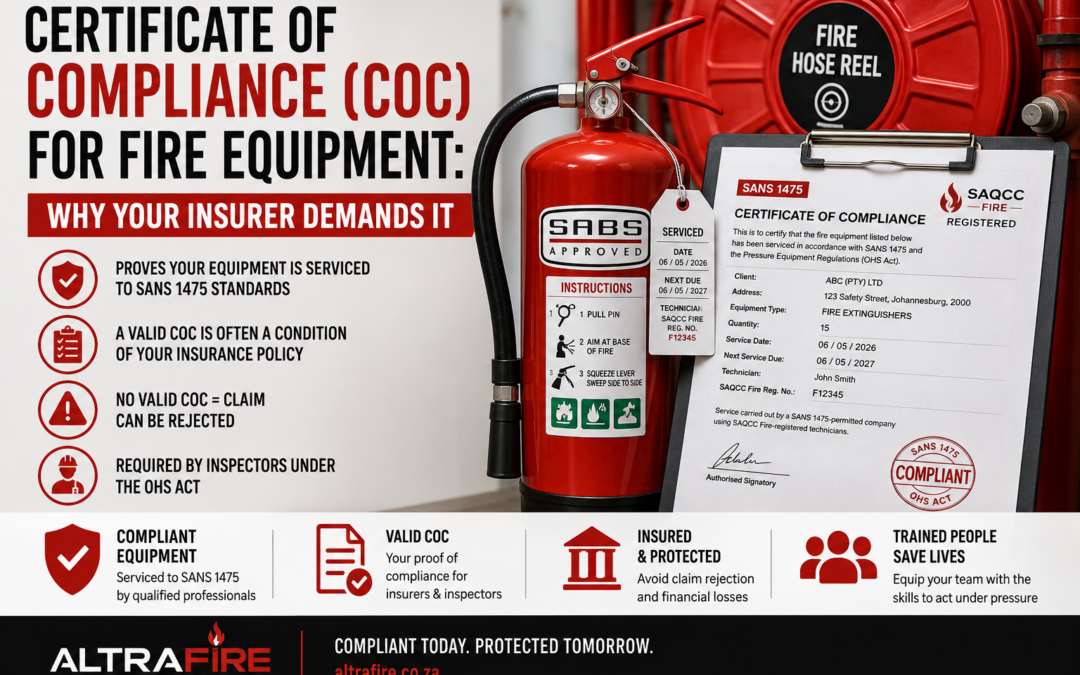
A Certificate of Compliance (CoC) for fire equipment is issued by a SANS 1475-certified company using SAQCC Fire-registered technicians after your extinguishers, hose reels or hydrants are serviced. It’s separate from your building’s fire compliance certificate. Insurers rely on it — without a valid CoC, a fire-related claim can be repudiated even if the fire wasn’t caused by faulty equipment.
What Is a Certificate of Compliance for Fire Equipment?
When your fire extinguishers, hose reels or hydrant components are serviced, the technician doesn’t just stick a new tag on the unit. A properly executed service produces a Certificate of Compliance (CoC) — a document confirming the equipment was serviced according to SANS 1475 Part 1 (extinguishers), the relevant hose reel and hydrant standards, and the Pressure Equipment Regulations under the OHS Act.
This is an equipment-level document. It’s easy to confuse with your building’s overall fire compliance certificate — they are not the same thing, and you can hold one without the other. We cover the building-level certificate separately in our guide to the fire compliance certificate in South Africa.
Who Can Legally Issue a Valid CoC?
Only a company holding a valid SANS 1475 permit, using SAQCC Fire-registered technicians, can issue a CoC that will actually hold up. The technician records the service date, next service due date, and their SAQCC registration number on the equipment tag, and the servicing company issues the CoC referencing that work.
A CoC from an unregistered installer, or for equipment that isn’t SABS-approved and SABS-marked, is not valid — non-SABS equipment can’t legally be serviced by a SAQCC-registered technician at all; it has to be condemned and replaced. If your CoC doesn’t reference a SAQCC registration number, treat it as worthless.
Why Do Insurers Require a CoC?
Fire insurance policies in South Africa are typically conditional on your equipment being maintained to the relevant SANS standard — the CoC is the paper trail that proves it. Insurers ask for it at two points: sometimes at policy inception or renewal, and always when a fire-related claim is submitted. We go into the full mechanics of claim rejection in why fire insurance claims get rejected in South Africa — an unmaintained extinguisher or an expired service tag is one of the most common reasons insurers repudiate.
What Happens If You Don’t Have One When You Claim?
If a fire breaks out and your equipment wasn’t serviced and certified, your insurer can — and regularly does — reject the claim, even where the fire itself had nothing to do with the extinguisher or hose reel in question. The absence of a valid CoC is treated as a breach of the policy’s maintenance condition, not just a missing document.
Department of Employment and Labour inspectors can also request to see your fire equipment service certificate as part of a general workplace safety inspection under the OHS Act — this sits alongside, not instead of, your building’s separate fire compliance certificate from the municipal fire department.
What Does a Valid CoC Actually Cover?
| Equipment | Governing standard | Typical service interval | Who issues the CoC |
|---|---|---|---|
| Fire extinguishers | SANS 1475-1 | Annually (pressure test per cylinder lifespan) | SANS 1475-permitted company, SAQCC-registered technician |
| Fire hose reels | SANS 1475 / SANS 543 | Annually | SANS 1475-permitted company, SAQCC-registered technician |
| Hydrant components | SANS 1475 / SANS 1128 | Annually | SANS 1475-permitted company, SAQCC-registered technician |
For the full service-interval breakdown across every system type, see our complete SANS service schedule. For hose reel and hydrant coverage specifics, see fire hose reel & hydrant compliance.
How Is This Different From a Building’s Fire Compliance Certificate?
The equipment CoC and the building’s fire compliance certificate are issued under different scopes and by different parties, and confusing the two is one of the most common compliance gaps we see:
| Equipment CoC | Building fire compliance certificate | |
|---|---|---|
| Covers | Individual extinguishers, hose reels, hydrant components | The building as a whole against SANS 10400-T design requirements |
| Issued by | SANS 1475-permitted servicing company | Municipal fire department, following inspection |
| Governing legislation | SANS 1475 / Pressure Equipment Regulations (OHS Act) | Fire Brigade Services Act 99 of 1987; National Building Regulations |
| Renewal trigger | Annual service (or per equipment lifespan) | Periodic re-inspection; building alterations |
You need both. Having a valid building fire compliance certificate doesn’t mean your extinguishers are individually certified, and a fresh extinguisher CoC doesn’t mean your building is compliant as a whole.
Frequently Asked Questions
No. The CoC certifies individual serviced equipment under SANS 1475. The fire compliance certificate is issued by the municipal fire department for the building as a whole under the Fire Brigade Services Act and SANS 10400-T.
Typically 12 months from the service date, matching the annual service interval required under SANS 1475 — check the service tag on your equipment for the exact next-due date.
No. Only a SAQCC Fire-registered technician working for a SANS 1475-permitted company can issue a CoC that insurers and inspectors will accept. Self-serviced or informally serviced equipment has no valid certification.
Non-SABS-approved or unmarked equipment cannot legally be serviced by a SAQCC-registered technician — it must be condemned and replaced with SABS-approved equipment before a valid CoC can be issued.
Yes, this happens regularly in South Africa. Maintenance to the relevant SANS standard is typically a policy condition, and insurers treat an expired or missing CoC as a breach of that condition when assessing a fire-related claim.
Certified Equipment Needs a Team That Knows How to Use It
A valid CoC proves your equipment works — it doesn’t mean your staff know how to use it under pressure. Altramed delivers HWSETA and QCTO-accredited fire-fighting and fire warden training, so the people standing next to your certified extinguishers actually know what to do with them. See Altramed’s fire-fighting training courses.
Not sure if your fire equipment servicing — or your building’s compliance — is up to date? Get a free assessment against SANS 10400-T.
Related Reading
This article is general guidance for South African businesses and is not legal or insurance advice. Confirm your specific policy’s maintenance conditions with your insurer or broker.